
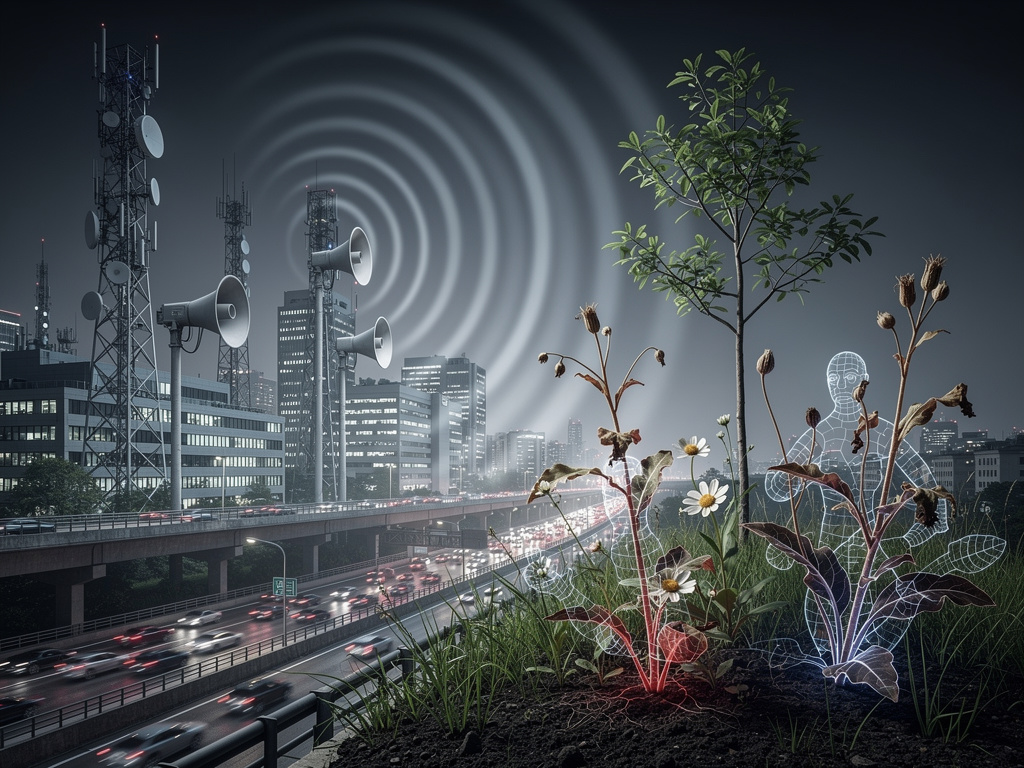
For decades, the conversation around urban noise has centered on human health — hearing loss, sleep disruption, cardiovascular strain. But a growing body of research is now turning that lens toward the millions of non-human species that share our cities, and the findings are forcing biologists to reconsider some fundamental assumptions about how animals adapt to the modern world.
A study published in April 2026 by researchers at Queen’s University Belfast has added striking new evidence to this discussion. The team found that chronic exposure to anthropogenic noise doesn’t just alter animal behavior in the moment — it reshapes physiological stress responses, reproductive success, and even immune function over time. The work, reported by ScienceDaily, synthesized data across multiple vertebrate taxa and arrived at a conclusion that should unsettle urban planners and conservation biologists alike: the biological toll of noise pollution on wildlife is systemic, not superficial.
That distinction matters enormously.
Previous studies had documented behavioral shifts — birds singing at higher frequencies in noisy cities, frogs calling louder near highways, bats avoiding illuminated and loud corridors. These were often framed as evidence of resilience. Animals adapting. Coping. The Belfast research suggests that framing was incomplete at best, misleading at worst. What looks like adaptation on the surface may mask chronic physiological stress underneath. Animals that appear to be coping may in fact be deteriorating.
Dr. Hansjoerg Kunc, a behavioral ecologist at Queen’s University Belfast and one of the study’s lead authors, has been working on this problem for years. His team’s meta-analysis examined peer-reviewed studies spanning mammals, birds, amphibians, and fish, looking not just at behavioral endpoints but at glucocorticoid levels, breeding output, hatching success, and markers of oxidative stress. The patterns were consistent. Elevated noise correlated with elevated stress hormones. Elevated stress hormones correlated with reduced reproductive performance. And reduced reproductive performance, sustained over generations, correlated with population-level consequences that don’t show up in a single breeding season’s data.
This isn’t a niche concern. The World Health Organization has long classified environmental noise as a major public health threat in Europe, estimating that road traffic noise alone affects the well-being of roughly 100 million people across the continent. But wildlife doesn’t file complaints or show up in epidemiological surveys. The damage accumulates invisibly.
When Stress Becomes Structure: The Physiology Behind the Problem
The mechanism is well understood in broad strokes. Noise triggers the hypothalamic-pituitary-adrenal axis — the same stress pathway that fires in humans during a traffic jam or a heated argument. In wildlife, chronic activation of this system diverts metabolic resources away from growth, immune defense, and reproduction. A bird nesting beside a four-lane highway isn’t just annoyed. Its body is running a sustained emergency protocol, burning energy on vigilance and cortisol production that would otherwise go toward eggs, chick-rearing, or fighting off parasites.
The Belfast team’s contribution was to show that this isn’t anecdotal. It’s statistically robust across species and geographies.
Consider the data on European robins. Urban populations have been documented singing at night — a behavioral shift widely attributed to daytime noise interference. But nighttime singing carries its own costs: lost sleep, increased predation risk, metabolic expenditure during hours that should be devoted to rest. A 2024 study published in Proceedings of the Royal Society B found that urban robins exhibiting nocturnal singing behavior showed measurably higher baseline corticosterone levels than their rural counterparts, even after controlling for light pollution. The song shift wasn’t free. It came with a physiological invoice.
Amphibians face a parallel problem. Male frogs in noisy environments call louder and longer to attract mates — an energetically expensive strategy that leaves them more vulnerable to predation and depletes fat reserves critical for surviving dry or cold periods. Research from Purdue University, published in Global Change Biology, has shown that some frog populations near chronic noise sources exhibit measurably lower body condition indices and reduced clutch sizes over multi-year monitoring periods.
Fish, too. And this surprises people.
Underwater noise from shipping, construction, and sonar has been linked to stress responses in species ranging from Atlantic cod to coral reef damselfish. A 2025 paper in Nature Ecology & Evolution documented altered foraging behavior and increased mortality rates in juvenile fish exposed to playback of boat engine noise under controlled conditions. The fish weren’t just startled. They made worse decisions — spending less time feeding, more time hiding, and ultimately growing slower than controls raised in quieter tanks.
The cumulative picture is one of widespread, cross-taxon physiological disruption. Not a single dramatic die-off, but a slow grinding down of fitness across populations that share space with human infrastructure.
So what’s being done about it?
Less than you’d think. Noise is regulated in many jurisdictions, but almost exclusively through the lens of human annoyance and human health. The European Union’s Environmental Noise Directive, for instance, requires member states to produce strategic noise maps and action plans for major urban areas — but the framework is anthropocentric. Wildlife impacts are acknowledged in passing, if at all.
In the United States, the situation is similarly lopsided. The National Park Service has invested significantly in natural soundscape preservation within park boundaries, producing some of the most detailed acoustic monitoring data anywhere in the world. But outside protected areas — where the vast majority of wildlife actually lives — noise regulation is fragmented, inconsistent, and rarely informed by ecological research.
There are exceptions. The Netherlands has experimented with “quiet zones” in ecologically sensitive areas, restricting motorized traffic and industrial activity during breeding seasons. Germany’s Federal Agency for Nature Conservation has funded studies on noise barriers designed specifically to reduce acoustic spillover into adjacent habitats. And in the UK, several local planning authorities have begun requiring noise impact assessments that include wildlife considerations for major development projects near Sites of Special Scientific Interest.
But these remain exceptions. The default, globally, is to treat noise as a human problem with human solutions — double-glazed windows, sound barriers along highways, nighttime curfews at airports. The animals on the other side of those barriers are largely on their own.
The Belfast study’s authors argue that this needs to change, and that the evidence base now supports a much more integrated approach. Their recommendation is straightforward: incorporate noise pollution into environmental impact assessments with the same rigor currently applied to chemical pollutants and habitat loss. Treat it as a stressor with measurable biological endpoints, not just a nuisance.
This would require new monitoring infrastructure. Acoustic sensors are cheap and increasingly sophisticated — passive acoustic monitoring networks are already deployed in marine environments to track whale populations and shipping traffic simultaneously. Extending similar networks into terrestrial habitats, paired with long-term wildlife health monitoring, would generate the kind of longitudinal data that policymakers need to act.
It would also require a shift in how conservation biologists think about habitat quality. A patch of forest adjacent to a highway may look intact from a satellite image. It may contain the right tree species, the right canopy cover, the right understory structure. But if it’s bathed in 70 decibels of road noise for 18 hours a day, its value as habitat is fundamentally compromised — in ways that traditional habitat assessments don’t capture.
And it would require urban designers to think differently about sound. Not just as an aesthetic concern or a quality-of-life metric for human residents, but as a physical force that shapes biological outcomes for every organism within earshot.
Some of this thinking is already emerging. The concept of “acoustic habitat” — the idea that sound environments are as important to species survival as physical structures — has gained traction in conservation biology over the past decade. Bernie Krause, the soundscape ecologist who coined the term “biophony” to describe the collective sound produced by living organisms in a given environment, has argued for years that the health of an acoustic environment is a reliable proxy for the health of the biological community it contains. His work, while sometimes criticized for its qualitative approach, has inspired a generation of researchers to take sound seriously as an ecological variable.
The Belfast findings give that argument quantitative teeth.
There’s a deeper question here, too — one that the study doesn’t answer but implicitly raises. If chronic noise exposure is degrading wildlife fitness across urban and suburban environments worldwide, how much of the biodiversity decline attributed to other factors — habitat fragmentation, pesticide use, climate change — is actually being compounded or even partly driven by noise? The stressors don’t operate in isolation. An animal already weakened by elevated cortisol from noise exposure is less equipped to cope with a heat wave, a food shortage, or a novel pathogen. Noise may be functioning as a silent multiplier, amplifying the impact of every other threat.
Disentangling these interactions is methodologically difficult. But it’s not impossible, and the Belfast team’s meta-analytic framework offers a template for doing so at scale.
For now, the practical takeaway is clear. Noise pollution is not just a backdrop to the biodiversity crisis. It is an active participant. And the organisms most affected are often the ones least visible — small passerines nesting in highway medians, amphibians breeding in roadside ditches, reef fish navigating shipping lanes they didn’t choose.
The world got quieter, briefly, during the early months of the COVID-19 pandemic. Researchers documented remarkable responses: birdsong became more complex in San Francisco, whale communication ranges expanded in the Atlantic, coyotes ventured into downtown cores they’d previously avoided. Those natural experiments were short-lived but revealing. They showed how quickly wildlife responds when the volume drops — and, by implication, how persistently it’s being suppressed when the volume stays up.
We turned the volume back up. The animals noticed, even if we didn’t.


 WebProNews is an iEntry Publication