
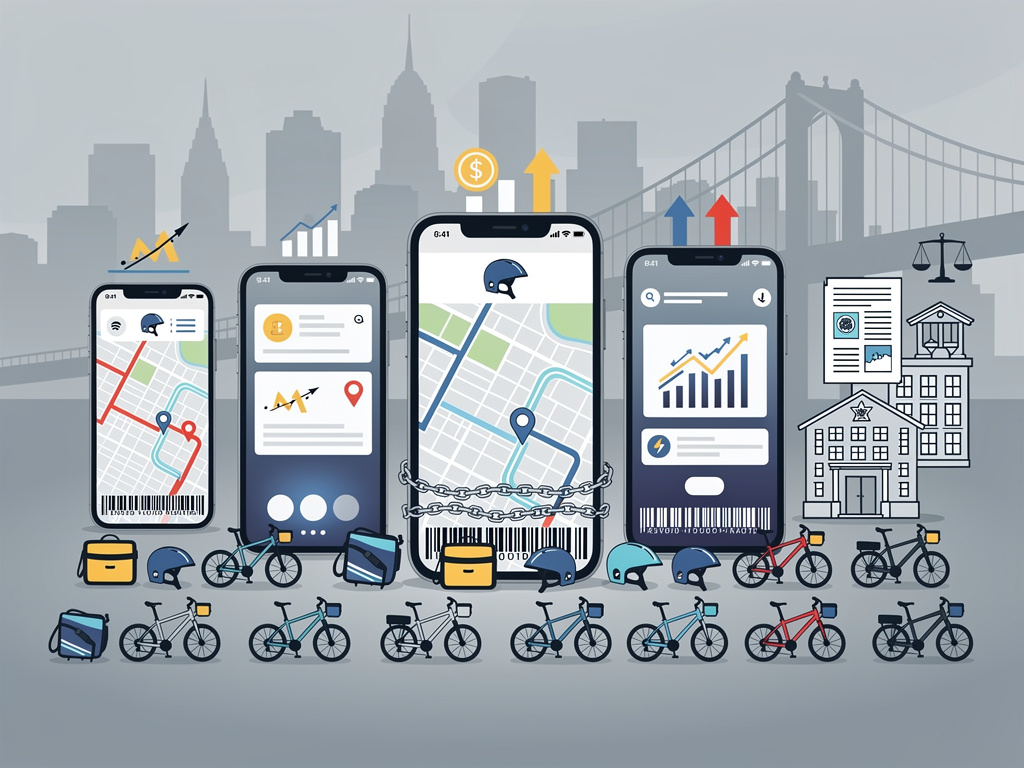
New York City’s streets have become a proving ground for one of modern capitalism’s most contentious experiments: the gig economy’s promise of flexibility clashing against the reality of algorithmic control. As delivery workers navigate treacherous conditions for meager pay, a growing chorus of critics argues that apps like DoorDash, Uber Eats, and Grubhub represent not innovation but exploitation dressed in technological clothing.
The debate intensified recently when Mahmood Mamdani, a distinguished professor at Columbia University, penned a scathing critique of delivery apps’ labor practices. Writing in Futurism, Mamdani argued that these platforms have created a “new form of servitude” that extracts value from vulnerable workers while insulating companies from traditional employer responsibilities. His analysis cuts to the heart of a transformation reshaping urban economies worldwide, with New York serving as the epicenter of this contentious revolution.
The numbers tell a stark story. Delivery workers in New York City, predominantly immigrants from Latin America, Asia, and Africa, often earn below minimum wage after accounting for expenses like e-bike batteries, phone data plans, and the constant threat of equipment theft. According to research from the Worker Institute at Cornell University, delivery workers face injury rates comparable to construction workers, yet lack basic protections like workers’ compensation or health insurance. The apps classify these workers as independent contractors, a designation that allows companies to avoid paying for benefits, unemployment insurance, or adhering to minimum wage laws.
The Algorithmic Overseer: Control Without Responsibility
What makes the delivery app model particularly insidious, critics contend, is how it exercises extraordinary control over workers while denying any employment relationship. The algorithms determine who gets orders, when they work, and how much they earn, functioning as an invisible manager that tracks every movement and decision. Workers who decline too many orders or fail to maintain arbitrary performance metrics find themselves receiving fewer opportunities, effectively punished for exercising the independence that supposedly defines contractor status.
Mamdani’s critique draws parallels to historical forms of labor exploitation, noting that the apps have essentially reinvented piecework for the digital age. Workers are paid per delivery rather than per hour, incentivizing dangerous behavior like running red lights or biking in hazardous weather conditions. The apps benefit from this arrangement by transferring all risk onto workers while maintaining the ability to flood the market with available couriers, ensuring that supply always exceeds demand and keeping per-delivery rates low.
The human cost of this system became tragically apparent during the COVID-19 pandemic, when delivery workers were deemed essential but treated as expendable. While app companies saw order volumes and revenues soar, workers faced increased exposure to the virus without adequate protective equipment or hazard pay. Many continued working despite illness because taking time off meant zero income and potential deactivation from platforms for low acceptance rates.
Regulatory Battles and Corporate Resistance
New York City has attempted to address these issues through regulation, most notably by establishing minimum pay rates for delivery workers. In 2023, the city implemented rules requiring apps to pay workers approximately $18 per hour before tips, a move that sparked fierce opposition from the delivery platforms. The companies argued that the regulations would harm workers by reducing flexibility and increasing costs for consumers, though critics noted that these same arguments have been deployed against virtually every labor protection in history.
The apps responded to the new pay standards with what labor advocates describe as deliberate sabotage. Multiple reports emerged of platforms limiting the number of active workers, creating artificial scarcity that reduced earning opportunities even as the per-hour rate increased. Some workers found themselves locked out of apps entirely, while others saw their total hours and income decline despite the higher nominal wage. This response, advocates argue, demonstrates that the platforms’ real objection is not to specific regulations but to any constraint on their ability to extract maximum value from workers.
The battle over delivery worker rights extends beyond New York. Similar conflicts are playing out in cities across the United States and Europe, with platforms spending hundreds of millions of dollars on lobbying and ballot initiatives to preserve their contractor-based model. In California, app companies successfully passed Proposition 22, which exempted them from a state law requiring worker classification as employees, though that measure faces ongoing legal challenges.
The Innovation Myth and Economic Reality
Proponents of the delivery app model often frame it as technological innovation that creates opportunities and convenience previously unavailable. The apps argue they have democratized access to restaurant delivery, enabling small businesses to reach new customers and providing flexible earning opportunities for workers who might otherwise struggle to find employment. This narrative has proven remarkably effective in attracting investment capital and regulatory forbearance, even as evidence mounts that the model is fundamentally unsustainable.
However, critics like Mamdani argue that the apps represent not innovation but arbitrage—exploiting regulatory gaps and information asymmetries rather than creating genuine value. The core service of delivering food has existed for decades; what the apps have innovated is a method of capturing a larger share of the transaction value while providing less compensation to the workers who perform the actual labor. The technology enables unprecedented surveillance and control, but the basic economic relationship mirrors exploitative labor arrangements that predate the smartphone era.
The financial performance of these companies supports this skeptical view. Despite massive market valuations and extensive venture capital funding, most delivery apps have struggled to achieve sustained profitability. Their business models depend on keeping labor costs artificially low through contractor classification, charging restaurants commission rates that many establishments find unsustainable, and subsidizing customer orders with investor capital. This raises fundamental questions about whether the convenience these apps provide can exist without either exploiting workers or operating at a loss indefinitely.
Worker Organizing and Alternative Models
In response to these conditions, delivery workers have begun organizing despite the challenges inherent in mobilizing a dispersed, algorithmically managed workforce. Groups like Los Deliveristas Unidos in New York have achieved notable victories, including the pay standards and regulations requiring apps to provide insulated bags and access to restaurant bathrooms. These organizing efforts represent a new frontier in labor activism, adapting traditional union tactics to the realities of platform-mediated work.
The success of these campaigns has inspired similar efforts in other cities and industries, suggesting that gig workers are not as atomized and powerless as platforms assumed. Workers have leveraged social media to coordinate actions, used data analysis to expose algorithmic manipulation, and formed alliances with traditional labor unions and community organizations. This organizing has occurred despite platforms’ efforts to prevent worker communication and solidarity, including app features that isolate workers from each other and policies that prohibit collective action.
Some advocates argue that the solution lies not in regulating existing platforms but in creating alternative models of ownership and governance. Worker-owned cooperatives and platform cooperatives offer the possibility of combining technological efficiency with democratic control and equitable distribution of profits. Examples like the Drivers Cooperative in New York, which provides ride-hailing services owned by the drivers themselves, demonstrate that alternative structures are viable, though they face significant challenges competing against well-funded corporate platforms.
The Broader Implications for Work’s Future
The delivery app debate extends far beyond food delivery or even the gig economy. It represents a fundamental question about the future of work in an increasingly digital, platform-mediated economy. If companies can use technology to exercise employer-like control while avoiding employer responsibilities, the implications reach across industries and potentially affect millions of workers. The precedents set in battles over delivery worker rights will shape labor relations for decades to come.
Mamdani’s critique resonates because it connects the specific injustices of delivery app labor to broader patterns of economic inequality and power asymmetry. The same dynamics that allow apps to extract value from delivery workers appear in other platform-based industries, from ride-hailing to freelance services to warehouse work. In each case, technology enables new forms of surveillance and control while companies claim that innovation requires exemption from traditional labor protections.
The question facing policymakers, workers, and society is whether we will allow this trajectory to continue unchecked or demand that technological change serve human welfare rather than merely concentrating wealth and power. The delivery workers navigating New York’s streets are not simply participants in a discrete labor dispute but protagonists in a larger struggle over who benefits from economic transformation and whether the future of work will be characterized by dignity and security or precarity and exploitation.
Reimagining Urban Economies
As cities grapple with these challenges, some are beginning to explore more comprehensive approaches that go beyond piecemeal regulation. This includes examining the entire ecosystem of platform-based services, considering how zoning laws, transportation policy, and business licensing interact with gig economy labor practices. The goal is to ensure that urban economies serve residents and workers, not just maximize convenience for consumers and returns for investors.
The delivery app controversy also highlights tensions between different progressive values—the desire for accessible services and support for small businesses versus the imperative to protect worker rights and ensure fair compensation. Resolving these tensions requires moving beyond the false choice between exploitative convenience and no service at all, instead imagining systems that provide genuine value to all stakeholders. This might involve higher prices for consumers, lower profit margins for platforms, or new models of service provision entirely, but it represents a more sustainable path than the current arrangement.
Ultimately, the fate of delivery workers in New York and beyond will depend on whether society chooses to prioritize human dignity over corporate profit maximization. The technology exists to create efficient, convenient delivery services that also provide fair compensation and decent working conditions. What has been lacking is not innovation but political will—the determination to ensure that economic progress benefits everyone, not just those who own the platforms. As Mamdani’s critique makes clear, the stakes extend far beyond food delivery to encompass fundamental questions about justice, equity, and the kind of society we want to build in the digital age.


 WebProNews is an iEntry Publication