
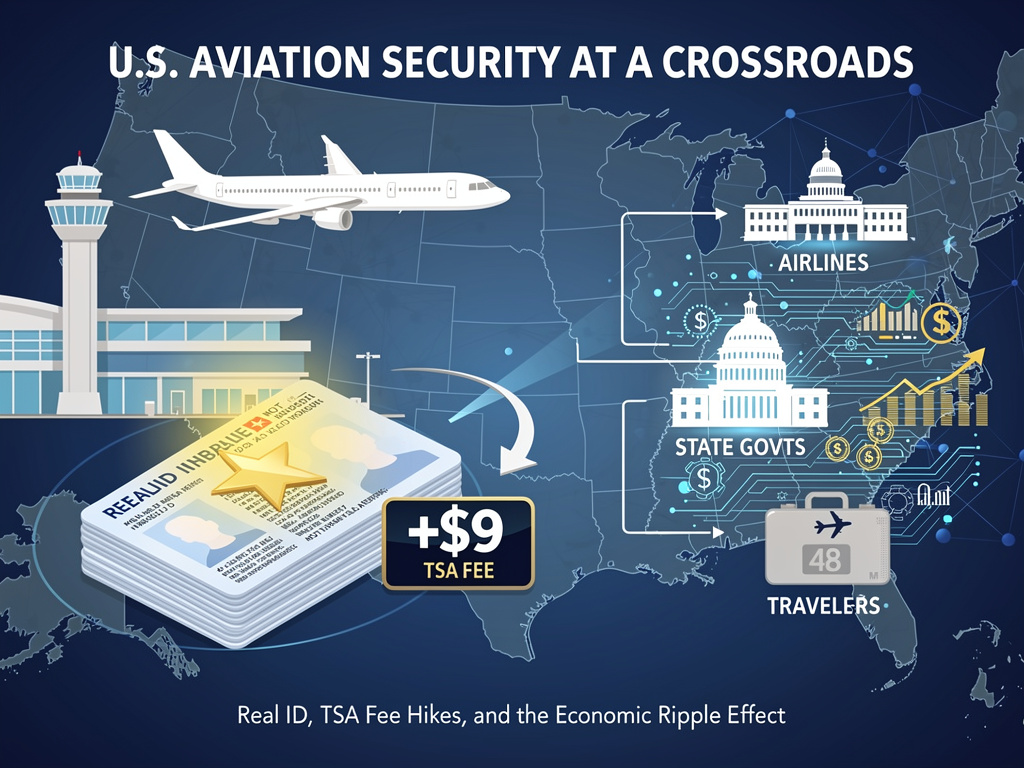
American travelers face an unprecedented shift in airport security protocols as the May 2025 Real ID deadline approaches, bringing with it a cascade of financial implications that extend far beyond the initial $9 fee increase recently announced by the Transportation Security Administration. The convergence of new identification requirements, modernized screening technology, and evolving security protocols represents the most significant transformation of domestic air travel infrastructure since the creation of TSA itself in the aftermath of September 11, 2001.
According to Business Insider, the TSA has confirmed plans to increase the September 11 Security Fee from $5.60 to $9.00 per one-way trip, marking the first adjustment to this charge since 2014. This increase, while seemingly modest on its surface, signals a broader recalibration of how the federal government finances aviation security in an era of heightened technological demands and evolving threat assessments. For the 2.9 million passengers who pass through TSA checkpoints daily, these incremental costs accumulate into billions of dollars annually, fundamentally altering the economics of domestic air travel.
The timing of this fee increase coincides with the Real ID enforcement deadline, creating a perfect storm of compliance challenges for both travelers and airport authorities. The Real ID Act, passed by Congress in 2005 but repeatedly delayed in its implementation, will finally become mandatory for domestic air travel on May 7, 2025. After this date, travelers will need either a Real ID-compliant driver’s license or another approved form of identification, such as a passport, to board domestic flights. The Department of Homeland Security estimates that approximately 48 million Americans still lack Real ID-compliant identification, setting the stage for potential chaos at security checkpoints nationwide.
The Real Economics Behind Enhanced Security Protocols
The financial burden of Real ID implementation extends well beyond federal fees, creating a complex web of costs that ripple through state governments, airlines, and ultimately passengers. State motor vehicle departments have invested hundreds of millions of dollars upgrading systems and training personnel to issue Real ID-compliant licenses. These costs have translated into higher fees at the state level, with many jurisdictions charging $10 to $30 more for Real ID licenses compared to standard versions. When combined with the TSA fee increase, frequent travelers could see their annual security-related expenses rise by hundreds of dollars.
Industry analysts point to the modernization of TSA screening equipment as a primary driver of increased costs. The agency has been rolling out Computed Tomography (CT) scanners, which provide three-dimensional images of carry-on bags and eliminate the need for passengers to remove laptops and liquids from their bags. While these systems enhance both security and passenger convenience, each unit costs approximately $300,000, compared to roughly $150,000 for traditional X-ray machines. The TSA plans to deploy more than 3,000 of these advanced scanners across U.S. airports, representing an investment exceeding $900 million.
State-Level Compliance Creates Patchwork of Readiness
The decentralized nature of Real ID implementation has created significant disparities in readiness across states. Some jurisdictions began issuing compliant licenses as early as 2008, while others waited until the past few years to update their systems. This variation has led to confusion among travelers, many of whom remain uncertain about whether their current identification meets federal standards. The small star or other marking that indicates Real ID compliance appears in different locations on licenses from different states, adding another layer of complexity to an already convoluted system.
State DMV offices report unprecedented demand for Real ID upgrades as the deadline approaches. Wait times at motor vehicle agencies in major population centers have increased substantially, with some locations reporting backlogs of several weeks for appointments. This surge in demand has forced states to allocate additional resources to DMV operations, including extended hours, temporary staffing increases, and enhanced online services. The administrative burden falls disproportionately on states with large populations and limited DMV infrastructure, potentially exacerbating existing inequalities in access to government services.
Airlines Navigate Operational Challenges and Customer Communication
Major carriers have launched extensive customer education campaigns to prevent widespread disruptions when the Real ID deadline takes effect. Airlines recognize that passengers turned away at security checkpoints represent not only lost revenue but also operational headaches in the form of rebooking complications and customer service demands. Delta, American, and United have incorporated Real ID reminders into their booking confirmations, mobile apps, and check-in processes, attempting to reach travelers at multiple touchpoints throughout their journey.
The potential for significant disruptions looms large in airline planning departments. If even a small percentage of the estimated 48 million non-compliant travelers attempt to fly without proper identification, the resulting delays and denied boardings could cascade through the aviation system, affecting on-time performance and creating customer service nightmares. Airlines have been coordinating with TSA to develop contingency plans, including the possibility of extending grace periods or implementing temporary workarounds for travelers caught unaware by the new requirements.
Technology Investment Reshapes Security Infrastructure
Beyond CT scanners, TSA has invested heavily in biometric screening technology and artificial intelligence-powered threat detection systems. These innovations promise to streamline the security process while maintaining or enhancing safety standards, but they come with substantial price tags and ongoing maintenance costs. The agency’s budget for technology modernization has grown steadily, reflecting a fundamental shift toward more sophisticated, data-driven security approaches that require continuous investment in both hardware and software.
The integration of facial recognition technology at security checkpoints represents another significant expense and policy consideration. While proponents argue that biometric screening can reduce wait times and improve accuracy in identity verification, privacy advocates have raised concerns about data collection and potential misuse. Several airports have implemented pilot programs testing facial recognition systems, with mixed results in terms of both efficiency gains and public acceptance. The TSA must balance the operational benefits of these technologies against legitimate privacy concerns and the substantial costs of system-wide deployment.
Economic Impact on Business Travel and Tourism
The cumulative effect of higher fees, stricter identification requirements, and more complex security procedures could have measurable impacts on travel demand, particularly among price-sensitive leisure travelers and small business owners. Economic research on travel elasticity suggests that even modest increases in the total cost of air travel can lead to decreased demand, potentially affecting airlines, hotels, and destination economies. The $3.40 increase in the TSA fee may seem negligible for individual trips, but for families or business travelers making multiple trips annually, these costs add up quickly.
Business travel associations have expressed concern that the fee increase comes at a time when many companies are already scrutinizing travel budgets and exploring virtual alternatives to in-person meetings. The pandemic accelerated the adoption of video conferencing and other remote collaboration tools, and some organizations have permanently reduced their travel expenditures. Additional fees and complications associated with air travel could further tip the balance toward virtual options, potentially reducing the volume of business travel and affecting the broader aviation ecosystem.
Federal Budget Politics and Aviation Security Funding
The TSA fee increase reflects broader debates about how to fund aviation security and whether the costs should be borne primarily by users or distributed across the general tax base. When Congress created the September 11 Security Fee in 2001, it was intended to offset a portion of TSA’s operational costs, with the remainder funded through general appropriations. Over time, the proportion of TSA costs covered by passenger fees has fluctuated based on congressional budget decisions and political priorities.
Critics of the fee increase argue that aviation security represents a national security function that benefits all Americans, not just those who fly, and therefore should be funded primarily through general taxation rather than user fees. Proponents counter that passengers who use the system should bear a greater share of its costs, particularly as TSA’s budget has grown to exceed $10 billion annually. This philosophical debate over cost allocation has significant practical implications for travelers, airlines, and federal budgeting, and it will likely continue as security requirements and technologies evolve.
Looking Ahead: The Future of Aviation Security Economics
The Real ID implementation and TSA fee increase represent just the latest chapter in the ongoing evolution of aviation security policy and economics. As threats evolve and technology advances, the costs and complexity of securing air travel will continue to grow. Future developments may include expanded biometric screening, artificial intelligence-powered threat assessment, and integration with international security standards and systems. Each of these innovations will require substantial investment and careful consideration of privacy, efficiency, and equity concerns.
The success of the Real ID transition will depend heavily on effective communication, adequate preparation by both travelers and authorities, and the ability of the system to handle inevitable complications and edge cases. State DMV offices, TSA checkpoints, and airline customer service departments will all play critical roles in ensuring a smooth transition. The lessons learned from this implementation will inform future efforts to modernize identification and security systems, potentially affecting not just air travel but other contexts where secure identification is required.
As May 2025 approaches, the convergence of new fees, identification requirements, and security technologies will test the resilience and adaptability of America’s aviation infrastructure. The outcome will shape not only how Americans travel but also how they think about the balance between security, privacy, convenience, and cost in an increasingly complex world. For industry stakeholders, policymakers, and travelers alike, the coming months will provide crucial insights into the future of domestic air travel and the ongoing challenge of securing it against evolving threats while maintaining accessibility and efficiency.


 WebProNews is an iEntry Publication