
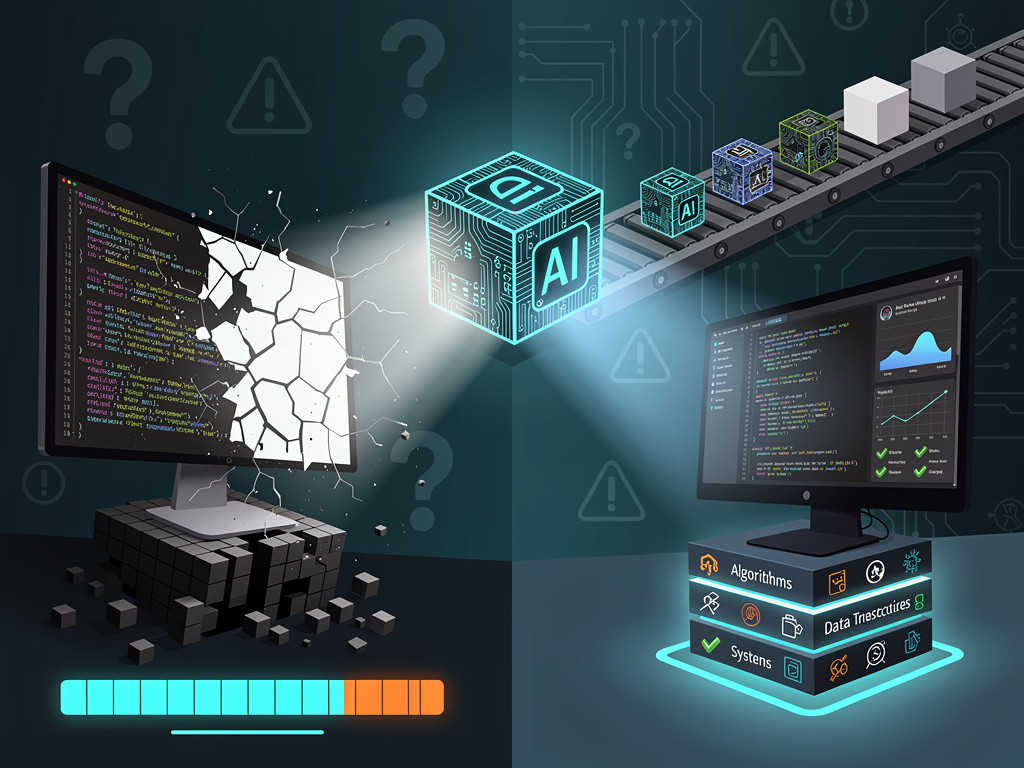
Software developers worldwide have embraced artificial intelligence coding assistants with remarkable enthusiasm, integrating tools like GitHub Copilot, ChatGPT, and Claude into their daily workflows. These systems promise to accelerate development cycles, reduce mundane tasks, and democratize programming expertise. Yet beneath this technological optimism lies a troubling question that industry leaders are only beginning to confront: Are these tools inadvertently creating a generation of developers who can write code but cannot truly understand it?
Research from Anthropic, the AI safety company behind Claude, has revealed a nuanced picture of how AI assistance affects the formation of fundamental coding skills. The study examined developers at various skill levels as they worked with and without AI support, measuring not just their immediate productivity but their deeper comprehension of programming concepts. The findings suggest that while AI tools can enhance experienced developers’ capabilities, they may simultaneously impede the skill acquisition process for novices—a phenomenon with profound implications for the technology industry’s future talent pipeline.
The research indicates that developers who rely heavily on AI assistance during their learning phase demonstrate measurably weaker problem-solving abilities when the assistance is removed. This pattern mirrors concerns that have emerged in other fields where automation has replaced human judgment, from aviation to medicine. The difference, however, is that software development sits at the heart of the modern economy, and the quality of code written today will determine the reliability of systems that billions depend upon tomorrow.
The Competency Paradox: When Productivity Masks Understanding
Anthropic’s research team discovered what they term a “competency paradox” in AI-assisted coding. Novice programmers using AI tools could produce functional code at rates approaching those of intermediate developers working without assistance. Surface-level metrics suggested these tools were successfully accelerating skill development. However, when researchers tested these same novices on fundamental programming concepts—asking them to explain their code’s logic, identify potential edge cases, or solve similar problems without AI support—their performance dropped precipitously.
The study employed a controlled experimental design, dividing participants into groups that coded with varying levels of AI assistance. One group received full access to advanced AI coding tools, another received limited assistance, and a control group worked entirely without AI support. After completing identical programming tasks, all participants faced assessments designed to measure conceptual understanding rather than mere code production. The results were striking: participants in the full-assistance group scored approximately 30% lower on conceptual understanding tests compared to those who had worked without AI help, despite producing similar amounts of working code.
This gap in understanding manifests most clearly when developers encounter novel problems that fall outside their AI assistant’s training data or when they need to debug complex issues. “The concern is that developers are learning to prompt rather than to program,” the Anthropic research notes. This shift represents a fundamental change in the nature of software development expertise—one that prioritizes knowing what to ask an AI system over understanding how to construct solutions from first principles.
The Experience Divide: How Expertise Changes the AI Equation
The impact of AI assistance varies dramatically based on a developer’s existing skill level, creating what researchers describe as a “skill amplification gap.” Experienced developers with strong foundational knowledge use AI tools as sophisticated productivity multipliers, leveraging them to handle boilerplate code, explore alternative approaches, and rapidly prototype solutions while maintaining critical oversight of the generated code. For these practitioners, AI assistance enhances rather than replaces their expertise.
Senior developers in the study demonstrated an ability to quickly identify when AI-generated code contained subtle bugs, violated best practices, or failed to account for important edge cases. Their years of experience provided a robust mental model against which to evaluate AI suggestions. When asked to rate their confidence in AI-generated code, experienced developers showed appropriate skepticism, carefully reviewing suggestions before integration. Novices, by contrast, often accepted AI-generated code with minimal scrutiny, lacking the expertise to recognize potential issues.
This divergence has created a bifurcated development environment within many technology companies. Teams with experienced engineers successfully integrate AI tools while maintaining code quality and system reliability. Meanwhile, organizations that have rapidly expanded their development teams with junior engineers trained primarily through AI-assisted methods report increasing technical debt, mysterious bugs that persist despite apparent fixes, and systems that work in common scenarios but fail unpredictably in edge cases. The long-term implications of this divide remain unclear, but the immediate effects are measurable in both productivity metrics and system reliability.
The Pedagogy Problem: Rethinking How Developers Learn
The Anthropic findings have sparked intense debate within computer science education circles about how to adapt teaching methodologies for an AI-augmented world. Traditional programming education emphasizes building skills progressively, from basic syntax and data structures through algorithms and system design. This approach assumes students will struggle with implementation details, and that this struggle builds the mental models necessary for expert performance. AI coding assistants short-circuit this process, allowing students to skip past implementation challenges to working solutions.
Some educators argue for temporarily restricting AI tool access during foundational learning phases, similar to how mathematics education limits calculator use until students master manual computation. Others contend this approach is futile and counterproductive, arguing that the industry has irrevocably changed and education must adapt to prepare students for an AI-integrated workplace. A middle path has emerged in some institutions: structured AI assistance that provides increasingly sophisticated help as students demonstrate mastery of underlying concepts, essentially gamifying the learning process while ensuring foundational skills develop.
Major technology companies have begun revising their training programs for junior developers in response to these concerns. Several firms now require new hires to complete initial projects without AI assistance, establishing baseline competencies before introducing productivity tools. Others have implemented mandatory code review processes specifically designed to catch the characteristic patterns of uncritically accepted AI-generated code. These adaptations acknowledge a reality that the industry is still grappling with: the tools that make experienced developers more productive may simultaneously make it harder to create the next generation of experienced developers.
The Quality Question: When Good Enough Becomes the Enemy of Good
Beyond individual skill development, the widespread adoption of AI coding assistants raises systemic questions about software quality and maintainability. Code is read far more often than it is written, and the long-term cost of software lies not in its initial creation but in its ongoing maintenance, debugging, and enhancement. AI-generated code, while often functional, frequently lacks the elegance, clarity, and thoughtful structure that characterizes expert human work.
The Anthropic research documented several concerning patterns in AI-generated code that novice developers often fail to recognize or correct. These include unnecessarily complex solutions to simple problems, inconsistent naming conventions within the same codebase, inadequate error handling, and poor consideration of performance implications. While each instance might seem minor, the cumulative effect across large codebases can be substantial. Systems built primarily through AI assistance without adequate expert oversight tend to exhibit what researchers describe as “structural brittleness”—they work as designed but prove difficult to modify, extend, or debug when requirements change.
Industry veterans worry that the current generation of AI tools optimizes for code that works rather than code that communicates intent clearly to future maintainers. “The best code is code that another developer can understand six months later,” notes the Anthropic study, highlighting a dimension of software quality that current AI systems struggle to optimize for. This concern becomes particularly acute in critical systems where reliability and maintainability trump rapid development. The financial services, healthcare, and aerospace industries—sectors where software failures carry enormous consequences—are approaching AI coding assistance with considerably more caution than consumer technology companies.
The Cognitive Offloading Dilemma: What Happens When We Stop Thinking
Anthropic’s research connects to broader cognitive science research on skill acquisition and the effects of cognitive offloading—the process by which humans delegate mental tasks to external tools. While offloading can free cognitive resources for higher-level thinking, it can also atrophy the skills being offloaded if not managed carefully. The research suggests that AI coding assistance represents a particularly potent form of cognitive offloading because it operates at multiple levels simultaneously: syntax, logic, algorithm selection, and even architectural decisions.
The study found that developers who worked extensively with AI assistance showed measurably different problem-solving approaches when later working without it. Rather than breaking problems into logical components and building solutions incrementally—the hallmark of expert programming—they often attempted to describe desired outcomes in natural language, essentially continuing to “prompt” an imaginary AI system. This behavioral persistence suggests that heavy AI reliance may be rewiring how developers think about programming itself, shifting from computational thinking to specification thinking.
This cognitive shift carries implications beyond individual skill development. Programming has historically been valued not just as a technical skill but as a form of disciplined thinking applicable to diverse problem-solving contexts. The logical reasoning, systematic debugging, and abstract thinking that programming cultivates have made computer science education valuable even for those who don’t become professional developers. If AI assistance fundamentally changes what programming practice entails, it may also change what cognitive benefits the activity provides.
Industry Adaptation: How Companies Are Responding
Major technology companies are implementing varied strategies to address the skill development challenges posed by AI coding assistants. Some organizations have established dual-track development processes, where critical system components require traditional development methods with AI assistance limited to specific, well-defined tasks. Others have invested heavily in enhanced mentorship programs, pairing junior developers with experienced engineers who can provide the contextual knowledge and critical evaluation that AI systems cannot.
The hiring market has also begun to reflect these concerns. Technical interviews increasingly emphasize conceptual understanding and problem-solving approaches over the ability to produce working code quickly. Some companies now conduct portions of technical assessments in environments where AI assistance is deliberately unavailable, attempting to evaluate candidates’ fundamental capabilities rather than their proficiency with AI tools. This shift represents a significant change from the industry’s previous emphasis on practical coding ability demonstrated through take-home projects or pair programming sessions where AI assistance was implicitly acceptable.
Forward-thinking organizations are also reconsidering how they measure developer productivity. Traditional metrics like lines of code written or features shipped per sprint fail to capture the quality dimensions that become critical in AI-assisted development. New evaluation frameworks attempt to assess code maintainability, bug rates in production, and the ability to work effectively on complex debugging tasks—metrics that better reflect the comprehensive skills that distinguish expert developers from those who can merely direct AI systems to produce functional code.
The Path Forward: Balancing Assistance with Autonomy
The Anthropic research ultimately suggests that AI coding assistance is neither inherently beneficial nor harmful to skill development—its impact depends entirely on how it is integrated into learning and work processes. The key lies in what researchers call “scaffolded assistance”: AI support calibrated to challenge users appropriately while preventing them from becoming dependent on automation for tasks within their capability.
This approach requires a more sophisticated understanding of when AI assistance helps versus when it hinders. For experienced developers tackling routine tasks, full AI assistance maximizes productivity without compromising expertise. For novices learning fundamental concepts, minimal or no AI assistance forces the productive struggle that builds robust mental models. For intermediate developers, selective AI assistance on peripheral tasks while requiring manual implementation of core logic may offer an optimal balance. The challenge lies in creating systems and organizational practices that can dynamically adjust assistance levels based on context and individual needs.
The technology industry stands at an inflection point in how it develops and maintains expertise. The same AI systems that promise to democratize programming and accelerate development may also create a future where fewer developers possess the deep expertise necessary to build reliable, maintainable systems or to advance the field itself. Addressing this challenge requires acknowledging that not all productivity gains are equally valuable—that the speed of initial development matters less than the long-term quality, reliability, and maintainability of software systems. As AI coding assistants become increasingly capable and ubiquitous, the industry must develop new frameworks for skill development, quality assurance, and expertise cultivation that account for these tools’ profound effects on how developers learn, think, and work. The alternative—continuing to optimize for short-term productivity while inadvertently undermining the expertise that makes long-term progress possible—risks creating a technology sector that can maintain existing systems but struggles to innovate beyond what its AI tools were trained to do.


 WebProNews is an iEntry Publication