
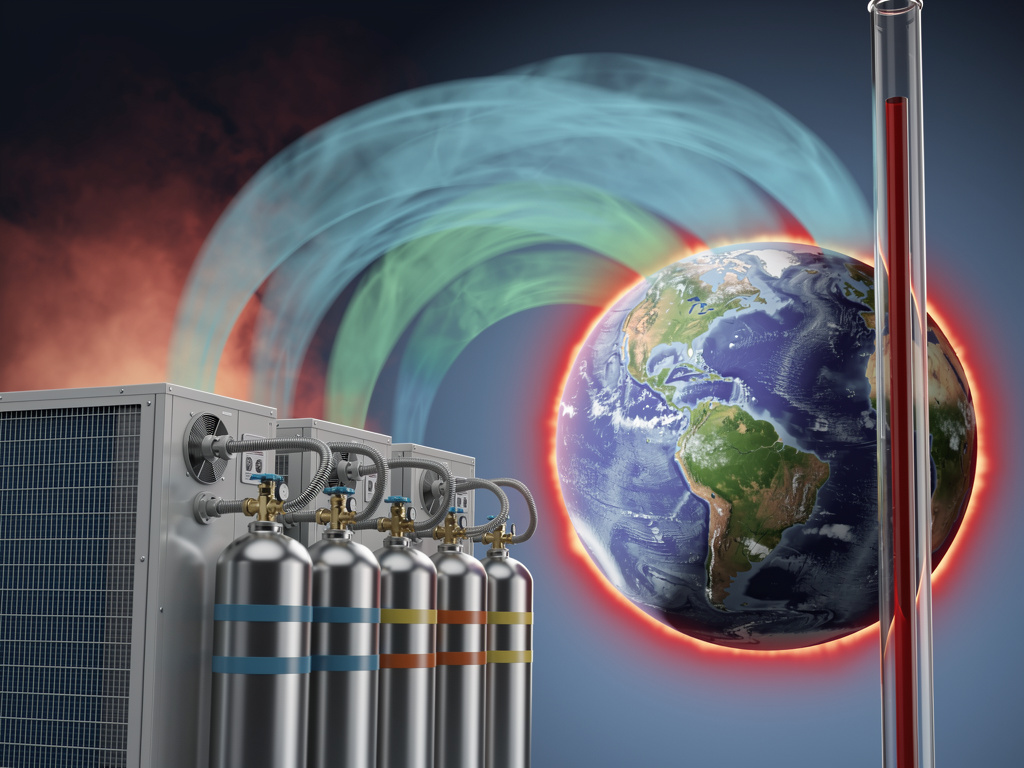
While carbon dioxide dominates climate change discussions, a category of industrial chemicals called hydrofluorocarbons—or HFCs—presents one of the most achievable opportunities to slow global warming in the near term. These super-pollutants, commonly used in air conditioning and refrigeration systems, trap thousands of times more heat than CO2 over their atmospheric lifetime. Yet they remain largely unknown to the general public, even as international agreements to phase them out could prevent up to 0.5 degrees Celsius of warming by century’s end.
According to Slashdot, the Kigali Amendment to the Montreal Protocol—ratified by nearly 200 countries—mandates a global phase-down of HFC production and consumption. The amendment, which entered into force in 2019, represents a rare moment of international climate consensus, building on the successful framework that eliminated ozone-depleting chlorofluorocarbons (CFCs) decades earlier. Industry insiders view this transition as both a significant challenge and a lucrative opportunity, with the global market for alternative refrigerants projected to reach tens of billions of dollars within the next decade.
The scale of HFC emissions has grown exponentially over the past three decades. These chemicals were originally introduced as replacements for CFCs after the 1987 Montreal Protocol successfully addressed the ozone hole crisis. While HFCs don’t damage the ozone layer, their global warming potential is staggering—some varieties are up to 12,000 times more potent than carbon dioxide over a 100-year period. As developing nations have expanded their use of air conditioning and refrigeration, HFC emissions have surged, particularly in rapidly growing economies across Asia and Africa.
The Economics of Transition: Winners and Losers in the Refrigerant Market
The phase-down of HFCs is reshaping the global refrigerant industry, creating clear winners among chemical manufacturers who invested early in alternative technologies. Companies like Honeywell and Chemours have positioned themselves at the forefront of this transition, developing next-generation refrigerants with significantly lower global warming potential. Honeywell’s Solstice line of products and Chemours’ Opteon series represent the current state-of-the-art, offering performance comparable to HFCs while reducing climate impact by up to 99.9 percent.
However, the transition presents substantial challenges for manufacturers in developing countries, many of whom built their businesses around HFC production and lack the capital to retool facilities for alternative refrigerants. The Multilateral Fund for the Implementation of the Montreal Protocol has allocated billions of dollars to assist these nations, but questions remain about whether this funding is adequate to ensure a smooth transition without creating competitive disadvantages. Industry analysts note that China, which produces the majority of the world’s HFCs, faces particular pressure to accelerate its phase-down schedule while maintaining its dominant position in the global HVAC supply chain.
The commercial refrigeration sector illustrates the complexity of this transition. Supermarket chains and cold storage facilities represent some of the largest users of HFC-based systems, with individual facilities potentially containing thousands of pounds of refrigerant. Retrofitting or replacing this equipment requires significant capital investment, and many businesses are weighing the costs of early action against the risk of being caught with stranded assets as regulations tighten. Major retailers including Target and Whole Foods have committed to transitioning their refrigeration systems to natural refrigerants like CO2 and propane, but these early adopters remain the exception rather than the rule.
Technical Hurdles and the Search for Perfect Alternatives
The quest for ideal HFC replacements has proven more challenging than initially anticipated. While several categories of alternatives exist—including hydrofluoroolefins (HFOs), natural refrigerants, and hydrocarbon-based solutions—each comes with its own set of trade-offs. HFOs, the most widely adopted HFC alternatives in developed markets, offer low global warming potential and good thermodynamic properties, but they’re more expensive to produce and some varieties break down into trifluoroacetic acid, raising questions about long-term environmental accumulation.
Natural refrigerants like ammonia, CO2, and hydrocarbons have been used in industrial applications for decades, but their adoption in consumer applications has been slower due to safety concerns and the need for specialized equipment. Ammonia is toxic, hydrocarbons are flammable, and CO2 requires systems that operate at much higher pressures than conventional equipment. These characteristics aren’t insurmountable—European and Japanese manufacturers have successfully deployed CO2-based systems in millions of vehicles and commercial installations—but they require different engineering approaches and regulatory frameworks than those built around synthetic refrigerants.
The air conditioning sector faces particularly acute challenges in hot, humid climates where cooling demand is growing fastest. High ambient temperatures reduce the efficiency of some alternative refrigerants, potentially increasing energy consumption even as direct emissions decrease. This creates a complex optimization problem: reducing HFC emissions while also minimizing the indirect climate impact from increased electricity use. Engineers are developing innovative solutions, including hybrid systems that use different refrigerants for different parts of the cooling cycle and advanced heat exchangers that improve efficiency, but widespread deployment remains years away.
The Compliance Challenge: Monitoring and Enforcement in a Global Market
Implementing the Kigali Amendment requires robust monitoring and enforcement mechanisms, which have proven difficult to establish in the fragmented global refrigerant market. Unlike CO2 emissions, which are relatively easy to estimate based on fossil fuel consumption, HFC releases occur through numerous pathways including manufacturing leaks, equipment servicing, and end-of-life disposal. The Environmental Investigation Agency has documented extensive illegal trade in HFCs, with smugglers exploiting price differentials between regions with different phase-down schedules.
The United States provides a case study in both the promise and pitfalls of HFC regulation. The EPA’s American Innovation and Manufacturing (AIM) Act, passed in 2020, established a national phase-down schedule aligned with the Kigali Amendment. The agency has implemented an allowance allocation system similar to cap-and-trade programs, creating a market mechanism to drive the transition. However, implementation has been complicated by legal challenges, supply chain disruptions, and debates over exemptions for specific applications. The refrigerant market has experienced significant price volatility, with some HFC varieties increasing in price by 500 percent or more as supplies tighten.
Developing effective monitoring systems requires cooperation between customs agencies, environmental regulators, and industry stakeholders. Some countries have implemented sophisticated tracking systems using blockchain technology to create transparent supply chains for refrigerants, while others struggle with basic enforcement capacity. The Montreal Protocol’s compliance mechanism, which has proven effective for ozone-depleting substances, provides a model, but the sheer volume of equipment using HFCs—from residential air conditioners to commercial chillers to mobile refrigeration units—makes comprehensive monitoring extraordinarily complex.
Climate Impact: Quantifying the Benefits of HFC Phase-Down
The climate benefits of eliminating HFCs extend beyond the direct reduction in emissions from these super-pollutants. Energy efficiency improvements in new equipment designed for alternative refrigerants could deliver additional climate benefits roughly equal to the direct emissions reductions. Modern systems using low-global-warming-potential refrigerants often incorporate improved compressors, heat exchangers, and control systems that reduce electricity consumption by 20 to 30 percent compared to older HFC-based equipment.
Climate scientists emphasize that HFC phase-down represents a rare opportunity for relatively rapid climate action. Unlike CO2, which persists in the atmosphere for centuries, most HFCs break down within 15 years. This means that reducing HFC emissions today produces measurable climate benefits within decades rather than centuries. Modeling by the Institute for Governance and Sustainable Development suggests that full implementation of the Kigali Amendment could avoid 0.3 to 0.5 degrees Celsius of warming by 2100—a significant contribution toward keeping global temperature rise below critical thresholds.
However, realizing these benefits requires addressing the installed base of HFC-containing equipment. Billions of air conditioners, refrigerators, and other appliances currently in use contain HFCs that will eventually be released unless properly recovered and destroyed. The refrigerant reclamation industry has grown in response to tightening regulations, but recovery rates remain low in many regions. Improving end-of-life management of refrigerants requires investment in collection infrastructure, technician training, and economic incentives to make proper disposal more attractive than venting refrigerants to the atmosphere.
The Innovation Imperative: Next-Generation Cooling Technologies
The HFC phase-down is catalyzing research into fundamentally different approaches to cooling that could eliminate the need for chemical refrigerants entirely. Solid-state cooling technologies based on thermoelectric, magnetocaloric, or elastocaloric effects have shown promise in laboratory settings, though commercialization remains elusive. These technologies could eventually provide cooling without any refrigerant, eliminating both direct emissions and the risk of leaks, but significant technical challenges remain in achieving the efficiency and cost-effectiveness of vapor-compression systems.
Passive cooling strategies are receiving renewed attention as architects and engineers seek to reduce cooling demand rather than simply finding better ways to meet it. Traditional building designs in hot climates incorporated features like thick walls, strategic shading, and natural ventilation to maintain comfortable temperatures without mechanical cooling. Modern interpretations of these principles, combined with advanced materials and digital control systems, can significantly reduce cooling loads in new construction. However, the billions of existing buildings in hot climates will continue to require active cooling for the foreseeable future, making the transition to low-global-warming-potential refrigerants essential regardless of progress in passive cooling.
The automotive sector has emerged as an unexpected leader in alternative refrigerant adoption. European regulations drove the transition to HFO-1234yf in mobile air conditioning systems beginning in 2011, and most new vehicles sold globally now use this low-global-warming-potential refrigerant. The automotive industry’s experience demonstrates both the feasibility of large-scale transitions and the importance of regulatory certainty in driving investment. However, the higher flammability of HFO-1234yf compared to the HFC it replaced has required new safety protocols and equipment designs, illustrating the trade-offs inherent in any refrigerant transition.
Looking Forward: The Path to a Post-HFC World
The success of HFC phase-down will ultimately depend on continued international cooperation, adequate financing for developing countries, and technological innovation to address remaining challenges. The Kigali Amendment’s differentiated timelines—with developed countries moving faster than developing nations—reflect the principle of common but differentiated responsibilities that has guided international environmental agreements. However, this approach creates opportunities for illegal trade and requires vigilant enforcement to prevent developed-country markets from being flooded with cheaper, non-compliant equipment.
Industry observers note that the refrigerant transition is occurring against the backdrop of surging cooling demand driven by rising temperatures and growing prosperity in developing countries. The International Energy Agency projects that the number of air conditioning units in use globally will triple by 2050, from 1.6 billion today to nearly 5 billion. Meeting this demand with HFC-based equipment would be catastrophic for the climate, but transitioning to alternatives while ensuring affordable access to cooling in hot climates requires careful policy design and substantial investment. The tension between climate mitigation and adaptation is particularly acute in the cooling sector, where the equipment needed to protect people from heat extremes can itself contribute to warming.
The HFC phase-down represents a test case for international climate action more broadly. Unlike CO2 emissions, which are deeply embedded in energy systems and economic structures, HFC emissions can be addressed through relatively targeted interventions in specific industries. The existence of technically viable alternatives and a proven international regulatory framework makes success achievable in ways that remain elusive for broader decarbonization efforts. Whether the world can successfully execute this transition will provide important lessons for tackling more difficult climate challenges ahead, demonstrating whether international agreements can drive real-world change at the pace and scale required to address the climate crisis.


 WebProNews is an iEntry Publication