
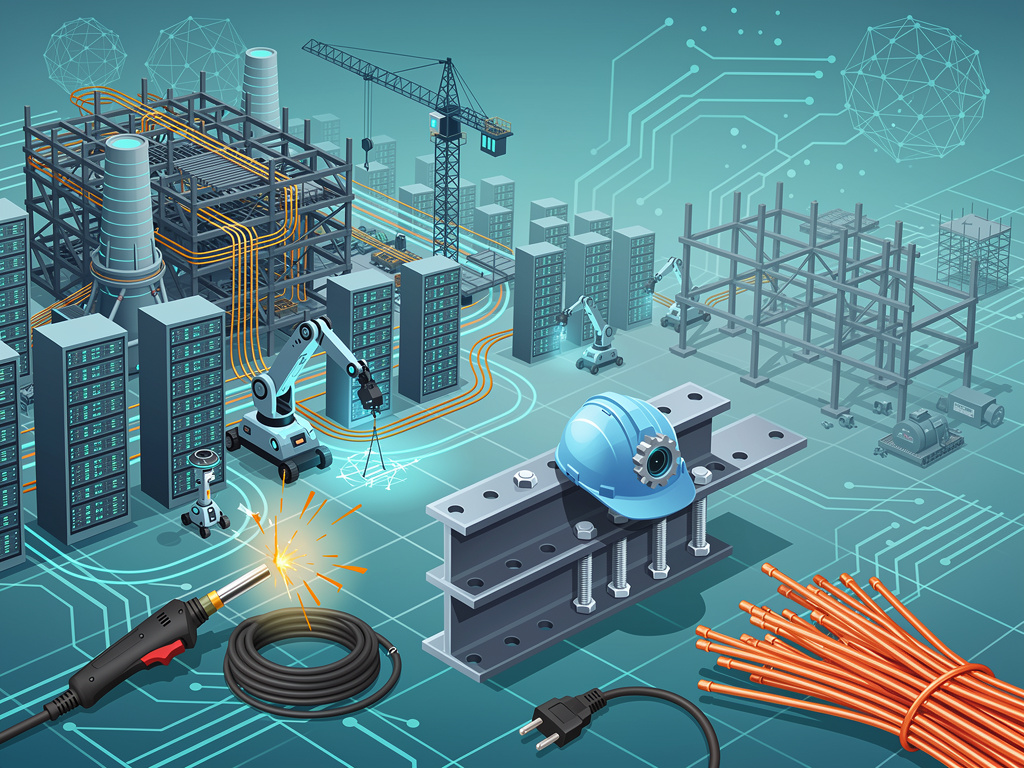
Somewhere in Louisiana, a welder is earning more than a junior software engineer in San Francisco. That’s not a punchline. It’s the emerging reality of America’s AI boom, where the most consequential labor shortage isn’t in machine learning talent — it’s in the people who can pour concrete, pull cable, and wire electrical systems for the massive data centers that make artificial intelligence possible.
Meta President Joel Kaplan made the case bluntly during a recent appearance at a Morgan Stanley technology conference. The company, he said, plans to spend between $60 billion and $65 billion on capital expenditures in 2025 alone, with the vast majority flowing into AI infrastructure. But the bottleneck isn’t silicon. It isn’t even chips. It’s workers. “We’re going to need more blue-collar workers to build all of this stuff,” Kaplan said, as Business Insider reported. He described the coming demand for electricians, plumbers, and construction workers as potentially the largest driver of blue-collar job creation in a generation.
The numbers are staggering. Meta alone has announced plans for a data center in Richland Parish, Louisiana, that will span more than 4 million square feet — making it one of the largest such facilities ever constructed. Microsoft, Google, Amazon, and a constellation of smaller players are all racing to build similar complexes across the United States, from the plains of Texas to the farmland of Wisconsin. The collective capital expenditure commitments from the five largest hyperscale cloud and AI companies are expected to exceed $300 billion in 2025, according to estimates compiled by Reuters.
And all of it needs to be physically built. By human hands.
That fact has created a paradox at the center of the AI revolution. The technology most associated with automating white-collar knowledge work is, in its current expansion phase, generating enormous demand for the most traditional forms of manual labor. Ironworkers. Crane operators. HVAC technicians. The trades that guidance counselors spent two decades steering students away from are suddenly among the most sought-after skill sets in the American economy.
The International Brotherhood of Electrical Workers has reported surging demand for its members, with locals across the South and Midwest fielding calls from contractors who can’t staff data center projects fast enough. In some markets, electricians with experience in high-voltage commercial work are commanding hourly rates that would have been unthinkable five years ago. The shortage is real. According to the U.S. Bureau of Labor Statistics, the construction industry needs to attract roughly 500,000 new workers annually just to keep pace with current demand — and that estimate was made before the AI infrastructure wave fully materialized.
Kaplan’s comments at the Morgan Stanley conference weren’t just corporate cheerleading. They reflected a strategic concern. Meta can design the most advanced AI chips in the world and develop training clusters of extraordinary scale, but none of it matters if the physical structures can’t be completed on schedule. Permitting delays, materials shortages, and labor constraints have already pushed timelines on several major data center projects across the industry. Kaplan acknowledged as much, noting that infrastructure buildout was one of the primary constraints on Meta’s AI ambitions.
This isn’t a problem unique to Meta. Microsoft has committed to spending more than $80 billion on AI-enabled data centers in fiscal year 2025, as the company disclosed in January. Google parent Alphabet has signaled comparable levels of investment. Amazon Web Services continues to expand aggressively. Each announcement carries an implicit demand signal for tens of thousands of construction workers, many of whom don’t yet exist in the labor market.
The geography of this buildout matters. Data centers require three things in abundance: cheap electricity, water for cooling, and land. That combination tends to exist in rural and semi-rural areas — places where the local labor pool is thin. Companies have responded by importing workers from other regions, establishing temporary housing near construction sites, and in some cases partnering with community colleges and trade schools to accelerate training pipelines.
In Louisiana, where Meta’s massive Richland Parish project is underway, state officials have scrambled to prepare. Governor Jeff Landry has promoted the project as a generational economic opportunity for a region that has struggled with population decline and limited private investment. But local workforce development boards have been candid about the challenge: there simply aren’t enough trained workers in the immediate area to staff a project of this magnitude. The solution has involved recruiting from across the Gulf Coast, offering relocation incentives, and fast-tracking apprenticeship programs.
Similar dynamics are playing out in places like New Albany, Ohio, where Google and other tech firms have clustered data center operations. And in central Texas, where multiple hyperscale facilities are under construction simultaneously, creating intense competition for the same pool of skilled tradespeople.
The wage effects are significant. Construction labor economists have noted that data center projects tend to pay premiums of 15% to 30% over comparable commercial construction work, driven by the technical complexity of the electrical and mechanical systems involved and by the urgency of completion timelines. For workers with the right credentials, the math is compelling. A journeyman electrician on a large-scale data center project in the South can earn $80,000 to $120,000 annually — and significantly more with overtime, which is abundant.
But higher wages in data center construction create ripple effects. Other construction sectors — residential, commercial, infrastructure — lose workers to the better-paying tech projects. Hospital systems, school districts, and municipal governments already struggling to fund construction find themselves competing for labor against companies with essentially unlimited capital budgets. It’s a dynamic that some industry observers have compared to the shale oil boom of the early 2010s, when energy companies vacuumed up skilled workers from surrounding industries and regions.
The training pipeline is the critical variable. The United States has underinvested in vocational and trade education for decades, a trend driven by cultural preferences for four-year college degrees and by policy choices that directed funding accordingly. The result is a structural deficit in skilled tradespeople that predates the AI boom and will outlast it. According to Associated Builders and Contractors, the construction industry faced a shortfall of approximately 501,000 workers in 2024. The AI infrastructure wave is layering new demand on top of an already strained system.
Some companies are trying to address this directly. Meta has discussed partnerships with trade organizations and educational institutions to develop training programs specifically oriented toward data center construction. Microsoft has announced workforce development initiatives tied to its data center investments in several states. These efforts are real but modest relative to the scale of the problem.
There’s a deeper irony here that’s hard to miss. Much of the public conversation about AI centers on its potential to displace workers — to automate customer service, legal research, content creation, financial analysis, and dozens of other white-collar functions. And those concerns are legitimate. But the immediate, measurable labor market effect of AI in 2025 is the opposite: it’s creating jobs. Lots of them. Physical, demanding, well-paying jobs that require showing up on a construction site at 6 a.m. and working with your hands.
Kaplan seemed aware of this tension. During his Morgan Stanley remarks, he framed the infrastructure buildout as a counternarrative to AI anxiety, suggesting that the technology’s economic benefits would be broadly distributed — not just to engineers and researchers, but to working-class Americans in construction, manufacturing, and related fields. Whether that framing holds over the longer term depends on how the technology ultimately reshapes the broader labor market. But for now, the demand signal is unmistakable.
The political dimensions are equally striking. Both parties have spent years competing to claim the mantle of blue-collar advocacy. The AI infrastructure boom offers a rare point of bipartisan alignment: massive private investment, domestic job creation, and the revival of manufacturing-adjacent employment in regions that have felt left behind by the knowledge economy. It’s no accident that data center announcements have become ribbon-cutting events attended by governors and senators of both parties.
Yet the boom is not without friction. Local communities near proposed data center sites have raised concerns about water usage, noise, property values, and the strain on local services from temporary construction workforces. In some cases, opposition has slowed or blocked projects. The tension between economic development and community impact is real, and it’s likely to intensify as the scale of construction accelerates.
So where does this go? The consensus among analysts is that AI-related capital expenditure will remain elevated for at least three to five years, with some projections extending the cycle further depending on the pace of AI adoption across industries. That implies sustained demand for construction labor over a period long enough to justify significant investments in training and workforce development. It also implies continued wage pressure in the trades, which could — over time — begin to shift cultural attitudes about vocational careers.
The AI economy, it turns out, runs on concrete and copper as much as it runs on code. The most advanced large language models in the world are housed in buildings that someone had to physically construct, cooled by systems that someone had to install, and powered by electrical grids that someone had to wire. The workers doing that building are, in a very real sense, the foundation of the AI era. And right now, there aren’t nearly enough of them.
Meta’s Kaplan put it simply. The company can design whatever it wants. But if it can’t build the infrastructure to support it, none of it matters. That’s the constraint. Not algorithms. Not data. Workers in hard hats.


 WebProNews is an iEntry Publication