
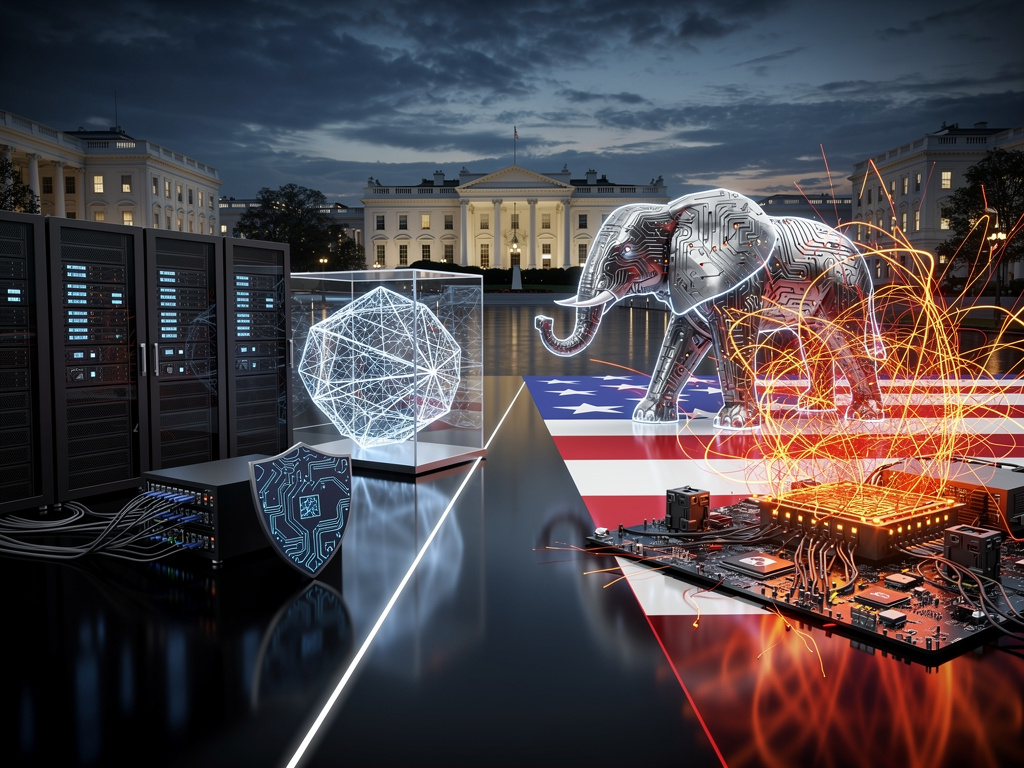
In the corridors of Silicon Valley, a palpable shift in sentiment is underway, moving away from the cautious optimism of the Biden era toward a more aggressive, deregulatory stance favored by the Republican ticket. The current administration has spent the better part of two years constructing a safety net around the rapid development of generative models, culminating in Executive Order 14110. However, former President Donald Trump and his allies are preparing to dismantle this framework entirely. According to reporting by Futurism, the GOP platform has explicitly promised to repeal Biden’s “dangerous” executive order, framing current safety regulations not as protections, but as impediments to innovation and vehicles for imposing radical left-wing ideas on American technology.
This proposed pivot is not merely a return to laissez-faire economics; it represents a fundamental ideological split in how Washington views the strategic utility of machine learning. While the current White House views AI as a tool requiring guardrails to prevent bias and existential risk, the Trump camp views it as a weapon in a new Cold War—one that is currently being stifled by bureaucratic oversight. The Republican platform argues that the current rules hinder radical innovation, effectively handing the advantage to adversaries like China. Instead of safety testing and watermarking, the emerging doctrine focuses on “freedom of speech” and the acceleration of military capabilities.
The promise to repeal Executive Order 14110 signals a departure from safety-first governance toward a strategy that prioritizes speed, open-source development, and the removal of what conservatives describe as ‘woke’ algorithmic bias, fundamentally altering the trajectory of the American technology sector.
At the heart of this strategy is the “Make America First in AI” draft executive order, originating from the America First Policy Institute. This document outlines a vision for “Manhattan Projects” dedicated to developing military capabilities, bypassing the safety protocols established by the National Institute of Standards and Technology (NIST). As detailed by the Washington Post, the framework suggests a radical reduction in federal oversight, replacing mandatory safety assessments with industry-led initiatives. This approach aligns with the desires of a growing faction of venture capitalists who believe that the precautionary principle has strangled American dynamism.
The shift is heavily influenced by the ascent of “effective accelerationism” (e/acc), a Silicon Valley subculture that argues the moral imperative is to build powerful technology as fast as possible. This philosophy has found a receptive audience in the Trump campaign, particularly through the influence of Senator J.D. Vance. Vance, a former venture capitalist with deep ties to the tech industry, serves as a bridge between the populist right and the accelerationist wing of the tech sector. His connections to figures like Peter Thiel and David Sacks suggest that a Trump administration would favor open-source models—like Meta’s Llama—over the closed, highly regulated systems preferred by companies like OpenAI and Google.
While the deregulation narrative dominates the headlines, a complex internal conflict is brewing within the Republican coalition regarding the role of Big Tech monopolies versus the burgeoning ecosystem of open-source challengers and the national security state.
This internal friction is best exemplified by the divergent views on antitrust and competition. While traditional Republicans might favor a hands-off approach to all corporate entities, the populist wing, led by Vance, has expressed skepticism toward Big Tech incumbents. There is a nuanced argument gaining traction that heavy regulation actually cements the dominance of giants like Google and Microsoft, as only they have the capital to comply with onerous safety testing. By stripping away these requirements, the Trump administration could inadvertently—or intentionally—empower smaller, open-source competitors. The New York Times reports that influential donors like Marc Andreessen and Ben Horowitz have gravitated toward Trump precisely because of his promise to support this fractured, competitive ecosystem over a centralized, regulated one.
However, the picture is complicated by the presence of Elon Musk. As a key advisor and supporter, Musk occupies a paradoxical position. While he rails against the “woke mind virus” in AI models—a stance that aligns perfectly with the GOP platform—he also runs xAI and has historically warned of the existential risks posed by superintelligence. In a surprising move that contradicts the pure deregulation narrative, Musk recently expressed support for California’s SB 1047, a controversial safety bill. As reported by CNBC, Musk’s endorsement of safety protocols highlights a potential fissure in the Trump inner circle: the tension between those who want total acceleration and those who fear the technology they are building.
The geopolitical dimension of this policy shift cannot be overstated, as the proposed regulatory rollback is explicitly framed as a necessary countermeasure to Chinese technological advancement, prioritizing military dominance over civilian safety concerns.
The rhetoric surrounding the “AI arms race” suggests that a second Trump term would treat machine learning primarily as a national security asset. The argument is that burdensome safety regulations slow down development, allowing China to gain a decisive edge. Reuters notes that the “Manhattan Project” language used by Trump allies implies a massive infusion of state capital into defense-focused AI, potentially creating a tiered system where military applications are hyper-accelerated while consumer applications face a chaotic, unregulated marketplace. This mirrors the Cold War dynamic, where technological supremacy was viewed as the only metric of success.
This approach also suggests a rollback of international cooperation on AI safety. The Biden administration has invested heavily in summits and treaties, such as the Bletchley Park declaration, attempting to build a global consensus on risk management. A Trump administration, guided by an “America First” doctrine, would likely view these international agreements as constraints on U.S. sovereignty. The focus would shift from global safety norms to export controls and aggressive protectionism, designed to deny adversaries access to American chips and models while unshackling domestic developers from international oversight.
As federal oversight recedes, a legal vacuum is likely to emerge, forcing individual states to implement their own patchwork of regulations, creating a complex and fragmented operating environment for technology companies across the nation.
If the federal government abdicates its role in regulating model safety, the battleground will inevitably shift to the states. California, home to the majority of the world’s leading AI labs, is already attempting to fill this void. However, a hostile federal administration could attempt to preempt state laws, arguing that they interfere with interstate commerce or national security. Politico analysis of recent legislative vetoes suggests that while Silicon Valley pushes back against state-level regulation, the absence of a federal floor creates immense uncertainty. Companies may find themselves caught between a federal government demanding deregulation and acceleration, and state governments imposing strict liability for AI-generated harms.
Furthermore, the removal of federal safety mandates does not remove legal liability. Without the safe harbor of regulatory compliance, companies could face a deluge of litigation regarding copyright infringement, defamation, and discrimination. The “free speech” absolutism championed by the GOP platform may clash with existing civil rights laws, leading to a judicial showdown over whether algorithmic outputs are protected speech or discriminatory conduct. This legal uncertainty could, ironically, slow down enterprise adoption of generative tools, as corporate legal departments hesitate to deploy systems in a lawless environment.
The ultimate trajectory of American artificial intelligence under a second Trump administration will depend on which faction of his advisors prevails: the libertarians seeking a free market, or the defense hawks seeking a state-controlled technological arsenal.
The coalition supporting Trump is not monolithic. On one side stands the libertarian tech wing, represented by Andreessen and the crypto-adjacent crowd, who want the government to simply get out of the way. On the other side are the national conservatives and defense hawks, who view AI as a critical component of state power that must be directed against foreign adversaries. The “Manhattan Project” rhetoric suggests the latter may have the upper hand. This would result not in a true free market, but in a form of industrial policy where favored champions—likely those with defense contracts—receive state support, while consumer-facing safety regulations are slashed.
Industry insiders must prepare for a volatile transition. The predictable, if burdensome, roadmap laid out by the Biden administration will likely be replaced by a high-stakes environment characterized by rapid deregulation, intense focus on military applications, and a culture war waged through code. For the companies building these models, the era of compliance seminars is ending; the era of political alignment and defense contracting is just beginning. The guardrails are coming down, but the road ahead is anything but straight.


 WebProNews is an iEntry Publication