
For more than two decades, TurboTax has dominated the American tax preparation market with the tenacity of a monopolist and the pricing strategy of a cable company. But a growing number of technically sophisticated filers are walking away — not because they’ve found a cheaper human accountant, but because artificial intelligence has finally become good enough to handle the job. One developer’s detailed account of leaving TurboTax for an AI-driven approach offers a window into what may become a much broader shift in how Americans prepare their taxes.
The story, published on the developer blog Kachess.dev, lays out a case that many tax filers will find familiar: the annual ritual of firing up TurboTax, enduring its increasingly aggressive upselling, and wondering whether the software is actually optimizing for the user’s benefit or for Intuit’s bottom line. The author, a software developer with a moderately complex tax situation — W-2 income, investment accounts, some freelance work, and rental property — had been a loyal TurboTax customer for years. But the 2025 tax season became the breaking point.
The Upsell Machine That Broke the Camel’s Back
The developer’s frustrations echo complaints that consumer advocates have raised for years. TurboTax’s interface, the author argues, is designed less to help users file accurately and more to funnel them toward higher-priced tiers. Every screen seems to present a new opportunity to upgrade — from Deluxe to Premier, from Premier to Self-Employed, from self-filing to “expert review.” The author estimates that what should be a straightforward filing process is extended by 30 to 45 minutes of navigating past upsell prompts, audit protection offers, and suggestions to add services that may or may not be necessary.
This is not a new criticism. ProPublica’s extensive reporting over the years has documented how Intuit, TurboTax’s parent company, spent millions lobbying against free government-provided tax filing while simultaneously making its own “free” product difficult to find and limited in scope. The Federal Trade Commission in 2023 banned Intuit from advertising TurboTax as free unless it actually is free for the majority of users. Yet the fundamental business model — get users in the door with a low price, then escalate — remains intact.
Enter the AI Tax Preparer
The Kachess.dev author’s alternative was not another traditional tax software package. Instead, the developer turned to a combination of AI tools — specifically, large language models capable of interpreting tax documents, applying relevant tax code provisions, and generating completed tax forms. The author used a workflow that involved feeding W-2s, 1099s, K-1s, and other documents into an AI system, then reviewing the output against IRS instructions before filing.
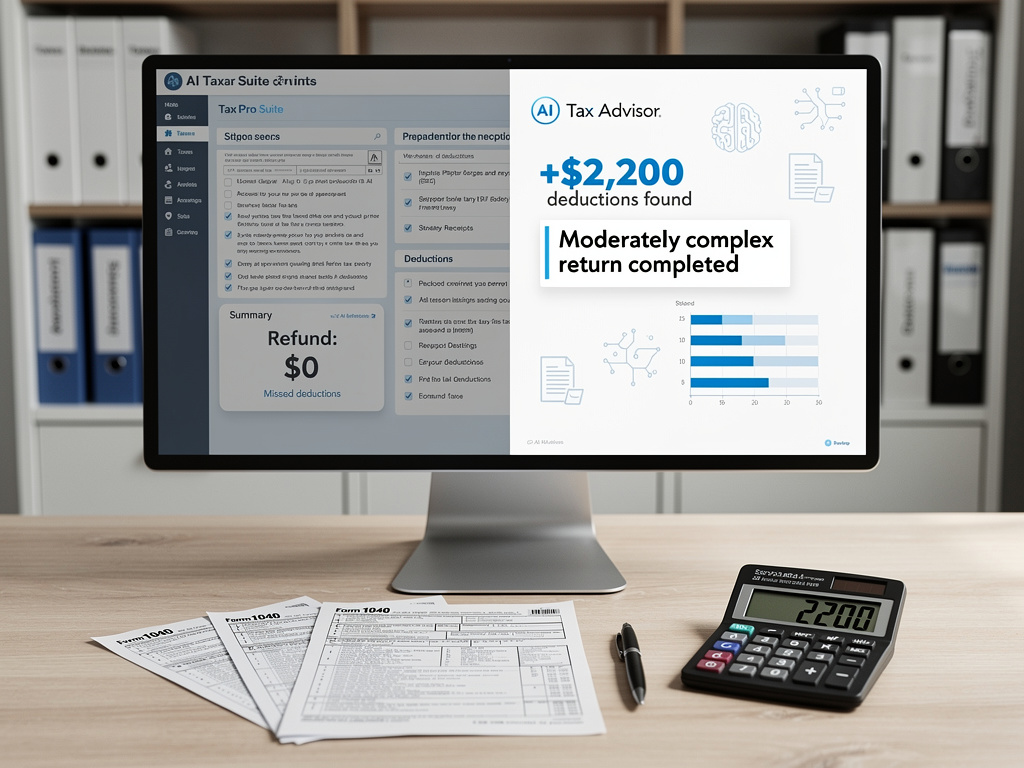
The results, according to the author, were striking. The AI-generated return matched the TurboTax-generated return from the prior year on every major line item, with two notable exceptions: the AI flagged a deduction the author had been missing for three years related to home office depreciation on the rental property, and it identified a more favorable method for calculating capital gains on certain investment sales. The author estimates these corrections were worth approximately $2,200 in combined tax savings.
The Trust Problem: Can You Really Let AI Do Your Taxes?
The obvious objection to AI-prepared tax returns is accuracy — and more specifically, liability. If TurboTax makes an error, Intuit offers an accuracy guarantee and will pay resulting penalties and interest. If an AI model hallucinates a deduction that doesn’t exist, the taxpayer is on the hook. The Kachess.dev author acknowledges this directly, noting that the AI approach requires a higher baseline level of tax literacy than simply clicking through TurboTax’s interview-style prompts.
The author’s mitigation strategy was straightforward: use the AI as a first-pass preparer, then manually verify every line item against source documents and IRS publications. This is, in effect, the same process a competent CPA would use — the AI drafts, the human reviews. The difference is speed. What might take a CPA several hours of billable time at $200 to $400 per hour took the developer roughly 90 minutes of review work, with the AI handling the initial heavy lifting in under five minutes.
A Market Ripe for Disruption — If Regulators Allow It
The tax preparation industry in the United States generates approximately $14.4 billion in annual revenue, according to IBISWorld. Intuit controls roughly 30% of the consumer tax preparation software market, with H&R Block holding another significant share. The remaining market is split among smaller software providers, independent CPAs, and enrolled agents. The introduction of capable AI tax tools threatens to compress the value proposition of all these players simultaneously.
Several startups have already entered this space. Companies like Keeper, which uses AI to identify deductions for freelancers, and newer entrants experimenting with full-return generation from document uploads, are targeting the exact pain points the Kachess.dev author describes. Meanwhile, the IRS’s own Direct File program — a free, government-run filing tool that launched as a pilot in 2024 and expanded for the 2025 filing season — represents a different kind of competitive threat to the incumbents, though it currently handles only simple returns.
The Technical Nuts and Bolts of AI Tax Filing
The Kachess.dev post goes into considerable technical detail about the workflow. The author used optical character recognition to extract data from PDF tax documents, then fed structured data into a large language model with a system prompt containing relevant sections of the Internal Revenue Code and IRS instructions. The model was asked to generate a completed Form 1040 and all applicable schedules, along with citations to the specific tax code sections justifying each entry.
This citation requirement is significant. One of the well-documented weaknesses of large language models is their tendency to generate plausible-sounding but incorrect information. By requiring the model to cite its sources — and then checking those citations against actual IRS publications — the author created a verification layer that substantially reduces the risk of AI-generated errors. The author reports that in two instances, the model cited tax code provisions that had been superseded by more recent legislation, but these were caught during the manual review process.
What Intuit and H&R Block Are Doing in Response
The major tax preparation companies are not standing still. Intuit has been integrating AI features into TurboTax for several years, including its “Intuit Assist” AI-powered assistant that launched for the 2024 tax season. H&R Block has similarly introduced AI-driven features. But these implementations are constrained by the companies’ existing business models — they need to add AI in ways that justify premium pricing tiers rather than in ways that make the entire product simpler and cheaper.
This creates an awkward dynamic. The incumbents are adding AI to make their products seem more sophisticated and worth paying for, while independent developers and startups are using the same underlying technology to argue that you don’t need the incumbents at all. The Kachess.dev author makes this point explicitly: the value of TurboTax was always its knowledge of the tax code and its ability to apply that knowledge to your specific situation. If an AI model can do both of those things — and do them better, based on the author’s experience — then what exactly are you paying TurboTax for?
The Broader Implications for Professional Services
Tax preparation is, in many ways, a canary in the coal mine for professional services more broadly. It involves applying a complex but well-documented set of rules to structured data — exactly the kind of task that modern AI models excel at. If AI can competently prepare a moderately complex individual tax return, the implications extend to bookkeeping, basic legal document preparation, financial planning, and other fields where the core work involves applying known rules to specific facts.
The Kachess.dev author is careful to note that AI tax preparation is not yet suitable for everyone. Taxpayers with very complex situations — multiple business entities, international income, estate planning considerations — would still benefit from a human CPA’s judgment and experience. But for the vast middle of American taxpayers — those with W-2 income, some investments, maybe a side business or rental property — the author argues that AI is already good enough, and getting better with each model generation.
The $2,200 Question
Perhaps the most provocative element of the Kachess.dev post is the claim that the AI found money that TurboTax had been leaving on the table. If true — and the author provides enough technical detail to be credible — this undermines the core promise of commercial tax software: that it will find every deduction you’re entitled to. The author speculates that TurboTax’s interview-based approach, which asks users to self-identify their deductions, inherently misses items that a more analytical, document-driven approach would catch. The AI, working from the raw data rather than from user responses to prompts, was able to identify deductions the user didn’t know to look for.
This is a powerful argument, and it cuts to the heart of why the tax preparation industry may be facing a genuine inflection point. The question is no longer whether AI can do taxes — it clearly can, at least for many filers. The question is how quickly mainstream taxpayers will trust it enough to make the switch, and whether regulators will create frameworks that hold AI-prepared returns to the same standards as those prepared by licensed professionals. For now, early adopters like the Kachess.dev author are blazing a trail. The rest of the market may not be far behind.


 WebProNews is an iEntry Publication