
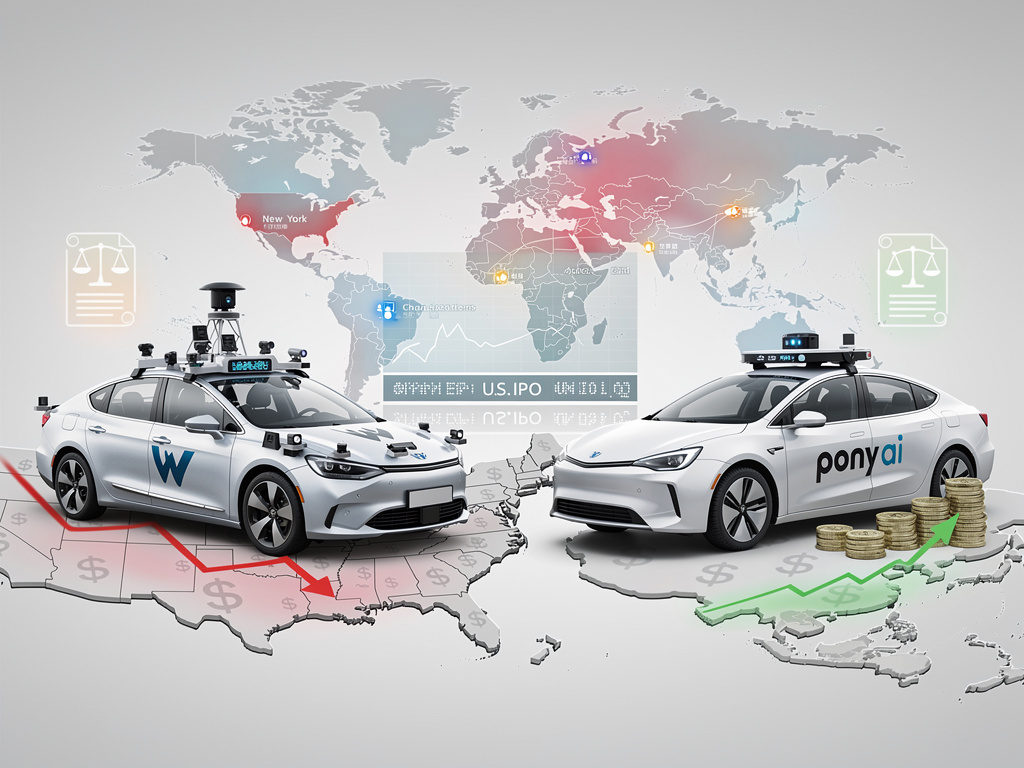
In the high-stakes race to automate urban mobility, a stark financial dichotomy has emerged between the American incumbent and its challengers across the Pacific. While Alphabet’s Waymo continues to pour capital into its operations, recently recording a burn rate of roughly $2.5 billion, a cohort of Chinese competitors is signaling that the path to profitability may be shorter, cheaper, and less reliant on the massive cash reserves that define Silicon Valley’s approach. This divergence in capital efficiency is not merely a matter of accounting; it represents two fundamentally different philosophies on how to scale autonomous driving hardware and software.
The numbers presented in recent financial disclosures paint a troubling picture for U.S. investors banking on a swift return from autonomous vehicle (AV) technology. According to a report by Benzinga, Waymo’s aggressive expansion into markets like Los Angeles and Austin has come at a staggering cost, with the unit’s losses contributing significantly to the wider operating deficit within Alphabet’s "Other Bets" division. In contrast, Pony.ai, a frontrunner in the Chinese market, is preparing for a U.S. initial public offering with a prospectus that suggests a far leaner operation, targeting a valuation of up to $4.5 billion.
The Unit Economics of American Autonomy
The primary driver of Waymo’s high expenditure lies in its vehicle platform and sensor suite. Currently, the fleet relies heavily on the Jaguar I-Pace, a premium electric SUV equipped with a complex array of custom LiDAR, radar, and cameras. The integration of this technology creates a vehicle with a unit cost that industry analysts estimate is significantly higher than a standard luxury vehicle. While Waymo does not publicly disclose the per-vehicle cost, the operational overhead required to maintain, charge, and remotely monitor these vehicles in complex U.S. traffic environments keeps margins suppressed.
Alphabet has attempted to mitigate investor concerns by highlighting ride volume growth. In their most recent earnings call, executives noted that Waymo is now facilitating over 150,000 paid trips per week. However, revenue generation does not equate to profitability. The infrastructure required to support these rides—including high-definition mapping, teleoperations support, and insurance—means that every mile driven currently costs the company more than it can recoup in fares. As CNBC reported following Alphabet’s Q3 earnings, the company is committed to the long-term vision, but the timeline for breaking even remains opaque.
Beijing’s Supply Chain Advantage
Conversely, Chinese firms like Pony.ai and WeRide benefit from a domestic supply chain that drastically reduces hardware costs. The electric vehicle (EV) market in China is characterized by fierce price wars, allowing AV developers to source base vehicle platforms at a fraction of the cost of their Western counterparts. Furthermore, the cost of LiDAR and other critical sensors has plummeted in China due to domestic mass production. This allows companies to outfit robotaxis with Level 4 autonomous capabilities without the prohibitive price tag associated with American hardware integration.
This cost advantage is compounded by a regulatory environment in China that has historically favored rapid deployment and testing. While U.S. regulators at the National Highway Traffic Safety Administration (NHTSA) have maintained a cautious stance, launching rigorous investigations into software safety following minor incidents, Chinese municipal governments have actively competed to host AV testing zones. This support reduces the legal and compliance overhead for firms like WeRide, allowing them to focus capital on fleet expansion rather than litigation and regulatory maneuvering. As noted in a recent filing analysis by Reuters, Pony.ai’s revenue growth has been accompanied by a narrowing net loss, a trajectory that appeals to institutional investors wary of indefinite cash burn.
The Geopolitical Firewall
Despite the favorable unit economics, Chinese AV firms face a precarious future in Western markets. The Biden administration has moved to restrict the import and sale of "connected vehicles" utilizing Chinese software and hardware, citing national security risks. This effectively walls off the U.S. market from the very vehicles that could theoretically undercut Waymo on price. However, this creates a bifurcated global market where Waymo may dominate North America, but Chinese firms could capture the vast majority of emerging markets in Southeast Asia, the Middle East, and South America, where price sensitivity outweighs geopolitical alignment.
The impending IPO of Pony.ai on the Nasdaq serves as a litmus test for U.S. investor appetite for Chinese tech amidst these tensions. The company is banking on its ability to commercialize trucking and robotaxi fleets simultaneously, a dual-revenue stream strategy that differs from Waymo’s primary focus on passenger ride-hailing. According to TechCrunch, Pony.ai’s filing reveals a strategy to mass-produce robotaxis with Toyota, further solidifying a manufacturing partnership that could outpace Waymo’s current manufacturing capabilities in terms of scale and speed.
Hardware Pivots and Future Platforms
Recognizing the unsustainability of its current burn rate, Waymo is in the process of transitioning its fleet. The company has announced a partnership with Geely’s Zeekr brand to produce a purpose-built robotaxi lacking a steering wheel and pedals. This vehicle is designed specifically for ride-hailing, with sliding doors and a flat floor, and crucially, it is expected to be manufactured at a much lower price point than the retrofitted Jaguars. However, the tariffs on Chinese-manufactured EVs imposed by the U.S. and potentially the EU complicate this strategy, forcing Waymo to navigate a complex logistics web to import these vehicles without erasing the cost savings.
Meanwhile, Tesla remains the wild card in this equation. The recent unveiling of the "Cybercab" promises a vehicle cost below $30,000, relying exclusively on camera-based vision rather than expensive LiDAR. While skepticism remains regarding Tesla’s timeline for true unsupervised Full Self-Driving (FSD), the mere promise of such a low-cost platform pressures Waymo to justify its expensive sensor stack. If Tesla succeeds in validating a vision-only approach, the billions Waymo has spent perfecting LiDAR integration could be viewed as an over-engineered solution to a problem solvable by cheaper means.
Regulatory Winds of Change
The regulatory landscape in the United States may be on the verge of a significant shift. Reports indicate that the transition team for the incoming Trump administration is exploring a federal framework to ease regulations on autonomous vehicles. Current rules limit the number of vehicles without traditional controls (like steering wheels) that a manufacturer can deploy. Lifting these caps would be a major boon for Tesla, but it would also accelerate Waymo’s ability to deploy its Zeekr-based fleet. Bloomberg reports that establishing a unified federal standard is a priority for the Department of Transportation under the new administration, potentially removing the state-by-state patchwork that has slowed deployment.
However, deregulation cuts both ways. While it lowers barriers to entry, it also invites competition from players who may have been held back by safety testing requirements. For Waymo, whose brand equity is built on an unblemished safety record and cautious rollout, a flood of less-tested competitors could erode public trust in the entire sector if accidents increase. The company must balance the need for speed with the imperative of safety, a dilemma its Chinese rivals have managed by leaning on state-sanctioned testing zones that isolate AVs from the most unpredictable traffic scenarios.
The Path to Sustainable Revenue
Ultimately, the battle between Waymo and its Chinese counterparts comes down to which model can reach sustainable margins first. Waymo is betting that its superior software stack and data advantage—accumulated over millions of autonomous miles—will justify a premium service that commands higher fares. They are positioning the robotaxi not just as a replacement for Uber, but as a safer, more consistent luxury experience. The Chinese model, exemplified by Pony.ai and WeRide, treats autonomy as a commodity to be deployed rapidly at scale, prioritizing market share and hardware efficiency over premium positioning.
The $2.5 billion burn rate is sustainable for Alphabet only as long as the search giant maintains its dominance in digital advertising. But as investors grow impatient with "moonshots" that fail to launch commercially, the pressure is mounting. The Chinese rivals have shown that it is possible to approach the precipice of profitability with a fraction of the capital. As these companies hit the public markets in New York, their financial disclosures will offer a transparent benchmark against which Waymo’s efficiency will be ruthlessly judged. The era of unlimited research budgets is ending; the era of operational discipline has begun.


 WebProNews is an iEntry Publication