
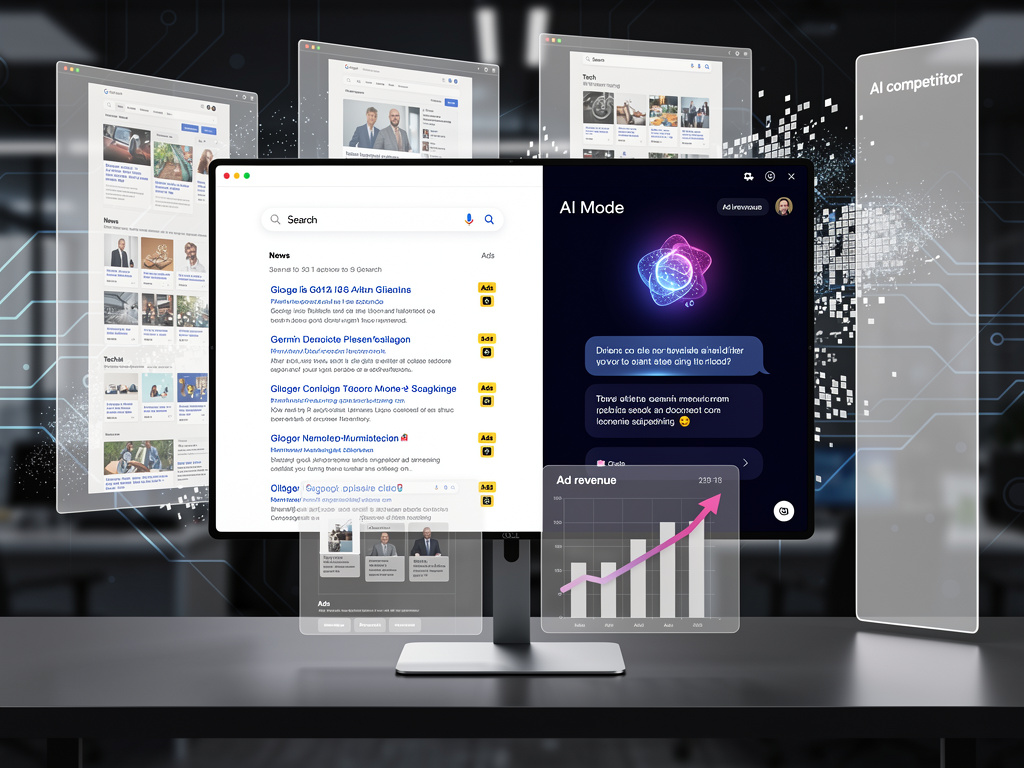
The fundamental architecture of the internet’s most profitable utility is undergoing a renovation so profound that the term “search engine” may soon feel like an anachronism. For two decades, the implicit contract between Google and its users was transactional: the user provided a keyword, and Google provided a map to a destination. However, recent updates to the Google app, specifically the integration of an “AI Mode” powered by the company’s most advanced Gemini models, signal that this contract is being rewritten. We are moving from an era of retrieval to an era of reasoning, a shift that carries massive implications for the digital economy.
This transition is no longer theoretical or confined to opt-in experiments like the Search Generative Experience (SGE). As reported by Android Central, Google is actively refining the mobile experience to prioritize conversation over clicks. The introduction of a dedicated “AI Mode” within the Google app suggests a bifurcation of the user experience: one path for traditional indexing and another for generative synthesis. This is not merely a UI tweak; it is a defensive fortification against a new wave of competitors seeking to dismantle Google’s monopoly on user intent.
The Architecture of Intent
The mechanics of this shift rely heavily on the deployment of Google’s Gemini 1.5 Pro and Flash models directly into the search infrastructure. Unlike previous iterations of search algorithms which focused on ranking signals and backlink authority, the new “AI Mode” relies on context windows and reasoning capabilities. The goal is to keep the user within the Google ecosystem for the duration of the query lifecycle. By surfacing a toggle or a distinct interface, Google is acknowledging that “searching” and “chatting” are becoming synonymous behaviors for modern users.
Industry insiders have watched closely as Google attempts to balance inference costs with query latency. The integration of these models serves to reduce the friction of follow-up questions. In the traditional model, refining a search required a new query; in the AI-centric model, it requires only a conversational nudge. According to analysis by The Verge, the deployment of Gemini 1.5 Flash is specifically designed to handle this high-volume, low-latency reasoning, allowing the search engine to summarize vast amounts of data without the sluggishness that plagued early LLM implementations.
Gemini’s Integration and the Latency War
The user interface updates spotted in the wild—such as the floating action button transforming into the Gemini sparkle or the “Q” icon for queries—are visual metaphors for a backend overhaul. The distinction is critical: traditional search is stateless, while AI search is stateful. The system must remember the previous turn of the conversation to make sense of the current one. This requires a computational overhead that dwarfs the cost of a standard keyword fetch. Google’s push to refine this experience, as noted in the Android Central breakdown, indicates they are confident enough in the efficiency of their Tensor Processing Units (TPUs) to roll this out to a broader audience.
This technical confidence is necessary because the competitive vector has shifted. It is no longer enough to have the largest index; one must have the smartest synthesizer. With OpenAI testing its own search prototypes and startups like Perplexity gaining traction among power users, Google’s “AI Mode” is a direct response to the threat of vertical search capabilities. Reuters recently highlighted how competitors are targeting the “answer engine” market, forcing Google to cannibalize its own interface to prevent users from drifting to platforms that offer direct answers without the noise of ten blue links.
The User Interface as a Battleground
The specific changes to the Google app interface are subtle but psychological. By labeling the interaction as a mode or a distinct state, Google is training users to understand that they are engaging with an agent rather than a database. This anthropomorphizing of the search bar is designed to increase dwell time. If a user feels they are “collaborating” with Google rather than just using it, the switching costs to a competitor increase. The “refined experience” mentioned in recent reports is essentially an engagement loop designed to mimic the sticky nature of social media feeds, but applied to information retrieval.
However, this shift creates a paradox for the open web. The “AI Mode” effectively places a hermetic seal over the content it summarizes. For the user, this is convenient; for the publisher, it is potentially catastrophic. As the AI becomes more adept at parsing complex queries and surfacing the “needle in the haystack,” the necessity for the user to click through to a source diminishes. Search Engine Land has documented the rising anxiety among SEO professionals who fear that this “zero-click” future will starve independent websites of traffic, fundamentally altering the economics of content creation.
Cannibalization and the Publisher Dilemma
The implementation of Gemini into the core search experience forces a re-evaluation of the symbiotic relationship between Google and publishers. In the past, Google needed content creators to populate its index. In the AI era, Google needs content creators to train its models, but the output of those models often negates the need for the user to visit the creator. The “AI Mode” creates a walled garden where Google is both the gatekeeper and the destination. This centralization of information consumption is likely to draw regulatory scrutiny as it matures, particularly in the European Union where digital sovereignty is a priority.
Furthermore, the data provenance within these AI summaries remains a point of contention. While Google attempts to link to sources within the AI overview—often via “chips” or footnote-style citations—the click-through rates on these elements are historically lower than traditional organic search results. The industry is watching to see if the new “refined experience” includes more aggressive citation methods or if it continues to privilege the synthesized answer over the source material.
The Monetization of Reasoning
The elephant in the room remains monetization. Google’s empire was built on the proximity of ads to intent. When a user searches for “best running shoes,” the intent is commercial, and the ads are relevant. In a conversational “AI Mode,” inserting advertisements is more complex. A jarring banner ad breaks the illusion of a helpful assistant. Therefore, the industry expects Google to innovate new ad formats that are native to the conversation—perhaps sponsored suggestions within the AI’s reasoning chain or “promoted queries” that guide the user toward specific vendors.
Ultimately, the rollout of these features signifies that Google is willing to disrupt its own cash cow to survive the platform shift. The company is betting that by controlling the AI interface, they can eventually figure out the economics, much like they did with the shift from desktop to mobile. As noted in broader industry analysis by Wired, the risk of inaction is far greater than the risk of imperfect monetization. If users form a habit of consulting ChatGPT or Perplexity for their daily questions, Google loses not just queries, but the raw data required to train the next generation of models.


 WebProNews is an iEntry Publication