
For years, private credit was the darling of institutional and retail investors alike — a seemingly bulletproof asset class that promised equity-like returns with bond-like stability. Now, cracks are forming in that narrative, and the tremors are being felt from Blackstone’s Manhattan headquarters to the offices of every major alternative asset manager on the Street.
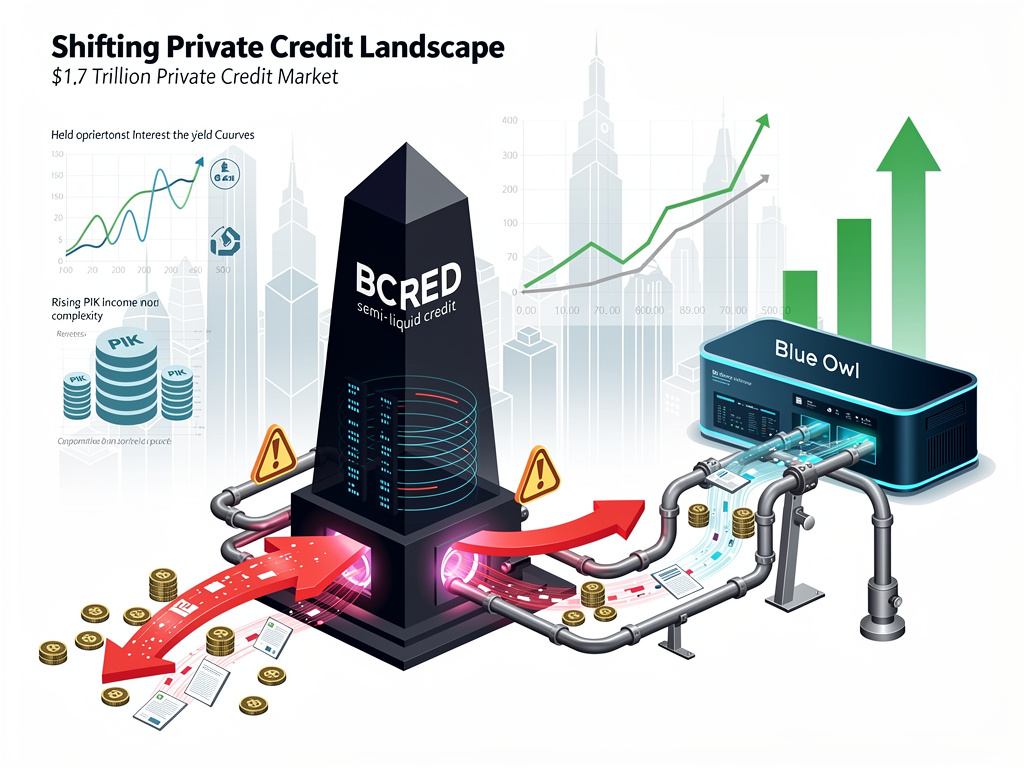
Blackstone’s flagship private credit fund, known as BCRED — formally Blackstone Private Credit Fund — has been experiencing a notable uptick in redemption requests, a development that has caught the attention of industry watchers and competitors alike. According to Business Insider, the fund has seen investors increasingly lining up to pull their money, raising pointed questions about whether the broader private credit boom is entering a more challenging phase.
Blackstone’s BCRED: From Crown Jewel to Cautionary Signal
BCRED, which launched in 2021, quickly became one of the largest business development companies (BDCs) in the world, amassing tens of billions of dollars in assets. The fund was designed to give wealthy individual investors access to the kind of direct lending strategies that had previously been the exclusive province of pension funds and sovereign wealth vehicles. Blackstone marketed BCRED aggressively, and for good reason: the fund delivered attractive yields in a low-rate environment, and its quarterly liquidity provisions — while limited — offered something resembling flexibility compared to traditional locked-up private equity structures.
But the calculus has shifted. As interest rates rose sharply beginning in 2022 and have remained elevated, the underlying borrowers in BCRED’s portfolio — predominantly middle-market and upper-middle-market companies carrying floating-rate debt — have come under increasing pressure. Payment-in-kind (PIK) income, where borrowers pay interest with more debt rather than cash, has been rising across the private credit industry, a sign that some companies are struggling to service their obligations. Investors, watching these dynamics unfold, have begun requesting redemptions at a pace that has drawn scrutiny.
Redemption Queues and the Liquidity Mismatch Problem
The structure of funds like BCRED has always contained an inherent tension: they invest in illiquid private loans but offer periodic redemption windows to investors. When times are good and inflows exceed outflows, this mismatch is manageable. But when sentiment turns and redemption requests spike, fund managers face difficult choices. They can gate redemptions — limiting the percentage of the fund that can be redeemed in any given quarter — or they can sell assets at potentially unfavorable prices to meet withdrawal demands.
Blackstone has previously demonstrated its willingness to use gating mechanisms. In late 2022 and into 2023, its non-traded real estate investment trust, BREIT, famously hit its redemption caps, sparking a firestorm of media coverage and investor anxiety. While BCRED has not yet reached the same level of crisis, the pattern of rising redemption requests is unmistakable. As Business Insider reported, the trend has not gone unnoticed by competitors, particularly Blue Owl Capital, which has been positioning its own private credit offerings as alternatives with different structural features.
Blue Owl and Competitors Smell Opportunity in Blackstone’s Discomfort
Blue Owl Capital, which has rapidly grown into one of the most significant players in the private credit space, has been actively courting investors who may be souring on BCRED. The firm has emphasized the structural differences in its own funds, including longer lock-up periods that it argues better align with the illiquid nature of the underlying assets. Blue Owl’s pitch is straightforward: if you’re investing in private credit, don’t pretend it’s liquid. Accept the lock-up, and in exchange, benefit from potentially more stable portfolio construction without the risk of forced selling to meet redemptions.
This competitive dynamic is playing out across the alternative asset management industry. Firms like Ares Management, Apollo Global Management, and Owl Rock (now part of Blue Owl) have all been expanding their private credit platforms, and each is watching Blackstone’s redemption pressures closely. The fear — and the opportunity — is that a sustained period of outflows from BCRED could reshape how the entire semi-liquid private credit fund category is perceived by financial advisors and their clients.
The Broader Private Credit Market Faces a Reckoning
The challenges facing BCRED are not occurring in isolation. The private credit market has ballooned to an estimated $1.7 trillion globally, according to recent estimates from Preqin and the International Monetary Fund. This explosive growth has drawn repeated warnings from regulators, including the Federal Reserve and the Financial Stability Board, about the potential for hidden risks in a market that operates largely outside the traditional banking system.
Default rates in private credit, while still relatively low by historical standards, have been ticking upward. Moody’s and S&P Global have both flagged rising stress among leveraged borrowers, particularly in sectors like healthcare, software, and consumer services that were heavily financed by private credit during the 2020-2021 boom. The concern is that many of these loans were underwritten at peak valuations with aggressive leverage multiples, and the combination of higher interest rates and slowing economic growth could lead to a wave of restructurings.
PIK Income: The Canary in the Coal Mine
One of the most closely watched metrics in private credit right now is the proportion of income being received as PIK rather than cash. When a borrower elects to pay interest in kind — essentially adding to its debt burden rather than making cash payments — it can be a sign of financial distress, or at least of cash flow pressure. Several publicly traded BDCs have reported increases in PIK income over the past several quarters, and industry analysts have flagged this as a potential early warning signal.
For funds like BCRED, rising PIK income creates a dual problem. First, it raises questions about the quality of the portfolio’s earnings. Second, it can reduce the cash available to the fund for distributions and redemptions, since PIK income is non-cash by definition. Investors who were attracted to private credit for its yield may find that an increasing share of that yield exists only on paper, at least in the near term.
Financial Advisors Caught in the Crossfire
The redemption pressures at BCRED have also put financial advisors in an awkward position. Many wealth managers enthusiastically recommended private credit funds to their high-net-worth clients during the low-rate era, touting the asset class as a superior alternative to traditional fixed income. Now, with clients asking questions about liquidity and portfolio quality, advisors are having to manage expectations — and in some cases, explain why their clients can’t access their money as quickly as they’d like.
This dynamic is particularly acute in the independent broker-dealer and registered investment advisor channels, where private credit products were sold heavily. The due diligence processes at these firms are now under a microscope, and several industry sources have indicated that new allocations to semi-liquid private credit funds have slowed meaningfully in recent months. Blackstone, for its part, has maintained that BCRED’s portfolio remains healthy and that the fund continues to generate attractive risk-adjusted returns. The firm has pointed to its deep credit expertise and extensive resources as differentiators that should give investors confidence.
What Comes Next for the Semi-Liquid Fund Model
The fundamental question raised by BCRED’s redemption pressures is whether the semi-liquid fund structure — which has been the primary vehicle for democratizing access to private credit — is fit for purpose. Critics argue that offering quarterly redemptions on a portfolio of illiquid loans is inherently problematic, creating the illusion of liquidity that can evaporate precisely when investors need it most. Defenders counter that gating provisions exist for exactly this reason and that investors who understood the product’s terms should not be surprised by occasional redemption delays.
The debate has implications far beyond Blackstone. The entire alternative asset management industry has been racing to create semi-liquid products aimed at the wealth channel, viewing it as the next great growth frontier. If investor confidence in these structures erodes, it could slow the flow of retail capital into alternatives more broadly — a development that would have significant consequences for firms whose growth strategies depend on capturing a larger share of the estimated $80 trillion in individual investor wealth.
A Stress Test for Private Credit’s Biggest Players
For now, the situation at BCRED remains manageable rather than existential. Blackstone has enormous resources, a diversified business, and a track record of successfully managing through periods of investor anxiety, as it demonstrated with BREIT. But the redemption trend bears close watching, both for what it says about BCRED specifically and for what it signals about the private credit market more broadly.
The coming quarters will serve as a critical stress test — not just for Blackstone, but for the entire semi-liquid alternative investment model. If redemption pressures stabilize and credit quality holds, the industry may look back on this period as a temporary bout of indigestion. If, however, defaults rise and redemption queues lengthen, the private credit boom could face its most serious challenge yet. Either way, the era of unquestioned enthusiasm for private credit appears to be giving way to something more sober — and for an industry built on the promise of superior risk-adjusted returns, that recalibration may ultimately prove healthy, even if it’s painful in the short term.


 WebProNews is an iEntry Publication