
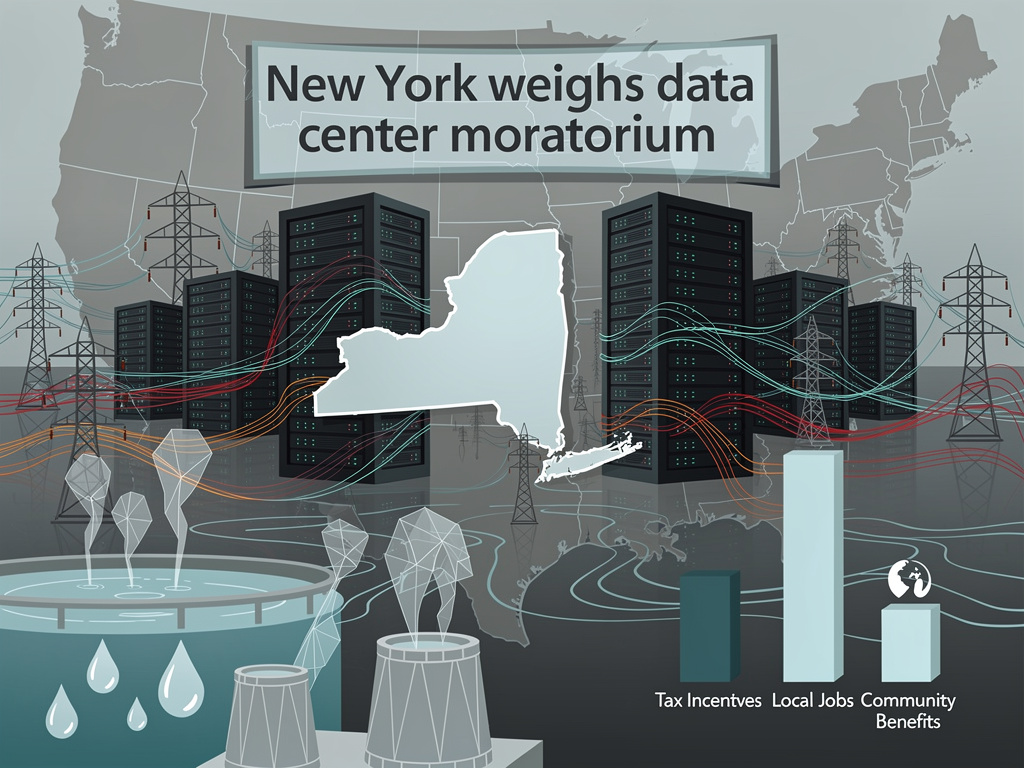
The insatiable appetite of artificial intelligence has triggered an unprecedented building boom in data centers across the United States. But as these massive facilities proliferate—consuming enormous quantities of electricity and water while straining local infrastructure—a political backlash is gathering force. New York has become the latest state to consider a moratorium on new data center construction, joining a growing chorus of jurisdictions that are questioning whether the economic promises of the AI revolution justify the environmental and civic costs being imposed on their communities.
The proposed legislation in New York, introduced in the state legislature in 2025, would impose a temporary halt on the permitting and construction of new data centers while lawmakers and regulators study the cumulative impacts of these facilities on the state’s power grid, water resources, and climate goals. As Wired reported, the bill reflects mounting anxiety among state officials that the rapid proliferation of data centers threatens to undermine New York’s ambitious climate commitments under the Climate Leadership and Community Protection Act, which mandates a 70 percent reduction in greenhouse gas emissions by 2030 and carbon neutrality by 2050.
A Surge in Demand That Is Outpacing the Grid
The scale of the data center boom is staggering. Across the country, technology companies including Microsoft, Google, Amazon, and Meta are racing to build the computing infrastructure needed to train and run increasingly powerful AI models. According to industry estimates, U.S. data center power consumption could double or even triple by 2030, driven almost entirely by artificial intelligence workloads. In New York, this surge is particularly acute because the state’s electrical grid is already under strain, and the transition to renewable energy sources has not kept pace with the explosive growth in demand.
The concern is not abstract. In communities across upstate New York, residents have watched as former industrial sites and farmland have been eyed for massive data center campuses that would each consume as much electricity as a small city. Local utilities have warned that accommodating these facilities could require billions of dollars in grid upgrades, costs that could ultimately be passed on to ratepayers. Environmental groups have raised alarms that data centers could force the state to keep fossil fuel power plants running longer than planned, or even build new natural gas infrastructure, directly contradicting the state’s decarbonization timeline.
New York Is Not Alone in Pushing Back
New York’s proposed moratorium is part of a broader national trend. Virginia, which hosts the largest concentration of data centers in the world in its so-called “Data Center Alley” in Loudoun County, has seen fierce local opposition to further expansion. In 2024, several Virginia counties imposed their own restrictions or moratoria on new data center projects after residents complained about noise, light pollution, and the industrialization of formerly rural areas. Georgia, South Carolina, Indiana, and other states have also seen legislative proposals or local actions aimed at slowing or regulating data center growth.
The backlash has been fueled in part by a reassessment of the generous tax incentives that states and localities have historically offered to lure data center developers. Critics argue that these incentives—which can include property tax abatements, sales tax exemptions, and reduced utility rates—often fail to deliver proportional economic benefits. Data centers are capital-intensive but employ relatively few workers compared to other industrial facilities of similar size. A facility that costs hundreds of millions of dollars to build may employ only a few dozen full-time workers once operational, a ratio that has led some lawmakers to question whether the tax breaks are a wise investment of public resources.
The Water Problem No One Wants to Talk About
Beyond electricity, water consumption has emerged as a flashpoint in the data center debate. Many large data centers use evaporative cooling systems that consume millions of gallons of water annually. In regions already facing water stress—including parts of the American West and increasingly the Northeast during drought conditions—this demand has sparked fierce opposition. As Wired noted, the water issue has been particularly galvanizing for community groups, who argue that prioritizing data center cooling over residential and agricultural water needs represents a fundamental misallocation of a shared public resource.
In New York, the water question intersects with broader environmental justice concerns. Many proposed data center sites are located in lower-income communities or communities of color that already bear disproportionate environmental burdens. Advocates have argued that allowing massive new industrial facilities to be sited in these areas without comprehensive environmental review perpetuates longstanding patterns of inequity. The proposed moratorium would, among other things, require a thorough assessment of the cumulative environmental justice impacts of data center development across the state.
Industry Pushes Back, Warning of Economic Consequences
The data center industry and its allies have pushed back forcefully against moratorium proposals. Trade groups representing technology companies and data center developers argue that pausing construction would drive investment to other states or even overseas, costing New York jobs, tax revenue, and a strategic position in the AI economy. They point out that data centers are critical infrastructure underpinning everything from cloud computing and e-commerce to healthcare systems and financial markets, and that restricting their growth could have cascading effects across the broader economy.
Industry representatives have also argued that the sector is making significant strides in sustainability. Major technology companies have committed to powering their data centers with 100 percent renewable energy, and some are investing in advanced cooling technologies that dramatically reduce water consumption. Microsoft, for example, has pledged to be carbon negative by 2030, while Google has committed to operating on 24/7 carbon-free energy at all of its data centers by the same year. Proponents say that a moratorium would penalize companies that are actively working to minimize their environmental footprint and could slow the deployment of the very AI technologies that might help solve climate challenges.
The Political Calculus Behind the Moratorium Movement
The politics of data center moratoria are more complex than a simple environment-versus-industry framing suggests. In New York, the proposed pause has drawn support from an unusual coalition that includes environmental groups, community organizations, fiscal conservatives skeptical of corporate tax breaks, and even some local officials who have grown frustrated with what they describe as a lack of transparency and community input in the data center permitting process. The legislation’s sponsors have framed it not as an outright ban but as a prudent pause—a chance for the state to develop a coherent regulatory framework before the buildout proceeds further.
At the same time, some labor unions have expressed reservations about moratorium proposals, noting that data center construction projects provide well-paying building trades jobs. The tension between construction employment and long-term operational employment is a recurring theme in the debate: while the building phase of a data center can employ hundreds or even thousands of workers, the permanent workforce is typically a fraction of that number. Navigating this tension will be a key challenge for lawmakers as they weigh the competing interests at stake.
What a Moratorium Would—and Wouldn’t—Accomplish
Supporters of the New York moratorium acknowledge that a temporary pause is not a permanent solution. The goal, they say, is to create space for the state to develop comprehensive siting standards, updated environmental review processes, and a clear framework for evaluating the cumulative impacts of data center development on the grid, water systems, and local communities. Without such a framework, they argue, the current ad hoc approach to permitting risks locking in infrastructure decisions that could undermine the state’s climate goals for decades to come.
Critics counter that a moratorium could set a dangerous precedent, signaling to the technology industry that New York is hostile to investment. They also warn that the regulatory process could drag on far longer than intended, effectively becoming a de facto ban. The experience of other jurisdictions suggests that moratoria can be difficult to lift once enacted, particularly if the political dynamics that produced them remain in place. In Virginia, for example, some local moratoria have been extended multiple times as communities continue to grapple with the pace of data center growth.
The Broader Question: Who Benefits from the AI Boom?
At its core, the debate over data center moratoria is a debate about who benefits from the AI boom and who bears its costs. The profits generated by artificial intelligence flow overwhelmingly to a handful of large technology companies and their shareholders, while the environmental and infrastructure burdens are distributed across communities that may see little direct benefit. This asymmetry has fueled a growing sense among residents and local officials that the current model of data center development is extractive—drawing on public resources like electricity, water, and tax incentives while returning relatively little to the communities that host these facilities.
As New York’s legislature takes up the moratorium proposal in the months ahead, the outcome will be closely watched by policymakers, industry executives, and community advocates across the country. The state’s decision could help set the terms of a national conversation about how to balance the enormous economic potential of artificial intelligence with the very real costs it imposes on the physical world. Whether New York chooses to pause or proceed, the era of unchecked data center expansion appears to be drawing to a close—replaced by a more contentious and politically fraught process of negotiation over the terms on which the AI revolution will be built.


 WebProNews is an iEntry Publication