
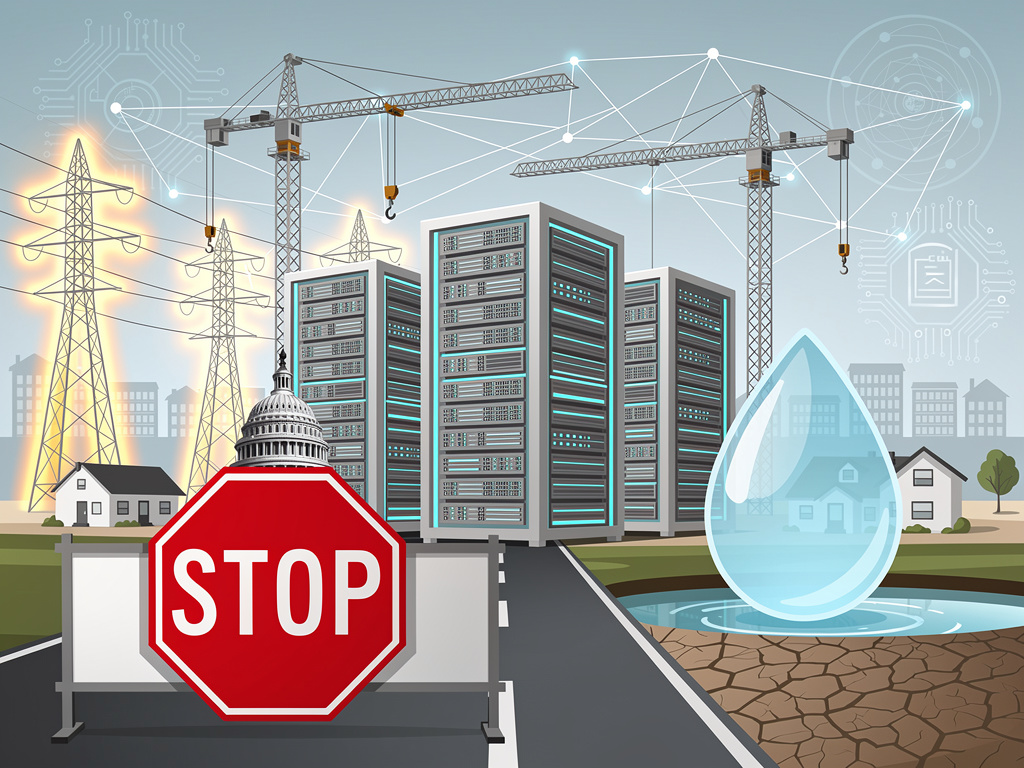
A new bill introduced by Senator Bernie Sanders and Representative Alexandria Ocasio-Cortez would impose a five-year moratorium on the construction of large-scale data centers in the United States — a direct challenge to the explosive buildout being driven by artificial intelligence demand. The legislation, called the No Data Centers on Public Lands Act and a companion moratorium proposal, takes aim at what its sponsors describe as an unchecked expansion that threatens energy grids, water supplies, and working-class communities. Whether or not the bill advances in a Republican-controlled Congress, it signals that political resistance to Big Tech’s infrastructure ambitions is crystallizing in ways the industry can no longer dismiss.
The scale of what’s underway is staggering. According to the International Energy Agency, global data center electricity consumption is projected to more than double by 2030, reaching roughly 945 terawatt-hours — equivalent to the entire electricity consumption of Japan. In the United States alone, data center power demand is expected to triple over the same period, as reported by Reuters. Meta, Microsoft, Amazon, and Google have collectively committed hundreds of billions of dollars to new facilities, many of them designed to serve the insatiable computational appetite of large language models and generative AI systems.
Sanders didn’t mince words. “Congress is way behind where it should be in understanding the nature of this revolution and its impacts,” he said in a statement accompanying the bill’s introduction, as reported by TechRadar. The Vermont independent has framed the data center expansion as fundamentally a question of who benefits and who pays. In his telling, tech billionaires reap profits while rural communities absorb the costs — higher electricity bills, strained water systems, and the noise and disruption of massive industrial construction.
Ocasio-Cortez has echoed that framing, pointing to constituent complaints in communities where data centers have arrived or are proposed. The pair’s legislation would halt construction of facilities exceeding 100,000 square feet on federal lands and impose the broader moratorium while a comprehensive federal study examines the environmental, economic, and social effects of the buildout.
The bill’s chances of becoming law are slim. Very slim. Republicans broadly favor deregulation and have championed AI development as essential to maintaining U.S. competitiveness against China. The Trump administration has signaled enthusiastic support for data center construction, with executive orders aimed at streamlining permitting. But legislation doesn’t need to pass to matter. The Sanders-AOC proposal functions as a marker — a political statement that energy and resource costs of AI infrastructure are now a live issue on Capitol Hill.
And those costs are real.
Data centers are voracious consumers of electricity and water. A single large facility can draw as much power as a small city. In northern Virginia — home to the densest concentration of data centers on the planet — Dominion Energy has warned that meeting projected demand will require billions in new grid investment, costs that will inevitably be passed to ratepayers. The situation has grown acute enough that some utility commissions are pushing back. In Georgia, regulators have questioned whether ratepayers should subsidize infrastructure upgrades driven primarily by corporate data center customers, according to reporting by The Wall Street Journal.
Water is another flashpoint. Microsoft disclosed in its 2023 environmental report that its global water consumption rose 34% in a single year, largely driven by data center cooling needs. In drought-prone regions of the American West, this creates obvious tension. Communities in Arizona, Oregon, and parts of the Midwest have raised objections to proposed facilities, worried about competition for increasingly scarce water resources.
The environmental concerns extend to carbon emissions. Despite aggressive net-zero pledges from every major hyperscaler, actual emissions have been climbing. Google’s 2024 environmental report revealed that its greenhouse gas emissions had increased nearly 50% since 2019, driven largely by data center energy consumption. Microsoft acknowledged a similar trajectory. The problem is straightforward: renewable energy buildout, while accelerating, simply cannot keep pace with the rate at which AI workloads are growing. So companies are turning to natural gas, and in some cases exploring nuclear power, to fill the gap.
That nuclear angle has attracted significant attention. Microsoft signed a deal to restart a unit at Three Mile Island in Pennsylvania. Amazon has invested in small modular reactor technology. Google announced a partnership with Kairos Power to develop next-generation nuclear plants. These are long-term bets — none of them will produce meaningful power for years. In the interim, fossil fuels are picking up the slack, complicating the climate calculus considerably.
The Sanders-AOC bill reflects a broader populist skepticism about whether the AI boom’s benefits are being distributed fairly. Tech companies argue that data centers create jobs, generate tax revenue, and are essential to national security and economic competitiveness. Those arguments carry weight. But the jobs created by a typical data center, once construction is complete, are modest — often a few dozen permanent positions for a facility that consumes enormous public resources. Tax incentive packages, meanwhile, have come under scrutiny. Virginia, which has offered generous data center tax breaks for years, is now reconsidering the terms as the fiscal costs become clearer.
The tension isn’t confined to Congress. Local governments across the country are grappling with the same questions. In Chesterfield County, Virginia, officials recently imposed a temporary moratorium on new data center zoning applications to give the community time to assess cumulative impacts. Similar pauses have been enacted or considered in places like Prince William County, Virginia, and several municipalities in the Midwest. These aren’t radical environmentalist enclaves. They’re communities trying to manage growth that arrived faster than anyone anticipated.
Industry groups have responded predictably, arguing that a moratorium would cripple American competitiveness. The Data Center Coalition, a trade group representing major operators, has warned that restricting construction would push investment overseas — to countries with fewer environmental protections and less reliable energy grids. There’s some logic to this. If demand for AI compute is going to grow regardless, building in the U.S. under American environmental standards may be preferable to offshoring it. But the argument also serves as a convenient shield against any form of regulation or restraint.
The deeper question the bill raises is one of governance. Who decides where data centers get built, how much energy they consume, and who bears the costs? Right now, those decisions are made primarily by corporations and local officials, often in negotiations that lack transparency. Federal oversight is minimal. There is no national framework for assessing the cumulative impact of data center construction on the electrical grid, water systems, or communities. The Sanders-AOC legislation, whatever its legislative fate, is essentially an argument that such a framework is overdue.
Some observers have noted that the bill’s five-year timeline is impractical in an industry moving at breakneck speed. AI development isn’t going to wait for a congressional study. But proponents counter that the speed of the buildout is precisely the problem — that decisions being made now will lock in energy consumption patterns and infrastructure commitments for decades. A pause, they argue, isn’t about stopping progress. It’s about making sure someone is actually thinking about the consequences before another hundred billion dollars is poured into concrete and copper.
The political dynamics are complex. The AI data center buildout enjoys bipartisan support at the federal level, backed by both tech industry lobbying and national security arguments about competing with China. President Trump has publicly praised major data center announcements. Democrats are split — many support AI development while expressing concern about environmental and equity impacts. Sanders and Ocasio-Cortez represent the left flank of that debate, but their concerns resonate with a wider constituency than their progressive base alone.
Rural communities in red states are experiencing the same disruptions. Farmers in Iowa and Ohio have watched data centers arrive with promises of economic development, only to find their electricity rates climbing and their aquifers under pressure. The politics of this issue don’t map neatly onto partisan lines, which is exactly what makes it volatile.
Wall Street, for its part, has been largely bullish on the data center buildout. Real estate investment trusts specializing in data centers — Equinix, Digital Realty, and others — have seen their valuations climb. Capital expenditure projections from the hyperscalers suggest spending will remain elevated for years. Morgan Stanley estimated in a recent research note that U.S. data center capital expenditure could exceed $300 billion cumulatively by 2030. That kind of money creates its own gravitational pull, drawing in construction firms, equipment manufacturers, energy companies, and a vast supply chain.
But there are cracks in the consensus. Some analysts have begun questioning whether the current pace of investment is sustainable — or whether it’s getting ahead of actual revenue generation from AI services. The comparison to previous technology buildouts, including the fiber optic boom of the late 1990s, hangs in the air. Not everyone is convinced that the demand projections will materialize on schedule.
None of this means the Sanders-AOC bill will reshape the industry. It almost certainly won’t, at least not directly. But it is doing something that legislation often does even when it fails: changing the conversation. Six months ago, data center construction was discussed almost exclusively in terms of investment, jobs, and technological progress. Now, it’s also being discussed in terms of energy strain, water scarcity, community impact, and corporate accountability. That shift matters.
The tech industry has spent years cultivating an image of environmental responsibility — carbon-neutral pledges, renewable energy purchases, sustainability reports full of optimistic projections. The reality on the ground is messier. AI has fundamentally altered the math, and the industry’s environmental commitments are being tested as never before. Sanders and Ocasio-Cortez may not be able to stop the buildout. But they’re making sure the costs are part of the public record.
And in politics, that’s often where change begins.


 WebProNews is an iEntry Publication