
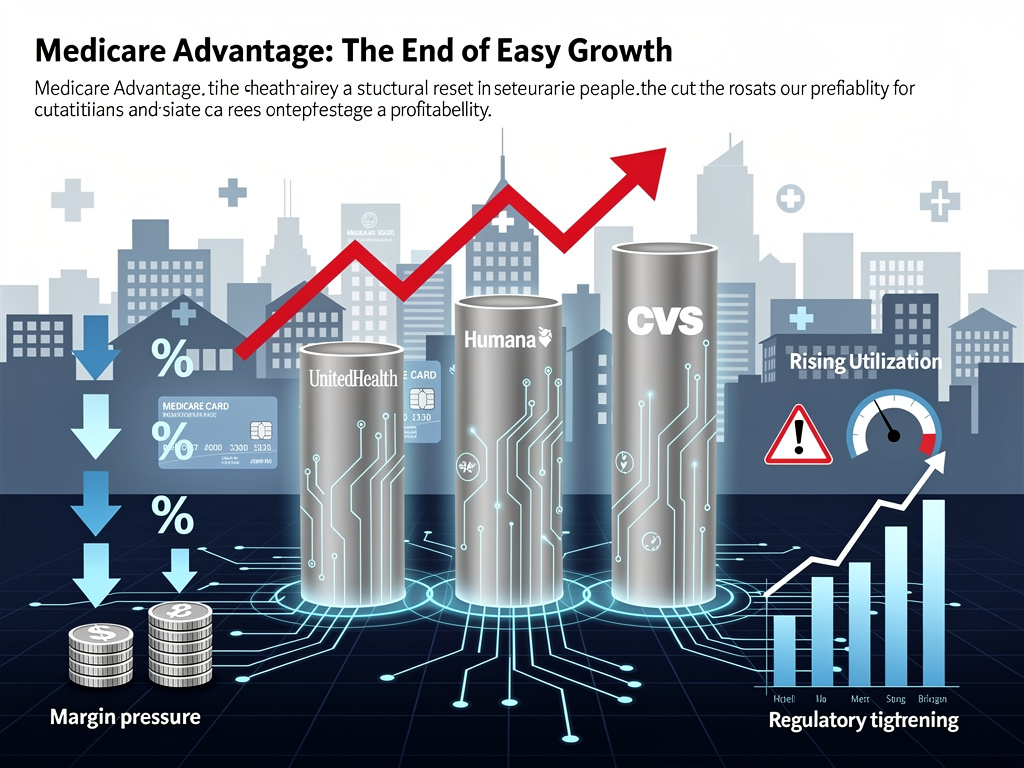
For over a decade, Medicare Advantage (MA) served as the reliable growth engine for the managed care sector, a veritable gold rush where demographics and government generosity intersected to fuel soaring stock prices. That era of predictable, double-digit earnings growth appears to have hit a structural wall. As major insurers look toward the 2026 and 2027 plan years, they are confronting a confluence of pressures—regulatory tightening, rising medical utilization, and a stricter reimbursement environment—that is forcing a fundamental revaluation of the sector. The narrative has shifted from aggressive expansion to margin preservation, creating a stark dichotomy between diversified giants and pure-play operators.
The catalyst for this reassessment lies in the forward-looking guidance emerging from Washington and Wall Street. Analysts are increasingly warning that the years ahead will not offer a return to the status quo but rather a rigorous stress test of business models. According to a recent detailed analysis, the outlook for 2026 and 2027 suggests that while the demographic tailwinds of an aging population remain, the profitability per member is under siege. As reported by Business Insider, industry observers caution that investors must brace for a prolonged period of recalibration, particularly for companies like Humana and CVS Health, which face distinct hurdles compared to their more diversified peer, UnitedHealth Group.
The Decoupling of Revenue and Profitability
The core of the current anxiety stems from the Centers for Medicare & Medicaid Services (CMS) and its evolving approach to reimbursement rates. For years, the gap between the effective rate increase and medical cost trends was wide enough to allow insurers to reinvest in rich supplemental benefits—gym memberships, dental coverage, and zero-premium plans—which in turn attracted more seniors. That dynamic has inverted. The latest advance notices and finalized rates from CMS have effectively offered flat to negative reimbursement growth when adjusted for risk model changes, specifically the phase-in of the V28 risk adjustment model. This model systematically reduces payments for certain diagnostic codes, stripping away a layer of revenue that insurers had baked into their long-term projections.
This regulatory tightening is occurring precisely as medical costs are accelerating. Post-pandemic utilization rates have remained stubbornly high, with seniors accessing outpatient surgeries and inpatient care at levels exceeding actuarial expectations. This mismatch creates a classic margin squeeze. Insurers are now in the precarious position of having to cut benefits to preserve margins, a move that risks alienating members during the crucial Annual Enrollment Period (AEP). The Centers for Medicare & Medicaid Services has signaled that its priority is stabilizing the solvency of the Medicare trust fund, implying that the private sector can no longer rely on the government to subsidize aggressive growth strategies.
UnitedHealth Group’s Defensive Moat
In this harsher environment, UnitedHealth Group (UNH) has emerged as the relative safe harbor, largely due to its vertical integration. While its insurance arm, UnitedHealthcare, faces the same rate pressures as its peers, its Optum division provides a massive internal hedge. Optum Health, which employs tens of thousands of physicians, captures the revenue that the insurance side pays out in medical claims. This circular economy allows UNH to absorb utilization spikes more effectively than competitors who must pay third-party providers. Furthermore, UnitedHealth’s scale allows for more granular data analytics, enabling them to navigate the risk adjustment changes with greater precision.
However, even the market leader is not immune to the sector-wide valuation compression. Investors are scrutinizing medical loss ratios (MLRs) with renewed intensity. A mere 50 basis point miss in MLR can trigger a massive sell-off, as seen in recent quarterly cycles. The market is effectively demanding that UNH demonstrate it can maintain its target margins of 4% to 5% in its Medicare book despite the headwinds. The consensus is that while UNH is best positioned to weather the storm, the days of easy earnings beats are likely over, replaced by a grind-it-out execution game where operational efficiency is paramount.
Humana’s Existential Challenge
Conversely, Humana finds itself in the eye of the storm. As a company that derives the vast majority of its earnings from Medicare Advantage, it lacks the diversification buffers of its larger rival. The pressure is compounded by a significant drop in its Star Ratings—a quality metric system used by CMS to determine bonus payments. A reduction in Star Ratings is a double blow: it directly reduces revenue per member and prevents the insurer from bidding as competitively on plans, potentially leading to market share losses. This vulnerability has forced Humana to engage in a painful restructuring, signaling to the market that it prioritizes margin recovery over membership growth for the 2026-2027 cycle.
The strategic pivot for Humana involves exiting unprofitable markets and slashing supplemental benefits, a risky maneuver in a commoditized market where seniors are highly price-sensitive. Financial analysts have noted that Humana’s recovery trajectory is steep, requiring not just a stabilization of medical costs but also a successful appeal or remediation of its Star Ratings. Speculation regarding potential M&A activity has swirled around the company, as reported by Reuters, though regulatory antitrust concerns make any large-scale consolidation difficult. For now, Humana represents the high-beta trade in the sector: a potential turnaround story if rates stabilize, but a falling knife if utilization trends worsen.
CVS Health and the Integration Struggle
CVS Health occupies a complex middle ground, grappling with the integration of its Aetna acquisition while managing a turbulent retail pharmacy environment. The Aetna unit has faced significant challenges in pricing its Medicare Advantage book correctly, leading to negative surprises in medical costs. Unlike UnitedHealth, which has spent decades integrating its provider and payer arms, CVS is still in the early innings of synergizing its erratic components—Oak Street Health, Signify Health, and Aetna. The market has punished CVS for this lack of visibility, resulting in a depressed valuation that reflects deep skepticism about its near-term earnings power.
Management at CVS has promised a “margin recovery” focused on 2025 and 2026, pledging to prioritize profitability over membership gains. This implies a willingness to shrink the Medicare book if necessary, shedding members in regions where the math no longer works under the new CMS rate regime. This discipline is welcomed by shareholders but creates operational friction. As the company attempts to steer the ship, it must also contend with the Wall Street Journal reporting on broader industry headwinds, which highlights that the aggressive pricing strategies of the past are now liabilities. The pressing question for CVS is whether it can fix its actuarial models fast enough to prevent further earnings erosion in 2026.
The Political and Regulatory Variable
Looming over the financial metrics is the unpredictable nature of Washington politics. With the Medicare trust fund solvency becoming a central talking point, neither political party has a strong incentive to increase payments to private insurers, especially when recent audits suggest established overpayments. The “Medicare for All” rhetoric may have subsided, but it has been replaced by a bipartisan consensus on “Medicare Advantage accountability.” This translates to stricter audits on risk adjustment coding and a more rigorous Star Ratings methodology, effectively raising the bar for earning quality bonuses.
Industry insiders are closely watching the appointment of CMS administrators and the tone of the Department of Health and Human Services. A regulatory environment that focuses heavily on curbing “upcoding”—the practice of making patients appear sicker than they are to increase payments—could strip billions from the sector’s top line. For the 2027 outlook, the hope among insurers is that the rate notices will eventually normalize to reflect the higher medical cost baseline. However, betting on a regulatory bailout has historically been a losing strategy in healthcare investing.
The Role of Pharmacy Benefit Managers (PBMs)
Another layer of complexity is the ongoing scrutiny of Pharmacy Benefit Managers (PBMs), which are integral profit centers for UNH (OptumRx), CVS (Caremark), and Cigna (Evernorth). As the government squeezes the MA side, insurers have historically leaned on their PBM arms to subsidize operations. However, legislative efforts to reform PBM pricing transparency could threaten this cross-subsidization model. If PBM margins are compressed simultaneously with MA rate cuts, the diversified insurers lose one of their key levers for earnings smoothing.
This creates a scenario where operational excellence becomes the only differentiator. Companies can no longer rely on the opacity of the supply chain or the generosity of the government to hit their numbers. They must drive genuine clinical value—keeping patients out of the hospital through better primary care and disease management. This shifts the competitive advantage heavily toward those who own the care delivery assets, reinforcing the vertical integration thesis that UnitedHealth pioneered and CVS is desperately trying to replicate.
The Investor Playbook for 2026-2027
For institutional investors, the sector has transformed from a growth compounder to a value trap with turnaround potential. The days of buying the entire basket of managed care stocks are over; stock selection is now critical. The market is bifurcating into “quality” (UNH) and “turnaround” (HUM, CVS). The 2026-2027 timeframe viewed by analysts suggests a clearing event where the weaker players will be forced to shrink significantly to survive, while the stronger players will consolidate market share, albeit at lower margins than historically enjoyed.
Ultimately, the Medicare Advantage sector is undergoing a painful maturation process. The “growth at any cost” phase has ended, replaced by a focus on sustainable economics. For the industry giants, the next two years will be defined by their ability to navigate a hostile reimbursement terrain while managing an increasingly sick and utilizing population. The winners will be those who can effectively manage risk without the tailwind of government overpayment, marking a new, more disciplined chapter in the history of American healthcare.


 WebProNews is an iEntry Publication