
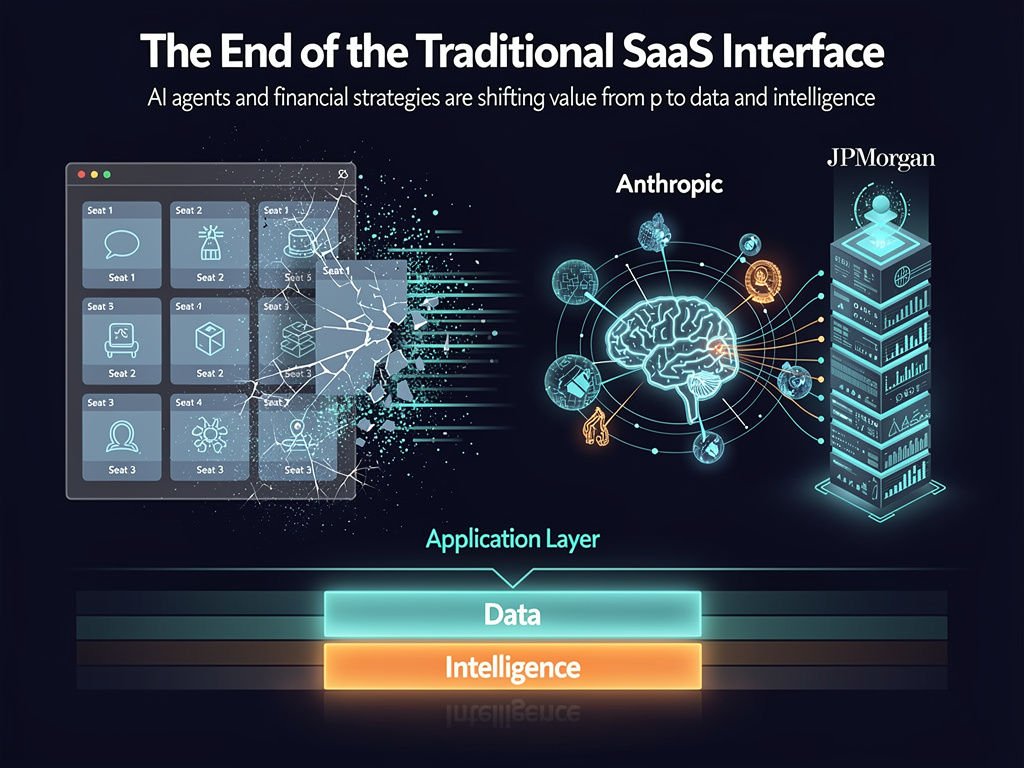
In the high-stakes corridors of Wall Street and the research labs of San Francisco, a consensus is quietly forming that threatens to upend the trillion-dollar business model of modern software. The thesis is stark: the era of the graphical user interface (GUI) as the primary mode of work is drawing to a close. As artificial intelligence evolves from passive chatbots into autonomous agents capable of manipulating software directly, the distinct application layer—the very heart of the Software-as-a-Service (SaaS) industry—is at risk of being bypassed entirely. According to a recent analysis by The Information, industry heavyweights like Anthropic and JPMorgan Chase are increasingly aligned on a future where AI does not merely assist users within an app but effectively acts as the user itself, rendering the visual interface obsolete.
This shift represents a fundamental architectural departure from the digitization waves of the past two decades. Where the cloud revolution moved on-premise servers to data centers, the agentic revolution promises to move human clicks to API calls. The implications for enterprise incumbents are profound. If an AI agent can interact directly with the backend of Salesforce, Workday, or SAP to execute complex workflows, the sticky, seat-based user interfaces that justify high recurring revenues may lose their dominance. The value proposition is shifting from the tool that facilitates the work to the intelligence that performs it.
The Rise of the Invisible Employee
The catalyst for this transformation is the rapid advancement of “computer use” capabilities within large language models. Anthropic, a leading AI safety and research company, recently demonstrated this capability with their upgraded Claude 3.5 Sonnet model. As detailed in their technical release, the model can now view a screen, move a cursor, click buttons, and type text, mimicking human interaction with startling accuracy. Anthropic notes that this development allows developers to direct Claude to use computers the way people do—by looking at a screen, moving a cursor, clicking buttons, and typing text. This is not merely an automation script; it is a generalized capability to navigate software designed for humans.
For enterprise giants like JPMorgan Chase, the allure of this technology lies in its ability to handle the “last mile” of manual data drudgery that traditional automation failed to capture. The bank has already begun rolling out its proprietary “LLM Suite” to over 140,000 employees, positioning it as a portal that could eventually abstract away the myriad of disjointed applications employees toggle between daily. As reported by Bloomberg, the bank’s massive deployment of generative AI tools underscores a strategy to internalize productivity gains rather than simply purchasing more external software seats. When the bank’s internal AI can navigate the ledger, the CRM, and the compliance portal simultaneously, the distinct branding and UI of those vendors become invisible plumbing.
The Existential Threat to Seat-Based Pricing
The economic ramifications of this shift are beginning to keep Silicon Valley venture capitalists awake at night. The traditional SaaS business model relies on charging for access—selling “seats” to humans who need to log in to perform tasks. However, if an autonomous agent is performing the work of ten humans, the justification for purchasing ten individual licenses evaporates. This creates a deflationary pressure on software pricing, forcing vendors to pivot toward outcome-based or consumption-based pricing models. Sequoia Capital has argued that the industry is moving toward “Service-as-a-Software,” where customers pay for the completed job—a closed ticket, a generated lead, a reconciled account—rather than the tool used to do it.
This transition threatens to commoditize the application layer. If the user interface is no longer the primary touchpoint, the “stickiness” of a software product is severely reduced. Historically, enterprise software maintained its moat through complex workflows and user familiarity; switching costs were high because retraining employees was expensive. However, AI agents do not need to be retrained in the same way humans do. They interact via code or visual interpretation, making it theoretically easier to swap out one backend provider for another, provided the data pipes remain accessible. This erosion of the interface moat is forcing incumbents to scramble for a new defensive position.
The Incumbents Strike Back: The Battle for the Agent Layer
Recognizing the danger of becoming mere data repositories, major software vendors are aggressively pivoting to own the agent layer themselves. Salesforce, the quintessential SaaS giant, has launched “Agentforce,” a suite of autonomous agents designed to work within the Salesforce ecosystem. In a direct challenge to Microsoft’s Copilot, Salesforce CEO Marc Benioff has criticized the “copilot” model as insufficient, arguing that enterprises need agents that can act without constant human hand-holding. As covered by TechCrunch, this move is a defensive play to ensure that if AI is going to eat the interface, it is Salesforce’s AI doing the eating, thereby preserving their control over the customer relationship.
Microsoft is executing a similar strategy but from the vantage point of the operating system and productivity suite. By embedding autonomous capabilities into Dynamics 365 and allowing users to build their own agents via Copilot Studio, they are attempting to make the “agent” synonymous with the Microsoft ecosystem. The battle lines are being drawn not over who has the best buttons or menus, but over who controls the orchestration layer—the brain that decides which apps to open and which data to pull. Whoever owns the agent owns the workflow, and by extension, the budget.
Data Gravity and the Context Window
As the interface dissolves, the competitive advantage in enterprise software is shifting toward data gravity and context. The ability of an AI agent to function effectively is entirely dependent on the quality and accessibility of the data it can reason over. This elevates the importance of the context window—the amount of information an AI model can process at one time. With models now capable of ingesting millions of tokens, the need for complex, pre-structured database queries is diminishing. Instead, massive amounts of unstructured documentation, email history, and transaction logs can be fed directly into the model’s context.
This technical shift favors platforms that already house the bulk of an enterprise’s unstructured data. It explains the feverish pace at which companies are trying to consolidate data silos. If an AI agent has to log into five different systems to answer a question, it is slow and brittle. If that data is unified in a data lake or accessible via a single robust API, the agent becomes exponentially more effective. Consequently, the value in the software stack is migrating downward to the data layer and upward to the intelligence model, squeezing the middle layer of workflow applications.
The Friction of Legacy Systems
Despite the high-level agreement between AI labs and banks on the future of automation, the reality on the ground remains messy. Enterprise environments are a labyrinth of legacy code, on-premise servers, and security protocols that were never designed to be accessed by autonomous agents. While Anthropic’s “Computer Use” can visually navigate a screen, doing so reliably across thousands of varied internal apps without hallucinating or triggering security flags is a massive engineering challenge. Reuters reports that while the potential is vast, early deployments are likely to be supervised and limited in scope to prevent costly errors.
Furthermore, the “human in the loop” remains a regulatory and operational necessity for high-stakes industries like finance and healthcare. An AI agent might be technically capable of approving a loan or finalizing a trade, but risk management frameworks require accountability that software cannot yet provide. Therefore, the immediate future is likely to be a hybrid model: AI agents handling the high-volume, low-risk navigation of apps, while humans retain the “seat” for judgment-based work. However, the ratio of humans to software seats is undoubtedly set to decline.
Redefining the Enterprise Architecture
The convergence of Anthropic’s technical breakthroughs and JPMorgan’s operational scale signals a maturing of the AI narrative from “chatting with data” to “executing work.” We are witnessing the early stages of an unbundling of the SaaS model, followed by a re-bundling around the AI agent. In this new architecture, the graphical user interface becomes a secondary feature, a debugging tool for humans rather than the primary workspace. The software that survives will be that which offers the best APIs, the most reliable data, and the most seamless integration with the autonomous workers of the future.
For industry insiders, the directive is clear: stop evaluating software based on its look and feel, and start evaluating it based on its agency and interoperability. The applications that are “eating” the enterprise today are not apps at all—they are intelligent, invisible threads weaving together the fragmented digital fabric of the corporation. The interface of the future is not a screen; it is a command.


 WebProNews is an iEntry Publication