
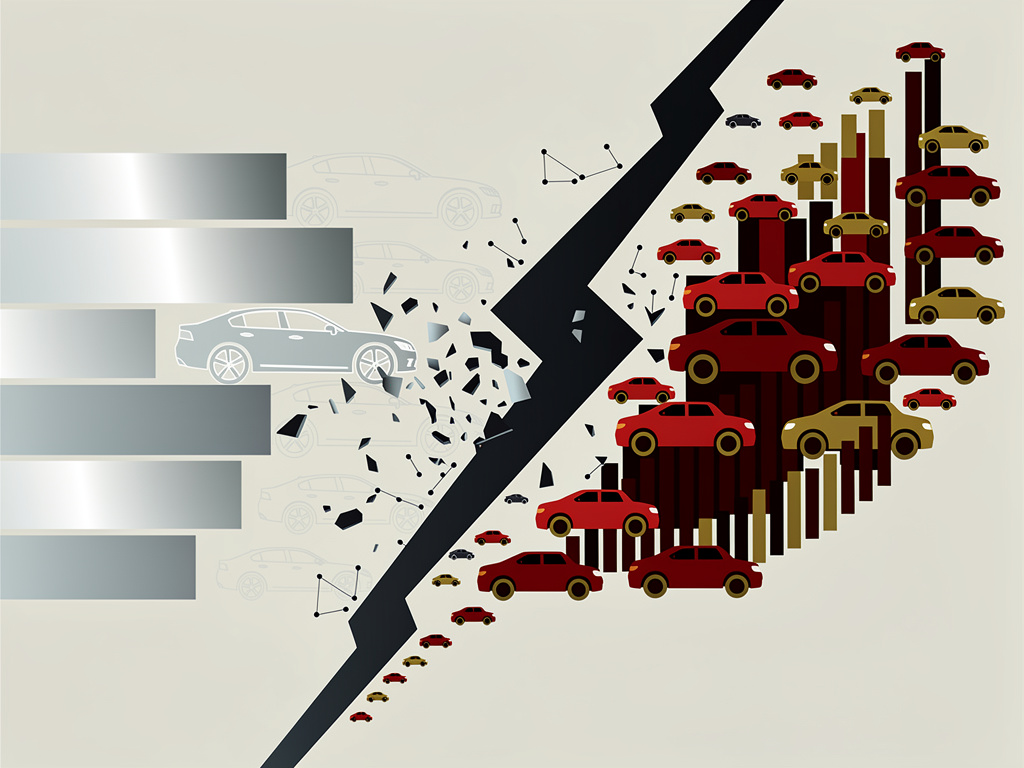
The electric vehicle future that automakers spent billions promising is being quietly dismantled, one canceled model at a time.
Over the past year, a parade of major manufacturers — from General Motors to Mercedes-Benz to Ford — have shelved, delayed, or outright killed planned electric vehicles. The reasons vary by company but converge on a single uncomfortable truth: the Western auto industry badly misjudged the speed, cost, and competitive dynamics of the EV transition. And now it’s scrambling to recalibrate while Chinese manufacturers eat their lunch.
As The Verge recently cataloged in exhaustive detail, the list of abandoned or postponed EV programs is staggering. General Motors killed the Chevrolet Bolt — its most affordable EV — before reversing course and promising a new version, only to push timelines further out. Ford delayed its next-generation electric SUV and pickup truck programs, citing the need to reduce costs. Mercedes-Benz pulled back its target of going all-electric by 2030, opting instead for a longer hybrid bridge. Volkswagen has wavered on factory timelines. Even Apple, the tech giant that spent a decade and billions of dollars on a secret car project, abandoned the effort entirely.
Not cold feet. A full-blown strategic retreat.
The proximate cause is demand softening — or at least demand not materializing at the pace projections assumed. EV sales in the United States grew in 2024, but the rate of growth decelerated. Early adopters are largely served. The next wave of buyers is more price-sensitive, more range-anxious, and less ideologically committed to going electric. They want affordable vehicles with practical range, and most Western automakers haven’t been able to deliver that profitably.
Which brings us to China. While legacy automakers in Detroit, Stuttgart, and Wolfsburg were publicly committing to electric futures but privately struggling with battery costs and software development, Chinese manufacturers were doing something different. They were shipping cars. BYD, the Shenzhen-based giant backed by Warren Buffett’s Berkshire Hathaway, overtook Tesla in global EV sales in late 2023 and hasn’t looked back. Its vehicles are cheaper, increasingly sophisticated, and available in markets across Asia, Europe, Latin America, and Africa. The company’s Seagull hatchback — a fully electric city car — sells for around $10,000 in China. Nothing from Detroit comes close.
BYD isn’t alone. Nio, Xpeng, Li Auto, Geely, and dozens of smaller Chinese EV makers are flooding global markets with competitively priced vehicles. According to Reuters, Chinese-brand vehicles accounted for roughly a quarter of all EV sales in Europe in recent months, up from negligible share just three years ago. The speed of this market capture has alarmed European policymakers enough to impose tariffs — the European Union finalized additional duties on Chinese-made EVs in late 2024 — but the competitive pressure hasn’t abated.
The tariff response extends to the United States as well. The Biden administration imposed 100% tariffs on Chinese EVs in 2024, effectively barring them from the American market. But that wall may not hold forever, and it doesn’t address the underlying problem: Chinese manufacturers have achieved cost structures that Western automakers can’t match. Vertical integration is a big part of it. BYD makes its own batteries, its own semiconductors, and much of its own software. It controls the supply chain in ways that GM and Ford, dependent on third-party suppliers and joint ventures, simply don’t.
Then came the Trump factor.
President Trump’s return to office in January 2025 introduced a new layer of uncertainty. His administration moved swiftly to roll back EPA tailpipe emissions standards that had been a primary regulatory driver of EV adoption. Trump has been openly hostile to EVs — calling them too expensive and unreliable — while simultaneously courting Tesla CEO Elon Musk as a political ally. The contradiction hasn’t gone unnoticed. As The Verge pointed out, the administration’s broader tariff regime, including sweeping duties on imports from multiple countries, has created cost chaos across the auto supply chain, affecting EV and combustion vehicle production alike.
The regulatory whiplash matters enormously. Automakers plan product cycles five to seven years in advance. Billions of dollars in tooling, factory construction, and supplier contracts get committed based on assumptions about what regulations will require and what consumers will want half a decade from now. When the regulatory signal flips — from “you must electrify” under Biden to “we don’t care if you electrify” under Trump — it doesn’t free automakers. It paralyzes them.
Ford’s situation illustrates the bind. The company has reportedly lost billions on its Model e electric vehicle division since its creation. Its F-150 Lightning, once heralded as the truck that would convert Middle America to electric driving, has seen demand plateau well below initial expectations. Ford CEO Jim Farley has been candid about the company’s need to find a profitable path to EVs — or face existential consequences. The company’s pivot toward hybrids, announced in early 2025, is an acknowledgment that the bridge technology it once dismissed still has a long road ahead.
GM tells a similar story with different details. CEO Mary Barra spent years positioning the company as a leader in the EV transition, pledging to phase out internal combustion engines by 2035. That target is now functionally dead. GM has delayed its Buick and Cadillac EV launches, restructured its Ultium battery partnership with LG, and leaned harder into plug-in hybrids. The Chevrolet Equinox EV, priced to compete at the mainstream level, has been a relative bright spot — but one model doesn’t constitute a strategy.
Across the Atlantic, the picture is equally turbulent. Volkswagen, which bet tens of billions of euros on its ID-series electric cars, has faced disappointing sales and factory utilization rates. The company announced plans to close some German factories — a politically explosive move in a country where auto manufacturing is a pillar of national identity. Mercedes-Benz, which once declared it would be “ready to go all electric” by 2030, has since backtracked to a more hedged position emphasizing customer choice and hybrid options. BMW, which was criticized for being slow to commit to EVs, now looks prescient for maintaining its combustion and hybrid lines.
Stellantis, the sprawling conglomerate formed from the merger of Fiat Chrysler and PSA Group, has its own challenges. Former CEO Carlos Tavares departed in late 2024 amid disagreements over the company’s EV strategy and cost structure. His successor faces the task of rationalizing a portfolio of 14 brands while navigating divergent regulatory demands across North America, Europe, and other markets.
So where does this leave the industry?
In a word: fractured. The global auto market is splitting along geopolitical lines. China dominates EV production and increasingly EV technology. The United States is retreating behind tariff walls while its domestic manufacturers try to close the cost gap. Europe is caught between its climate ambitions and the economic reality that its auto champions are losing ground to Chinese competitors. And consumers — the people who actually buy cars — are increasingly choosing hybrids as a compromise that offers some electrification without the range anxiety, charging hassle, or price premium of a full battery-electric vehicle.
Hybrid sales have surged. Toyota, long mocked by EV enthusiasts for its stubborn commitment to hybrid technology, is enjoying vindication. The company’s hybrid lineup is selling faster than it can build it. According to data from Cox Automotive, hybrids accounted for nearly 10% of all U.S. new vehicle sales in early 2025, a record. Plug-in hybrids — which offer a modest electric-only range plus a gasoline engine — are growing even faster from a smaller base.
This hybrid resurgence isn’t a rejection of electrification. It’s a market signal that the transition will be slower and messier than the industry’s most ambitious timelines assumed. Consumers want electrified options. They just don’t want to pay $50,000 for a vehicle with uncertain resale value, limited charging infrastructure, and a battery that might cost $15,000 to replace.
The charging infrastructure gap remains a persistent drag on adoption. Despite billions in federal funding allocated through the Bipartisan Infrastructure Law, the buildout of public fast-charging stations has been painfully slow. As of mid-2025, the National Electric Vehicle Infrastructure (NEVI) program has delivered a fraction of the stations originally projected. Bureaucratic requirements, utility interconnection delays, and permitting bottlenecks have all contributed. Tesla’s Supercharger network remains the most reliable option for long-distance EV travel in the U.S., giving Tesla an advantage that competitors haven’t been able to replicate.
Battery technology is advancing, but not fast enough to solve the cost problem in the near term. Solid-state batteries — long promised as the breakthrough that would deliver higher energy density, faster charging, and lower costs — remain years away from mass production. Toyota has been the most aggressive in targeting solid-state commercialization, but even its timelines have slipped. In the meantime, lithium-iron-phosphate (LFP) batteries, which are cheaper but heavier than nickel-based alternatives, have become the chemistry of choice for affordable EVs. Chinese manufacturers, particularly BYD and CATL, dominate LFP production.
That supply chain dominance is perhaps the most underappreciated dimension of China’s EV advantage. It’s not just that Chinese companies make cheaper cars. They control the critical minerals, the battery cell manufacturing, the cathode and anode material processing, and increasingly the software platforms that run modern EVs. The International Energy Agency has estimated that China accounts for roughly 75% of global lithium-ion battery cell production and an even higher share of upstream processing for materials like lithium, cobalt, and graphite. Building alternative supply chains in the U.S. and Europe is possible — the Inflation Reduction Act included massive incentives to do so — but it will take years and tens of billions of dollars.
And time is something legacy automakers may not have in abundance. Every quarter that passes without a competitive, affordable EV on dealer lots is a quarter where Chinese manufacturers deepen their hold on global markets. BYD’s expansion into Southeast Asia, the Middle East, and South America is accelerating. Its entry into Europe, though complicated by tariffs, is proceeding through local assembly partnerships. A BYD factory in Hungary is expected to begin production in 2025, giving the company a manufacturing foothold inside the EU’s tariff wall.
The competitive threat isn’t theoretical anymore. It’s here.
Some industry observers see a parallel to what happened to the Western consumer electronics industry in the 2000s, when Asian manufacturers — first Japanese, then Korean, then Chinese — systematically displaced incumbents through superior manufacturing efficiency and relentless cost reduction. The auto industry has historically been more insulated from this dynamic because of the complexity of vehicle manufacturing, the importance of dealer networks, and regulatory barriers. But EVs are simpler to build than combustion vehicles. Fewer moving parts. Fewer components. More software. The barriers that protected legacy automakers are eroding.
Tesla, for its part, occupies an unusual position. It remains the largest EV seller in the United States by a wide margin, but its global market share is declining as Chinese competitors scale up. The company’s political entanglements — Musk’s role in the Trump administration’s Department of Government Efficiency and his increasingly polarizing public persona — have created brand headwinds. Tesla deliveries declined in the first quarter of 2025 compared to the prior year, a first. Whether that’s a temporary blip or the beginning of a trend is one of the most consequential questions in the industry.
What’s clear is that the narrative of an inevitable, rapid, wholesale transition to battery-electric vehicles — the story that dominated auto industry conferences and investor presentations from roughly 2020 to 2023 — is over. The transition is still happening. EV sales globally continue to grow, driven overwhelmingly by China. But in the West, the path forward is muddled by political uncertainty, competitive disadvantage, consumer hesitation, and the stubborn economics of making affordable electric cars at a profit.
The automakers that survive this period will be the ones that manage three things simultaneously: they must keep investing in electrification even as short-term demand disappoints; they must find ways to close the cost gap with Chinese competitors, whether through better battery sourcing, simpler vehicle architectures, or manufacturing innovation; and they must maintain profitable combustion and hybrid businesses long enough to fund the transition.
That’s a brutally difficult triple mandate. And there’s no guarantee that all the current players will pull it off.
The great irony of the EV retreat is that it’s happening precisely when the technology is getting good enough to go mainstream. Battery costs have fallen dramatically over the past decade. Electric drivetrains are more efficient, more reliable, and more refined than ever. The vehicles themselves — when priced right — are genuinely compelling. The problem isn’t the technology. It’s the business model, the geopolitics, and the pace of change in an industry that has never moved this fast and clearly isn’t comfortable doing so.
The cars of the future will be electric. Almost everyone in the industry still believes that. But the road from here to there just got a lot longer, a lot more expensive, and a lot more uncertain than anyone wanted to admit.


 WebProNews is an iEntry Publication