
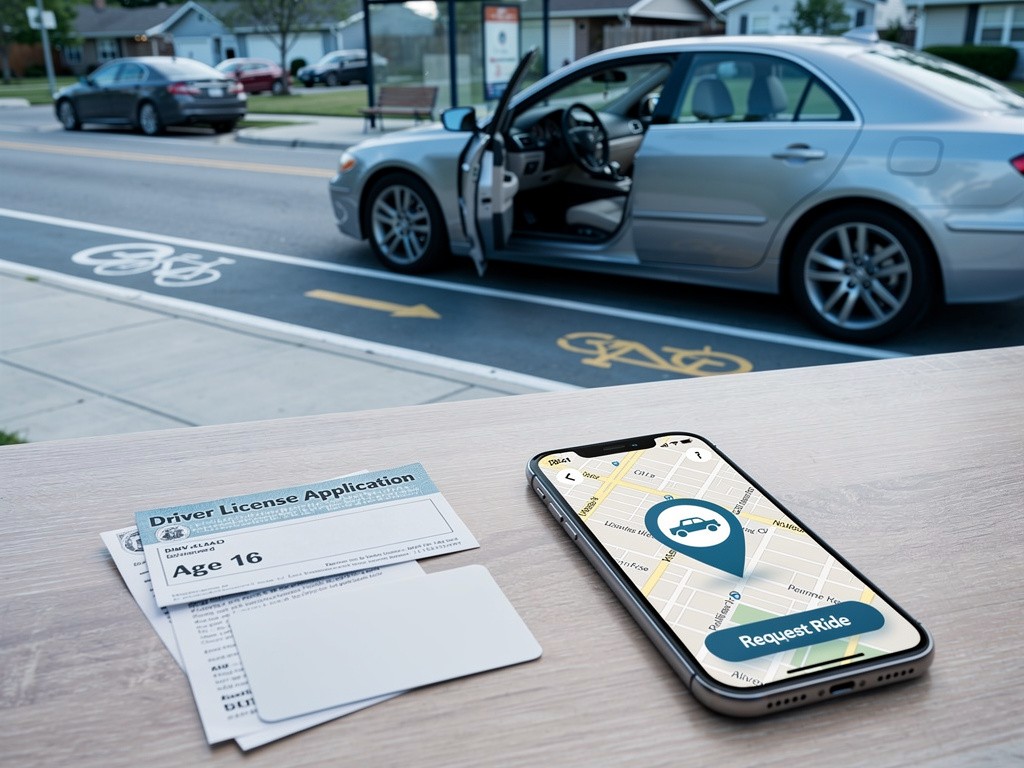
For decades, the 16th birthday in America carried a singular, almost sacred significance: it was the day a teenager could finally get behind the wheel. The driver’s license was more than a laminated card — it was a passport to independence, a symbol of adulthood, and the culmination of months spent white-knuckling through parking lots with a nervous parent in the passenger seat. But for Generation Z, that cultural milestone is rapidly losing its luster, and the implications are rippling through families, schools, urban planning offices, and the automotive industry itself.
A growing body of evidence suggests that today’s teenagers are in no rush to drive. According to Business Insider, the share of 16-year-olds with a driver’s license has plummeted compared to previous generations. Where Baby Boomers and Gen Xers once counted down the days until they could take the road test, many members of Gen Z are content to let their parents, rideshare apps, or simply their smartphones fill the void that a car once occupied. The shift is not marginal — it represents a fundamental rethinking of what mobility means for young Americans.
A Statistical Freefall Behind the Wheel
The numbers are stark. Federal Highway Administration data shows that in 1983, nearly half of 16-year-olds held a driver’s license. By 2020, that figure had dropped to roughly 25%. The decline has continued into the mid-2020s, with researchers noting that the trend accelerated during and after the COVID-19 pandemic. Teenagers who spent their formative driving years in lockdown simply never developed the urgency to get licensed, and many have found that the world adapted around them in ways that made driving less necessary.
As Business Insider reported, the phenomenon has created an unexpected burden on parents, many of whom find themselves serving as full-time chauffeurs well into their children’s college years. The carpool has become not just a convenience but a necessity in households where teenagers show little interest in obtaining a license. Some parents describe driving their 18- and 19-year-olds to jobs, social events, and even college campuses — a scenario that would have been nearly unthinkable a generation ago.
The Rideshare Generation and the Smartphone Effect
Several converging forces explain why Gen Z has cooled on driving. The most obvious is the rise of rideshare platforms like Uber and Lyft, which have made on-demand transportation available to anyone with a smartphone. For a generation that grew up with instant digital access to virtually everything, summoning a car with a few taps feels far more natural than maintaining a vehicle, paying for insurance, and navigating the bureaucratic gauntlet of a Department of Motor Vehicles office.
But technology’s role extends beyond ridesharing. Social media and digital communication have fundamentally altered the reasons teenagers once needed cars in the first place. In previous generations, driving was the gateway to socializing — you needed a car to see your friends, go to the mall, or cruise the strip on a Friday night. Today, Gen Z socializes through FaceTime, Discord, TikTok, and group chats. The physical imperative to be somewhere has been partially replaced by the digital ability to be everywhere at once, without ever leaving the couch. Researchers at the University of Michigan’s Transportation Research Institute have documented this shift extensively, noting that the decline in teen licensure correlates closely with the rise of smartphone adoption.
The Economics of Driving Have Turned Punishing
Cost is another powerful deterrent. The financial burden of car ownership has escalated dramatically for young people. Insurance premiums for teenage drivers have soared, with some families reporting annual costs exceeding $3,000 to $5,000 just to add a 16-year-old to a policy. The average price of a used car, which surged during pandemic-era supply chain disruptions, remains elevated. Gas prices, while volatile, add another layer of expense that many teenagers — and their parents — would rather avoid.
For Gen Z members entering the workforce in an era of stagnant entry-level wages and soaring costs of living, the calculus is simple: a car is an expensive liability, not an asset. Many young adults are prioritizing student loan payments, rent in increasingly expensive urban centers, and savings over the cost of vehicle ownership. According to data cited by multiple automotive industry analysts, new car affordability has reached its worst level in decades, with the average monthly payment on a new vehicle exceeding $700. For a generation already anxious about financial stability, that figure is a nonstarter.
Graduated Licensing Laws and Parental Anxiety
Regulatory changes have also played a role. Since the late 1990s, every U.S. state has adopted some form of graduated driver licensing, or GDL, which imposes restrictions on new teenage drivers — including nighttime driving curfews, passenger limitations, and extended supervised driving requirements. While these laws have been enormously successful in reducing teen traffic fatalities, they have also made the process of getting a license longer, more cumbersome, and less immediately rewarding for teenagers.
Parental attitudes have shifted in tandem. As Business Insider noted, many parents are themselves ambivalent about putting their children behind the wheel. In an era of heightened safety consciousness — fueled by constant news coverage of distracted driving accidents and social media awareness campaigns — some parents quietly prefer to remain their child’s primary driver rather than face the anxiety of a newly licensed teenager on the road. The result is a feedback loop: parents don’t push, teenagers don’t ask, and the license gets deferred indefinitely.
Urban Planning and the Transit Renaissance
Geography matters, too. In dense urban areas, where public transit systems offer viable alternatives, the decline in teen driving is even more pronounced. Cities like New York, San Francisco, Chicago, and Washington, D.C., have long had lower rates of teen licensure, but the trend is now spreading to suburban and even some exurban communities as transit options expand and mixed-use development brings amenities closer to residential neighborhoods.
The broader push toward walkable, transit-oriented communities — championed by urban planners and increasingly demanded by younger homebuyers and renters — is reshaping the built environment in ways that make car-free or car-light lifestyles more feasible. E-bikes and electric scooters have emerged as popular alternatives for short trips, particularly among Gen Z users who view them as more environmentally responsible and more fun than sitting in traffic. Companies like Lime and Bird have reported strong ridership growth among users under 25.
What the Auto Industry Stands to Lose — and Gain
The automotive industry is watching these trends with a mixture of concern and strategic recalibration. Fewer young drivers today means fewer car buyers tomorrow. Automakers have spent billions courting younger consumers through marketing campaigns, partnerships with influencers, and the development of tech-forward vehicles loaded with connectivity features. But if Gen Z never develops the emotional attachment to car ownership that defined their parents and grandparents, those investments may yield diminishing returns.
Some industry players are pivoting accordingly. Subscription-based car services, car-sharing platforms, and mobility-as-a-service models are all gaining traction as alternatives to traditional ownership. Companies like Toyota and Volkswagen have invested heavily in mobility ventures that decouple transportation from ownership, betting that the future customer may want access to a car without the commitment of a title and registration. Tesla, meanwhile, has positioned its robotaxi ambitions as the ultimate answer to a generation that wants to get from Point A to Point B without the hassle of actually driving.
A Cultural Identity Crisis on Four Wheels
Perhaps the most profound dimension of this shift is cultural. The car has been central to the American identity for more than a century — from Route 66 to the muscle car era to the minivan-driven suburbs of the 1990s. The driver’s license at 16 was not just a practical milestone but a narrative one, woven into countless coming-of-age films, songs, and family traditions. Its decline signals something deeper than a change in transportation preferences; it reflects a generational reimagining of freedom, independence, and what it means to grow up in America.
For Gen Z, freedom is less about the open road and more about the open internet. Independence is measured not in miles driven but in digital fluency, financial literacy, and the ability to craft a life that doesn’t depend on a 4,000-pound machine and a $60 tank of gas. Whether this represents progress or loss depends largely on whom you ask — but the data leaves little room for debate about the direction of the trend. The American teenager, once inseparable from the automobile, is charting a decidedly different course. And the rest of the country, from parents still serving as chauffeurs to automakers rethinking their business models, is scrambling to keep up.


 WebProNews is an iEntry Publication