
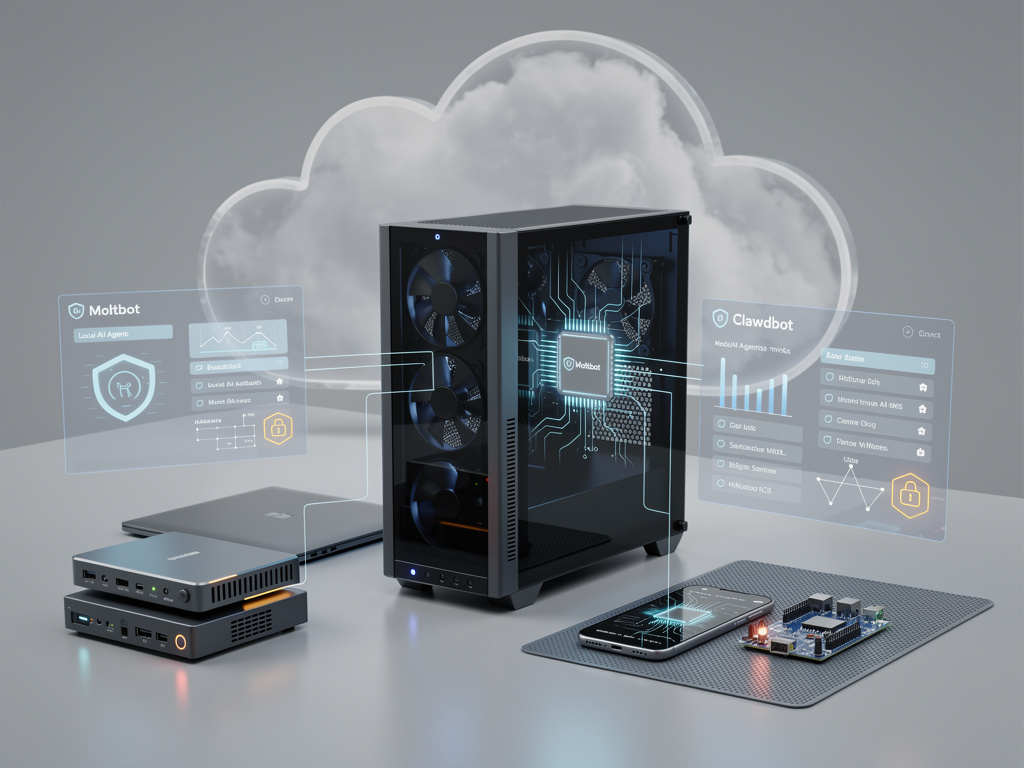
In the dimly lit corridors of GitHub repositories and Discord servers, a quiet insurrection is brewing against the centralized dominance of Silicon Valley’s AI giants. For the past two years, the narrative has been dictated by the massive, cloud-tethered data centers of OpenAI, Google, and Anthropic. However, a new report from The Verge highlights a pivotal shift in the ecosystem: the emergence of highly capable, local-first AI agents. Dubbed “Moltbot” and “Clawdbot,” these open-source tools represent a departure from the chat-based paradigm, moving toward autonomous agents that live on your hardware, not in the cloud.
This transition marks the beginning of the "Agentic Era," where artificial intelligence is no longer a passive oracle answering questions but an active participant in digital workflows. Unlike their predecessors, which relied on API calls to remote servers, Moltbot and Clawdbot are designed to run on consumer-grade silicon—specifically targeting the neural engines in Apple’s M-series chips and NVIDIA’s RTX cards. This localization addresses the two most significant bottlenecks in enterprise AI adoption: latency and data sovereignty. By severing the umbilical cord to the cloud, these agents promise a level of privacy and speed that SaaS models simply cannot match.
The Architecture of Autonomy
To understand why Moltbot and Clawdbot are generating such intense interest among industry insiders, one must look under the hood at the architecture of local agency. Moltbot, as detailed in recent technical breakdowns, utilizes a dynamic "molting" technique—essentially a localized mixture-of-experts (MoE) approach that swaps specialized model weights in and out of VRAM on the fly. This allows a machine with limited memory to punch above its weight class, performing coding tasks with one sub-model and creative writing with another, without the massive overhead of loading a 70-billion parameter model all at once.
Conversely, Clawdbot focuses on the "action layer." While Large Language Models (LLMs) predict text, Clawdbot is engineered to predict actions. It interfaces directly with the operating system’s accessibility API, effectively giving the AI "hands" to click, scroll, and type. According to a deep dive by Ars Technica, this capability allows for complex, multi-step workflows—such as scraping a website, formatting the data into a spreadsheet, and emailing it to a colleague—without human intervention. The synergy between Moltbot’s efficient processing and Clawdbot’s execution capabilities creates a potent alternative to subscription-based services like ChatGPT Plus.
Economic Implications for the SaaS Sector
The rise of competent local agents poses an existential query for the current software-as-a-service market. If a local instance of Clawdbot can autonomously manage a user’s calendar, draft replies, and organize files without sending a single byte of data to a third-party server, the value proposition of monthly AI subscriptions begins to erode. We are witnessing a potential return to the "buy once, run forever" software model, but powered by constantly evolving open-source weights. This threatens the recurring revenue models that have propped up tech valuations for the last decade.
Furthermore, the cost arbitrage is impossible to ignore. For enterprise CIOs, the bill for API tokens from providers like OpenAI can be staggering. Running agents locally shifts the cost from OpEx (operational expenditure on APIs) to CapEx (capital expenditure on hardware). As noted in a financial analysis by Bloomberg, companies are increasingly calculating the break-even point where buying a fleet of high-end GPUs becomes cheaper than renting intelligence from the cloud. Moltbot’s efficiency makes that break-even point accessible even to small and medium-sized businesses.
Privacy as the Ultimate Feature
Beyond economics, the driving force behind the adoption of tools like Moltbot is the absolute necessity of data privacy. In highly regulated industries such as finance, healthcare, and legal services, the idea of piping sensitive client data into a black-box API is a non-starter. Local agents offer a "sovereign AI" solution. The data never leaves the local machine or the corporate intranet. This air-gapped capability allows for the integration of AI into workflows that were previously off-limits due to compliance and security concerns.
Security researchers, however, warn that this power comes with its own set of risks. A local agent like Clawdbot, which has permission to control a mouse and keyboard, could theoretically be manipulated by prompt injection attacks to perform harmful actions on the user’s machine. A report from Wired emphasizes that while local AI eliminates the risk of data leaks to the cloud, it introduces the risk of "rogue execution," where an agent might misunderstand a command and delete critical files or send unauthorized communications. The industry is currently scrambling to develop "guardrail" protocols that sit between the LLM and the OS to prevent such catastrophes.
The Hardware Renaissance
The software breakthroughs of Moltbot and Clawdbot are inextricably linked to a renaissance in consumer hardware. The demand for local inference is pushing chipmakers to prioritize NPU (Neural Processing Unit) performance over raw clock speed. We are seeing a divergence in the market: while data centers demand massive H100 clusters, the edge computing market is optimizing for high-bandwidth memory (HBM) on laptops and desktops. This hardware-software flywheel is accelerating at a pace that traditional software development cycles cannot match.
This shift is also revitalizing the custom PC market. Builders are no longer just optimizing for gaming framerates but for "tokens per second" (TPS). Community benchmarks for Moltbot performance have become a standard metric on forums, replacing 3DMark scores as the bragging right of choice. Tom’s Hardware has begun including local LLM inference speeds in their GPU reviews, acknowledging that for a growing segment of users, the graphics card is primarily a math coprocessor for their digital employees.
The Developer Ecosystem and Open Source
The speed at which Moltbot and Clawdbot have evolved is a testament to the power of the open-source community. Unlike proprietary models developed in silos, these tools are iterated upon daily by thousands of contributors. A bug fix or optimization discovered by a developer in Tokyo is pushed to GitHub and available to a user in San Francisco within hours. This decentralized development model is proving to be more agile than the monolithic release schedules of corporate AI labs.
This democratization of development also means that the "moat" for AI companies is shrinking. If a community can build a local agent that performs 90% as well as GPT-4 for free (excluding hardware costs), the premium for proprietary models must be justified by vastly superior capabilities or unique features. As the gap narrows, the pressure on closed-source providers to innovate increases. The ecosystem is becoming a battleground between the convenience of the cloud and the control of the local environment.
Navigating the Unregulated Frontier
As these local agents become more capable, they are entering a legal and ethical gray zone. There are currently no regulations governing the use of autonomous AI agents running on private hardware. While the EU AI Act attempts to regulate high-risk systems, enforcing these rules on decentralized, open-source software running on personal computers is virtually impossible. This creates a "Wild West" scenario where the capabilities of the software are limited only by the hardware it runs on and the ingenuity of the user.
The emergence of Moltbot and Clawdbot signals that the AI revolution is entering its second phase: distribution. The technology is diffusing from the center to the edges, empowering individuals with capabilities that were once the domain of supercomputers. For industry insiders, the message is clear: the future of AI is not just in the cloud; it is sitting on your desk, waiting for a command.


 WebProNews is an iEntry Publication