
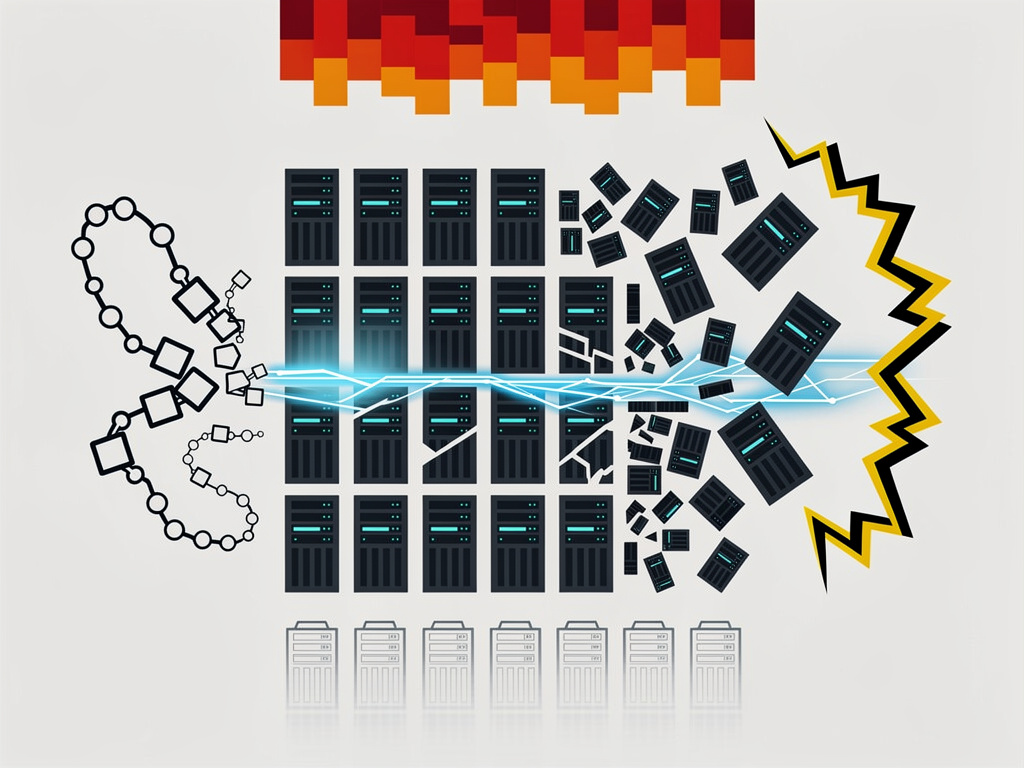
The American data center boom was supposed to be unstoppable. Hundreds of billions of dollars committed. Massive campuses announced in every corner of the country. Governors holding press conferences. CEOs making bold promises about artificial intelligence infrastructure that would reshape the economy.
It’s not working out that way.
Nearly half of all U.S. data center capacity planned for delivery in 2026 has been canceled or pushed back, according to a report from TD Cowen cited by TechRadar. The figures represent a staggering reality check for an industry that, just months ago, seemed poised for the most aggressive expansion in its history. And the situation could deteriorate further as tariffs, power constraints, and supply chain fractures compound one another in ways that few executives anticipated when they signed their initial commitments.
The TD Cowen analysis pegs the disruption at roughly 45% of planned 2026 capacity. That’s not a rounding error. That’s a structural problem.
What makes this moment particularly treacherous is the cascading nature of the failures. Data center construction depends on an intricate web of components arriving on schedule — electrical switchgear, backup generators, cooling systems, transformers, fiber optic cabling, and the AI-optimized chips that give these facilities their purpose. As one industry executive told researchers, “If one piece of your supply chain is delayed, then your whole project can’t deliver.” That single sentence captures the fragility underlying what many assumed was an invincible building spree.
The proximate cause of much of the disruption is tariffs. The Trump administration’s trade policies have driven up costs on imported electrical equipment, steel, and specialized components sourced from Asia and Europe. Data centers are extraordinarily materials-intensive. A single hyperscale facility can require thousands of tons of steel, miles of copper wiring, and custom-manufactured power distribution units that often have lead times measured in years, not months. When tariffs add 10%, 20%, or in some cases more than 50% to the cost of these inputs, project economics shift dramatically. Developers who locked in pricing assumptions 18 months ago are now staring at budget overruns that make their original pro formas untenable.
But tariffs alone don’t explain the full picture. Power availability — or rather, the lack of it — has emerged as the single greatest bottleneck constraining data center growth in the United States. According to reporting from multiple industry sources, utility interconnection queues in key markets like Northern Virginia, Dallas, Phoenix, and parts of the Midwest have stretched to five, seven, even ten years. That means a developer who secures land and financing today may not be able to energize a facility until the early 2030s. For an industry racing to meet AI demand that’s accelerating on a quarterly basis, those timelines are catastrophic.
The power problem is multidimensional. It’s not just about generation capacity. Transmission infrastructure — the high-voltage lines that carry electricity from power plants to substations and ultimately to data center campuses — hasn’t kept pace with demand. Transformers, the critical devices that step voltage up and down across the grid, are in desperately short supply globally. Domestic transformer manufacturing capacity is limited, and imports face both long lead times and, now, tariff exposure. A large power transformer can take 18 to 24 months to manufacture and deliver under normal circumstances. These are not normal circumstances.
Some of the biggest names in technology are directly affected. Microsoft, Amazon, Google, and Meta have collectively committed more than $200 billion in capital expenditure for 2025 alone, much of it directed toward data center construction. Yet even these companies, with their enormous balance sheets and purchasing power, are encountering delays. Microsoft reportedly paused or slowed several data center projects earlier this year, a move that sent tremors through the construction and real estate industries that had been banking on sustained hyperscaler demand. The company has since indicated it remains committed to its long-term AI infrastructure plans, but the pacing has clearly shifted.
For colocation providers — companies like Equinix, Digital Realty, and CyrusOne that build data centers and lease space to enterprise customers — the math is even harder. These firms operate on thinner margins than hyperscalers and are more sensitive to construction cost inflation. When the price of a backup diesel generator jumps 30% due to tariffs on imported components, or when electrical switchgear lead times extend from 40 weeks to 70 weeks, it’s not just an inconvenience. It’s a project killer.
The ripple effects extend well beyond the technology sector. Data center construction has become a major driver of employment and economic activity in dozens of communities across the country. A single hyperscale campus can generate hundreds of construction jobs over two to three years and dozens of permanent operational positions. When projects stall, contractors idle crews, subcontractors lose revenue, and local governments that approved tax incentives based on projected investment timelines find themselves waiting.
There’s a geopolitical dimension too. The United States has been positioning itself as the global leader in AI infrastructure, a strategic imperative that transcends commercial interests. Every delayed or canceled data center represents capacity that competitors — particularly in the Gulf states, Singapore, and increasingly in parts of Europe — may capture instead. The UAE and Saudi Arabia have been aggressively courting hyperscalers with cheap power, fast permitting, and generous incentives. If American developers can’t deliver capacity on time, some of that demand will inevitably migrate.
So what happens next?
Industry analysts are divided. Optimists argue that the delays are temporary — a function of tariff uncertainty that will resolve once trade policy stabilizes and supply chains adjust. They point to the sheer scale of committed capital and the insatiable demand for AI compute as factors that will ultimately overwhelm the bottlenecks. The demand signal, they say, hasn’t weakened. Only the delivery timeline has shifted.
Pessimists see something more structural. They argue that the U.S. power grid simply cannot support the pace of data center growth that the AI boom demands, and that no amount of capital spending will fix a transmission and generation deficit that took decades to create. They note that permitting reform — which could accelerate new power plant construction and transmission line buildout — remains stuck in congressional gridlock. And they warn that tariff policy, far from stabilizing, could become more aggressive, further inflating costs and discouraging investment.
The truth, as is often the case, probably lies somewhere in between. But the numbers are hard to argue with. Forty-five percent of planned 2026 capacity delayed or scrapped. That’s not a blip.
One area where there’s broad agreement is that the supply chain for critical electrical infrastructure needs urgent attention. The U.S. has underinvested in domestic manufacturing of transformers, switchgear, and other grid components for decades, relying instead on imports from countries like South Korea, Mexico, Germany, and China. That dependency is now a vulnerability. Several initiatives are underway to expand domestic production — including provisions in the Inflation Reduction Act that incentivize U.S. manufacturing of grid components — but new factories take years to build and staff. The capacity won’t arrive in time to rescue projects that are already behind schedule.
Cooling technology is another pressure point. As AI chips grow more powerful, they generate more heat, requiring increasingly sophisticated cooling systems. Liquid cooling, once a niche approach, is rapidly becoming standard for high-density AI deployments. But the supply chain for liquid cooling infrastructure — specialized piping, coolant distribution units, rear-door heat exchangers — is still maturing. Manufacturers are scaling up, but demand is outpacing supply, adding yet another variable to an already complex construction equation.
The financial markets have begun to price in some of this uncertainty. Shares of data center REITs, which surged through much of 2023 and 2024 on AI enthusiasm, have shown more volatility in recent months. Investors are asking harder questions about lease-up timelines, construction cost escalation, and the risk that hyperscalers may consolidate spending with fewer, larger providers rather than spreading it across the industry. The era of easy money for anyone with a data center business plan may be drawing to a close.
And yet the underlying demand remains extraordinary. OpenAI, Anthropic, Google DeepMind, and a growing roster of enterprise adopters are consuming compute at rates that would have seemed absurd five years ago. Training runs for frontier AI models now require tens of thousands of GPUs running for months. Inference workloads — the compute needed to actually run AI applications in production — are growing even faster. Every chatbot interaction, every AI-generated image, every automated customer service response requires server capacity somewhere. That somewhere is a data center, and right now, there aren’t enough of them.
This supply-demand mismatch is, paradoxically, both the industry’s greatest challenge and its strongest argument for long-term investment. The projects that do get built will command premium pricing. Developers who can secure power, navigate permitting, and lock in supply chain commitments will have significant competitive advantages. The winners in this environment won’t necessarily be the biggest spenders. They’ll be the best operators — the ones who planned ahead, diversified their supply chains, and built relationships with utilities and component manufacturers long before the current crunch.
For now, though, the headline number tells the story. Nearly half of the data center capacity America expected to bring online in 2026 isn’t going to show up on time. Some of it may never show up at all. In an industry defined by exponential ambition, the physical world — with its tariffs, its grid constraints, its transformer shortages, and its stubborn supply chains — is imposing a hard ceiling.
The AI revolution needs a place to live. Building that place just got a lot harder.


 WebProNews is an iEntry Publication