
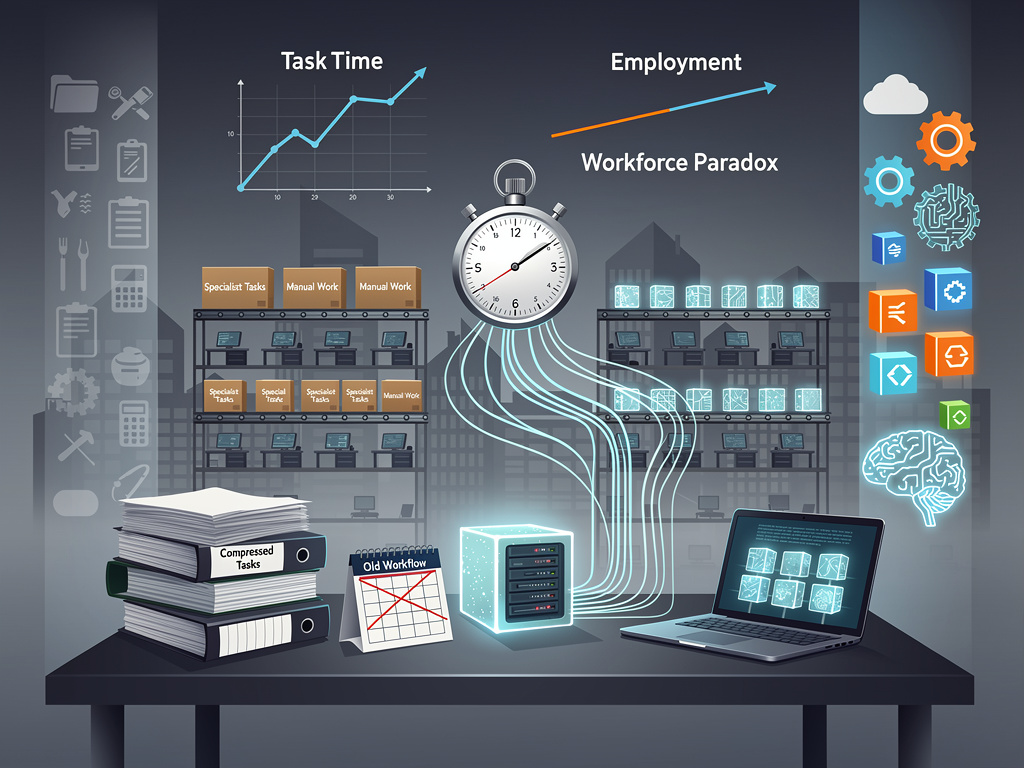
The conversation about artificial intelligence and employment has been dominated by a binary question: Will robots take our jobs? But this framing misses the more nuanced transformation already underway in workplaces across every sector. According to Jan Tegze’s analysis, jobs aren’t vanishing—they’re compressing. Tasks that once consumed entire workdays are being reduced to minutes, forcing professionals to confront an uncomfortable reality: their roles are shrinking, even as their titles remain unchanged.
This compression effect represents a fundamental shift in how we conceptualize work itself. When a marketing manager who previously spent three days crafting campaign copy can now generate comparable content in thirty minutes using large language models, the question isn’t whether the job exists—it’s what fills the remaining 23.5 hours of that work week. As Tegze notes, this creates a peculiar paradox: workers remain employed but find their core competencies increasingly obsolete, their expertise compressed into algorithmic efficiency.
The implications extend far beyond individual productivity gains. Organizations are beginning to recognize that if one person can accomplish what previously required five, the economic pressure to rightsize teams becomes irresistible. Yet this realization is unfolding slowly, creating a transitional period where workers sense their diminishing indispensability but haven’t yet faced the structural consequences. This lag between technological capability and organizational restructuring may prove to be a brief grace period before more dramatic workforce reconfigurations.
The Cognitive Compression Across Professional Domains
Software development offers perhaps the clearest example of task compression in action. Code that once demanded hours of careful construction, debugging, and testing can now be generated in seconds through AI-powered development tools. GitHub Copilot and similar platforms don’t merely autocomplete—they architect entire functions based on natural language descriptions. The developer’s role hasn’t disappeared, but it has fundamentally transformed from creator to curator, from builder to reviewer.
Legal professionals face similar compression. Document review, contract analysis, and legal research—tasks that justified armies of associates billing hundreds of hours—are increasingly handled by AI systems that process documents at superhuman speeds. A recent analysis found that AI tools can review contracts with accuracy rates exceeding 90%, completing in minutes what would take lawyers days. The associate who once spent weeks reviewing discovery documents now oversees AI systems that complete the same work during a lunch break.
Creative fields, long considered immune to automation, are experiencing their own compression. Graphic designers watch as generative AI produces dozens of logo variations in seconds. Writers observe AI drafting articles, reports, and marketing copy with unsettling competence. Musicians experiment with tools that generate original compositions in any style. The creative professional’s value is shifting from execution to direction, from craft to curation—a transition that fundamentally alters the nature of creative work itself.
The Economic Mathematics of Workforce Compression
The financial calculus facing organizations is straightforward and unforgiving. If artificial intelligence enables one employee to accomplish what previously required five, maintaining the original headcount becomes economically indefensible. Companies operate under competitive pressures that reward efficiency and punish unnecessary overhead. The question isn’t whether organizations will eventually adjust their workforce sizes to match compressed task requirements—it’s when and how rapidly this adjustment will occur.
This economic reality creates what might be called the ‘compression trap.’ Workers who embrace AI tools and dramatically increase their productivity inadvertently demonstrate that fewer people can accomplish the same organizational output. The most efficient employees may be hastening the very workforce reductions that threaten their colleagues—and eventually themselves. This perverse incentive structure means that rational individual behavior (adopting productivity-enhancing tools) leads to collectively adverse outcomes (workforce reduction).
Early indicators suggest this compression is already affecting hiring practices and workforce planning. Companies are leaving positions unfilled, reasoning that existing staff augmented with AI tools can absorb the work. Job postings increasingly emphasize AI proficiency, signaling that organizations expect individual workers to operate at historically unprecedented productivity levels. The implicit message: we need fewer people, but those we employ must accomplish more.
The Skill Devaluation Cascade
As task compression accelerates, professional skills are experiencing a devaluation cascade. Expertise that required years to develop can suddenly be replicated by AI systems accessible to novices. The paralegal who spent a decade mastering legal research finds their specialized knowledge compressed into a search algorithm. The financial analyst whose Excel modeling skills were highly valued watches as AI systems generate sophisticated financial models from simple prompts.
This devaluation doesn’t mean these skills become worthless—rather, they transition from scarce and valuable to abundant and commoditized. When everyone has access to AI tools that perform complex analyses, the competitive advantage shifts to higher-order capabilities: judgment, strategic thinking, relationship management, and the ability to ask the right questions. But these meta-skills are harder to define, teach, and credential, creating uncertainty about how professionals should adapt.
The compression also affects the economics of skill acquisition. Why invest years developing expertise that AI might replicate? This question haunts educational institutions and individual career planning alike. The traditional model of deep specialization—investing heavily in narrow expertise—becomes riskier when that expertise might be compressed into software. The alternative—developing broad, adaptable capabilities—sounds appealing but offers less clear pathways and fewer established credentials.
Organizational Inertia and the Compression Lag
Despite the technological capability for dramatic workforce compression, organizational change occurs slowly. Companies face institutional inertia, regulatory constraints, and cultural resistance to rapid restructuring. Many organizations haven’t yet fully grasped the magnitude of compression potential, or they’re deliberately moving cautiously to avoid disruption. This creates a temporary buffer—a compression lag during which technological capability outpaces organizational adaptation.
This lag period offers workers time to adapt, but it also creates false security. Employees may observe that AI tools are enhancing their productivity without triggering immediate job losses, leading to the mistaken conclusion that compression won’t ultimately affect headcount. Organizations, meanwhile, are often conducting quiet experiments, testing how far they can compress roles before quality suffers or operations become unstable. These experiments inform future restructuring decisions that may arrive suddenly after extended periods of apparent stability.
The compression lag also varies dramatically across industries and organizations. Highly competitive sectors with thin margins are compressing faster, while regulated industries or those with strong labor protections are moving more slowly. Technology companies, paradoxically both creators and early adopters of AI tools, are experiencing compression most acutely. Traditional industries may follow similar trajectories but on delayed timelines, creating sector-specific windows for adaptation.
The Human Remainder: What Survives Compression
As tasks compress, attention naturally focuses on what remains—the specifically human contributions that resist algorithmic replication. Relationship building, emotional intelligence, ethical judgment, and creative vision are frequently cited as compression-resistant capabilities. Yet even these domains face pressure as AI systems become more sophisticated at simulating empathy, generating novel ideas, and navigating complex ethical frameworks.
The uncomfortable truth is that the boundary between compressible and compression-resistant work keeps shifting. Tasks once considered quintessentially human—writing, visual art, strategic analysis—have proven more susceptible to compression than experts predicted. This pattern suggests humility about predictions regarding which capabilities will remain exclusively human. The safe assumption may be that compression will continue advancing into domains currently considered secure.
What likely survives longest are capabilities that involve high-stakes judgment in novel situations, work requiring deep contextual understanding of specific organizational cultures, and tasks where the human presence itself provides value independent of output. A therapist’s value isn’t purely in the advice given but in the human connection established. A leader’s effectiveness depends partly on their ability to inspire, which may resist compression even as their analytical and strategic tasks become AI-assisted.
Navigating the Compressed Future
For individual workers, the compression era demands new strategies. Developing AI literacy becomes essential—not just using tools, but understanding their capabilities, limitations, and trajectory. Professionals must position themselves as AI augmenters rather than AI competitors, finding ways to add value that complements rather than duplicates machine capabilities. This requires honest assessment of which current skills face compression and which might prove more durable.
Career diversification offers another hedge against compression. Rather than deepening expertise in potentially compressible domains, professionals might develop portfolios of complementary skills that together prove harder to compress than any single specialization. This approach trades the depth of traditional expertise for the resilience of adaptability, a calculation that may prove wise in rapidly changing environments.
The compression era also demands new organizational thinking. Companies that view AI purely as a headcount reduction tool may miss opportunities to redeploy compressed capacity toward innovation, market expansion, or service enhancement. The question isn’t just ‘how few people do we need?’ but ‘what becomes possible when task constraints ease?’ Organizations that answer this question creatively may find compression enables growth rather than merely reducing costs.
The Societal Reckoning Ahead
Task compression at scale creates challenges that extend beyond individual careers or organizational efficiency. If broad swaths of professional work compress simultaneously, labor markets face potential disruption exceeding historical precedents. The pace of compression may outstrip society’s ability to retrain workers or create new employment categories, creating transitional unemployment even if new opportunities eventually emerge.
Policy responses remain underdeveloped relative to the scale of potential compression. Discussions of universal basic income, shortened work weeks, and job guarantees reflect growing recognition that traditional employment models may not survive intact. Yet political will for dramatic policy interventions remains limited, particularly in the absence of immediate crisis. The compression lag that provides individual adaptation time also delays the policy urgency that might drive systemic responses.
The compression era ultimately forces a fundamental question about work’s role in human life. If many tasks can be compressed to near-zero time requirements, what justifies the traditional 40-hour work week? What happens to identity, purpose, and social structure in a world where employment occupies a fraction of life that it once did? These questions lack easy answers, but the compression of work proceeds regardless, forcing society toward a reckoning it hasn’t yet prepared for.


 WebProNews is an iEntry Publication