
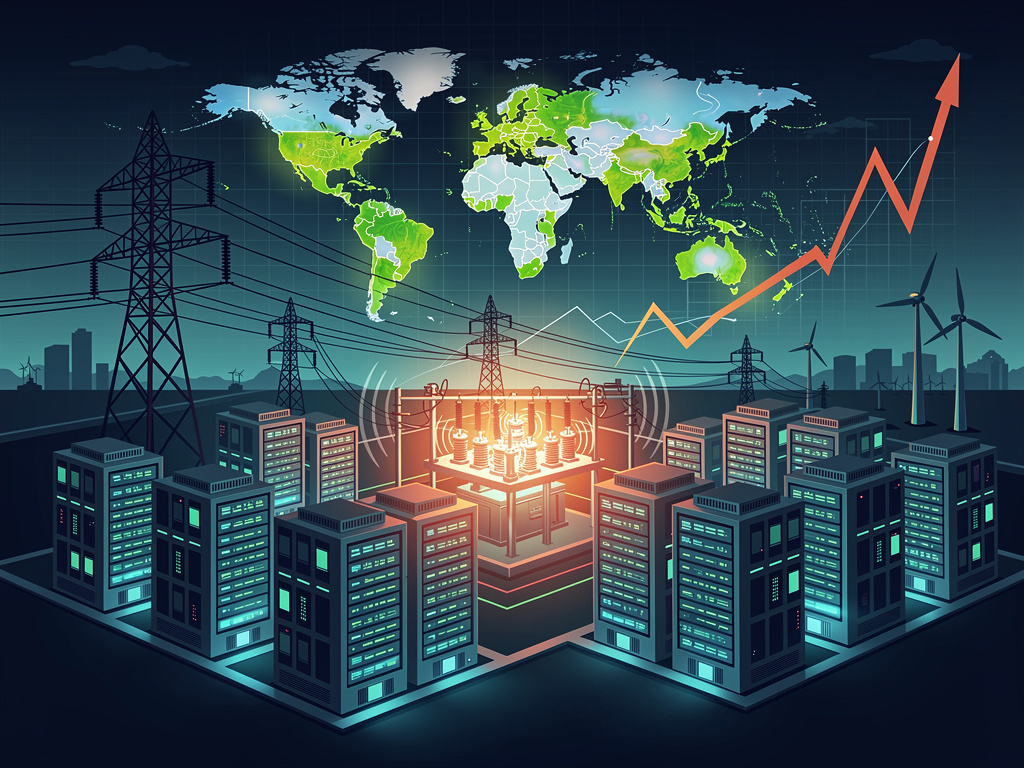
The numbers are staggering. Microsoft, Google, Amazon, and Meta collectively plan to spend more than $300 billion on capital expenditures in 2025 alone, the vast majority directed at data centers hungry for electricity. Behind the glossy AI demos and chatbot wars lies a far more fundamental contest — one fought not with algorithms but with megawatts, transmission lines, and long-term power purchase agreements that would make a utility executive’s head spin.
This is the story of how artificial intelligence became an energy story. And why that transformation is sending shockwaves through electricity markets, grid planning, and climate policy across the developed world.
The Demand Shock Nobody Planned For
For two decades, electricity demand in the United States was essentially flat. Efficiency gains in lighting, appliances, and industrial processes offset population growth and economic expansion. Grid planners built their models around this comfortable stasis. Then generative AI arrived, and those models shattered.
According to the Financial Times, the electricity required to power AI data centers is surging at a pace that has caught utilities, regulators, and even some tech executives off guard. The International Energy Agency projects that global data center electricity consumption could more than double by 2030, reaching over 1,000 terawatt-hours — roughly equivalent to Japan’s entire electricity consumption today.
The scale is hard to overstate. A single large AI training cluster can consume as much power as a small city. Nvidia’s latest GPU racks draw significantly more electricity per unit than their predecessors, and the trend line points relentlessly upward. Every leap in model capability demands a corresponding leap in computational power, and computation means heat, cooling, and enormous quantities of electricity flowing around the clock.
What makes this different from previous waves of tech infrastructure buildout is the density and urgency. Cloud computing grew steadily over a decade. AI demand is compressing that timeline into years, sometimes months. Tech companies aren’t just requesting grid connections — they’re showing up with plans for campuses that require gigawatts of capacity, the kind of load that used to be associated with aluminum smelters or steel mills.
Virginia’s Loudoun County, already home to the world’s largest concentration of data centers, has become a case study in what happens when demand outstrips infrastructure. Dominion Energy, the local utility, has warned that it cannot connect new facilities fast enough. Wait times for grid interconnection have stretched to years. Similar bottlenecks are emerging in Texas, Arizona, Georgia, and increasingly across Northern Europe.
The problem isn’t just generation. It’s transmission. Building new high-voltage power lines in the United States takes seven to twelve years on average, tangled in permitting disputes, environmental reviews, and local opposition. The grid was designed for a world of centralized power plants sending electricity to distributed consumers. Data centers flip that model — they are massive, concentrated loads often located far from existing generation assets.
So the tech giants are improvising.
Microsoft signed a deal to restart a unit at Three Mile Island, the Pennsylvania nuclear plant infamous for its 1979 partial meltdown. Google has inked agreements with multiple nuclear startups, including Kairos Power, for small modular reactors that don’t yet exist commercially. Amazon has purchased a nuclear-powered data center campus in Pennsylvania and is investing in fusion energy research. Meta has sought proposals for nuclear power to feed its AI ambitions.
These aren’t PR stunts. They’re acts of strategic desperation wrapped in climate branding.
The Price of Power — and Who Pays
The financial implications ripple far beyond Silicon Valley balance sheets. As tech companies compete for scarce electricity, they’re driving up power costs for everyone else. In some markets, wholesale electricity prices have already begun to reflect the new demand reality. Industrial manufacturers, hospitals, municipal water systems — all compete for the same electrons.
The Financial Times reported that utilities are grappling with how to allocate the costs of grid upgrades necessitated by data center growth. Should existing ratepayers subsidize the infrastructure needed to serve tech companies generating billions in revenue? Or should the data center operators bear the full cost of their grid impact? The answer varies by jurisdiction, but the political tension is intensifying.
In Georgia, regulators approved a rate increase partly driven by data center demand, sparking backlash from residential customers. In Virginia, lawmakers have debated whether the tax incentives that attracted data centers in the first place still make economic sense given the strain on local infrastructure. Ireland, where data centers already consume roughly a fifth of the nation’s electricity, imposed a de facto moratorium on new connections in the Dublin area.
The economics are paradoxical. Tech companies can afford to pay premium prices for power — their margins on AI services dwarf the cost of electricity. But their willingness to pay more doesn’t create more electrons. It simply redirects existing supply, potentially crowding out less profitable but socially essential users. A hospital can’t outbid Microsoft for megawatts.
And then there’s the climate dimension. Big Tech has made sweeping carbon neutrality pledges. Microsoft aims to be carbon negative by 2030. Google claims to match 100% of its electricity consumption with renewable energy purchases on an annual basis. But the sheer volume of new demand is making these targets harder to hit, not easier.
Google’s 2024 environmental report acknowledged that its greenhouse gas emissions had risen roughly 50% since 2019, driven largely by data center expansion. The company attributed the increase to AI-related energy consumption. Microsoft made a similar admission. The disconnect between corporate climate rhetoric and operational reality has not gone unnoticed by environmental groups or investors focused on ESG commitments.
Natural gas is filling the gap. Despite the renewable energy aspirations, much of the new generation being built or contracted to serve data centers runs on gas. In Texas, several new gas-fired power plants have been announced explicitly to serve hyperscale data center clusters. The logic is straightforward: gas plants can be built in two to three years, provide reliable baseload power, and don’t depend on weather conditions. Renewables plus battery storage remain cheaper on a levelized cost basis in many regions, but they can’t yet guarantee the 99.999% uptime that AI workloads demand without significant overbuilding.
Nuclear offers that reliability, which explains the sudden tech industry infatuation with atomic energy. But new nuclear capacity — whether conventional large reactors or the much-hyped small modular designs — won’t arrive at meaningful scale until the 2030s at the earliest. The NRC hasn’t approved a new reactor design in decades. Construction timelines for nuclear projects have historically blown past estimates by years and billions of dollars.
The urgency mismatch is the central tension. AI companies need power now. The clean energy sources that could supply it without wrecking climate goals need years, sometimes decades, to build. Something has to give, and right now it’s the emissions targets.
Meanwhile, the geopolitical stakes are rising. The Biden administration framed AI infrastructure as a national security imperative, and the Trump administration has continued that posture, linking data center buildout to maintaining American technological dominance over China. This framing gives tech companies powerful political cover to push for faster permitting, relaxed environmental review, and public investment in grid infrastructure that primarily benefits private data center operators.
The CHIPS and Science Act and the Inflation Reduction Act both contain provisions that indirectly support data center energy needs through clean energy tax credits and grid modernization funding. But the scale of public investment pales beside the private capital being deployed. When Microsoft alone plans to spend $80 billion on data centers in a single fiscal year, federal programs offering billions over a decade look like rounding errors.
What Comes Next
The fundamental question isn’t whether AI will consume vastly more energy. It will. The question is whether the institutions responsible for energy planning — utilities, regulators, grid operators, permitting agencies — can adapt fast enough to prevent the worst outcomes: brownouts, soaring consumer electricity bills, and a meaningful setback in decarbonization progress.
Some promising developments exist. Efficiency improvements in chip design could moderate demand growth. Nvidia’s newest architectures deliver more computation per watt than their predecessors, and software optimization techniques like model distillation and quantization reduce the energy required for AI inference. But historically, efficiency gains in computing have been overwhelmed by demand growth — a dynamic known as Jevons paradox. Cheaper, more efficient AI will likely mean more AI, not less electricity consumption.
Grid-enhancing technologies — advanced conductors, dynamic line rating systems, topology optimization software — could squeeze more capacity from existing transmission infrastructure without building new lines. The Department of Energy has championed these approaches, and several utilities are piloting them. But deployment remains slow, hampered by regulatory inertia and utility business models that reward capital investment in new infrastructure over operational optimization of existing assets.
The most likely scenario? A messy, expensive, politically contentious buildout that takes longer than the tech industry wants and costs more than anyone currently projects. Some regions will attract the data centers and the jobs and tax revenue that come with them. Others will resist, citing environmental concerns, grid reliability, or simple NIMBYism. The geography of AI will be shaped as much by permitting timelines and transmission capacity as by fiber optic connectivity or proximity to talent.
For investors, the implications are significant. Utilities serving data center-heavy regions — Dominion Energy, Southern Company, Entergy — stand to benefit from load growth after years of stagnation. Independent power producers with gas and nuclear assets are seeing renewed interest. Companies in the transmission and distribution supply chain — transformers, switchgear, high-voltage cables — face demand that exceeds manufacturing capacity.
But there are risks. Overbuilding is possible if AI demand projections prove overly optimistic. Some analysts have drawn parallels to the fiber optic boom of the late 1990s, when companies laid vast networks of cable that went dark for years. If the AI revenue model falters — if customers prove unwilling to pay enough for AI services to justify the infrastructure costs — the write-downs could be enormous.
The tech industry is betting that won’t happen. That AI will generate enough economic value to justify every dollar spent on GPUs, every megawatt consumed, every ton of carbon emitted. It’s the biggest infrastructure bet since the railroads. And like the railroads, it will reshape not just an industry but the physical fabric of the economy — the power plants, the transmission towers, the substations, the rivers diverted for cooling water.
Whether that reshaping happens intelligently or chaotically depends on decisions being made right now, in utility commission hearing rooms and congressional offices and corporate boardrooms that most people will never see. The AI revolution, it turns out, runs on copper and concrete as much as code.


 WebProNews is an iEntry Publication