
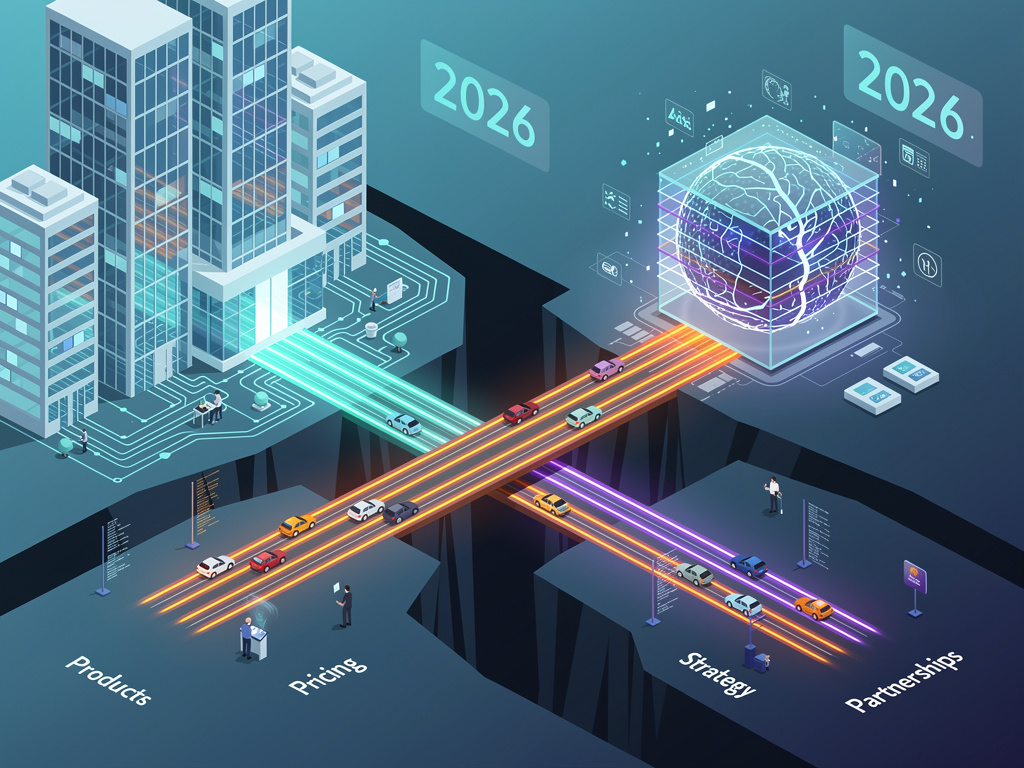
A quiet but seismic transformation is underway across the enterprise software industry. Companies that once sold static, subscription-based tools are now scrambling to reinvent themselves as AI-native platforms—or risk being rendered obsolete by a new generation of competitors that never knew a world without large language models. The urgency is palpable, the stakes enormous, and the timeline unforgiving: industry executives and analysts increasingly point to 2026 as the year when the gap between AI leaders and laggards becomes irreversible.
According to Business Insider, a growing number of traditional software companies are forging partnerships with frontier AI labs—most notably OpenAI—as a survival strategy. These alliances are not mere marketing exercises. They represent fundamental shifts in product architecture, business models, and competitive positioning. For industry insiders, the implications are profound: the enterprise software market as we know it is being dismantled and rebuilt in real time.
The Partnership Gold Rush With Frontier AI Labs
The most visible manifestation of this shift is the flurry of partnership announcements between established software vendors and frontier AI companies. OpenAI, Google DeepMind, and Anthropic have become the gravitational centers around which legacy software firms are now orbiting. As Business Insider reported, these partnerships are designed to embed cutting-edge AI capabilities directly into existing software products, allowing incumbents to offer generative AI features without building foundation models from scratch.
The logic is straightforward but the execution is anything but simple. Building a competitive large language model requires billions of dollars in compute infrastructure, access to vast training datasets, and a deep bench of machine learning researchers—resources that most software companies simply do not possess. By partnering with frontier labs, companies like Salesforce, SAP, and others can leapfrog the foundational research phase and focus instead on application-layer innovation. But this dependency creates its own risks: what happens when your AI partner decides to compete with you directly, or when the terms of access change overnight?
Why 2026 Has Become the Industry’s Defining Deadline
The year 2026 has emerged as a critical inflection point in conversations among software executives and venture capitalists alike. Multiple factors converge to make this timeline significant. First, enterprise procurement cycles typically run 18 to 24 months, meaning that companies making AI investment decisions today will see those bets mature—or fail—by 2026. Second, the current generation of frontier models is expected to undergo another major capability leap by then, potentially enabling AI agents that can autonomously execute complex business workflows rather than merely assisting human operators.
This timeline pressure is forcing boards and C-suites to make consequential decisions under conditions of extreme uncertainty. Do you build your own AI capabilities in-house, at enormous cost and with no guarantee of success? Do you partner with a frontier lab and accept the strategic dependency that entails? Or do you acquire smaller AI-native startups and attempt to integrate their technology into your existing stack? Each path carries distinct risks, and the wrong choice could prove existential. As Business Insider’s reporting makes clear, most incumbents are hedging their bets by pursuing some combination of all three strategies simultaneously.
The Existential Threat From AI-Native Startups
While legacy software companies scramble to bolt AI onto their existing products, a new cohort of startups is building from the ground up with AI at the core. These AI-native companies have no legacy code to maintain, no existing customer workflows to preserve, and no organizational inertia to overcome. They can design their products around the capabilities of frontier models from day one, creating user experiences that feel fundamentally different from anything incumbents can offer through incremental upgrades.
Consider the customer relationship management space, long dominated by Salesforce. A wave of AI-native CRM startups is now promising to automate lead scoring, email drafting, meeting scheduling, and even deal negotiation—tasks that traditional CRM systems merely track and organize. The value proposition shifts from “a system of record” to “an autonomous agent that closes deals.” For incumbents, the challenge is not just technological but philosophical: their entire business model is built around selling seats and subscriptions to human users. If AI agents replace many of those users’ tasks, the per-seat pricing model collapses.
OpenAI’s Expanding Ambitions Complicate the Picture
OpenAI’s evolution from a research lab into a full-fledged platform company adds another layer of complexity to the partnership calculus. The company’s rapid expansion into enterprise tools, APIs, and custom GPT offerings means that today’s partner could become tomorrow’s competitor. This dynamic is not new in technology—Microsoft’s history of partnering with and then competing against software vendors is well documented—but the speed at which AI markets are evolving makes the threat more acute.
Software companies entering partnerships with OpenAI must carefully negotiate terms around data usage, model customization, and competitive restrictions. Yet even the most carefully drafted agreements may not protect against the fundamental reality that OpenAI, flush with tens of billions in funding and growing revenue, has every incentive to move up the application stack. The same is true of Google and Anthropic, both of which are building increasingly sophisticated enterprise-facing products. For legacy software vendors, the question is whether these partnerships buy them enough time to develop proprietary AI capabilities—or merely delay an inevitable reckoning.
The Pricing Model Revolution Nobody Is Talking About
Perhaps the most underappreciated dimension of the AI transformation in enterprise software is the looming disruption to pricing models. The SaaS industry was built on predictable, recurring revenue from per-seat subscriptions. Wall Street rewarded this model with premium valuations because of its predictability and high gross margins. But AI changes the economics in fundamental ways.
First, AI features consume significantly more compute than traditional software, compressing gross margins unless vendors can pass those costs on to customers. Second, if AI agents perform work that previously required multiple human users, the per-seat model becomes untenable—customers will demand outcome-based or usage-based pricing instead. Some companies are already experimenting with “per-agent” or “per-task” pricing, but the industry has not yet converged on a standard approach. This pricing uncertainty makes financial modeling difficult for both vendors and investors, adding another variable to an already complex equation.
What the Smart Money Is Watching
Institutional investors and analysts are closely monitoring several leading indicators to assess which software companies will emerge as winners in the AI transition. Key metrics include the percentage of revenue derived from AI-enhanced products, the depth and exclusivity of frontier lab partnerships, the pace of AI feature adoption among existing customers, and—critically—whether companies can maintain or improve gross margins while scaling AI capabilities.
Venture capital firms, meanwhile, are placing aggressive bets on AI-native startups that they believe can unseat incumbents in specific vertical markets. The funding environment for AI startups remains robust even as broader venture funding has cooled, reflecting a consensus view that AI represents a generational platform shift comparable to the rise of cloud computing. For incumbent software companies, this means that the competitive threat is not hypothetical—it is being funded to the tune of billions of dollars by some of the most sophisticated investors in the world.
The Human Capital Dimension
Beyond technology and business models, the AI pivot is creating a fierce war for talent that further advantages well-funded startups and frontier labs. Machine learning engineers, AI product managers, and data scientists command premium compensation packages, and many prefer the culture and equity upside of startups over the bureaucratic structures of large software companies. Legacy vendors are responding with aggressive hiring, acqui-hires, and internal reskilling programs, but the talent gap remains a significant constraint on execution speed.
The organizational challenge extends beyond hiring. Integrating AI into existing products requires cross-functional collaboration between data science teams, product engineers, sales organizations, and customer success teams—a level of coordination that many large software companies struggle to achieve. Companies that fail to align their organizations around the AI imperative risk producing disjointed products that feel like AI has been bolted on as an afterthought rather than woven into the core experience.
The Road Ahead Is Narrow and Unforgiving
The enterprise software industry is entering a period of creative destruction that will reshape market leadership, redefine product categories, and fundamentally alter the relationship between software vendors and their customers. The companies that thrive will be those that move decisively, partner strategically, and—most importantly—reimagine their products from the user’s perspective rather than simply adding AI features to existing workflows.
For industry insiders, the message is clear: the window for action is closing rapidly. The partnerships being announced today, the architectural decisions being made this quarter, and the talent being recruited this year will determine which companies are still relevant when the dust settles in 2026 and beyond. In an industry accustomed to gradual, iterative change, the AI revolution demands something far more radical—and far more urgent.


 WebProNews is an iEntry Publication