
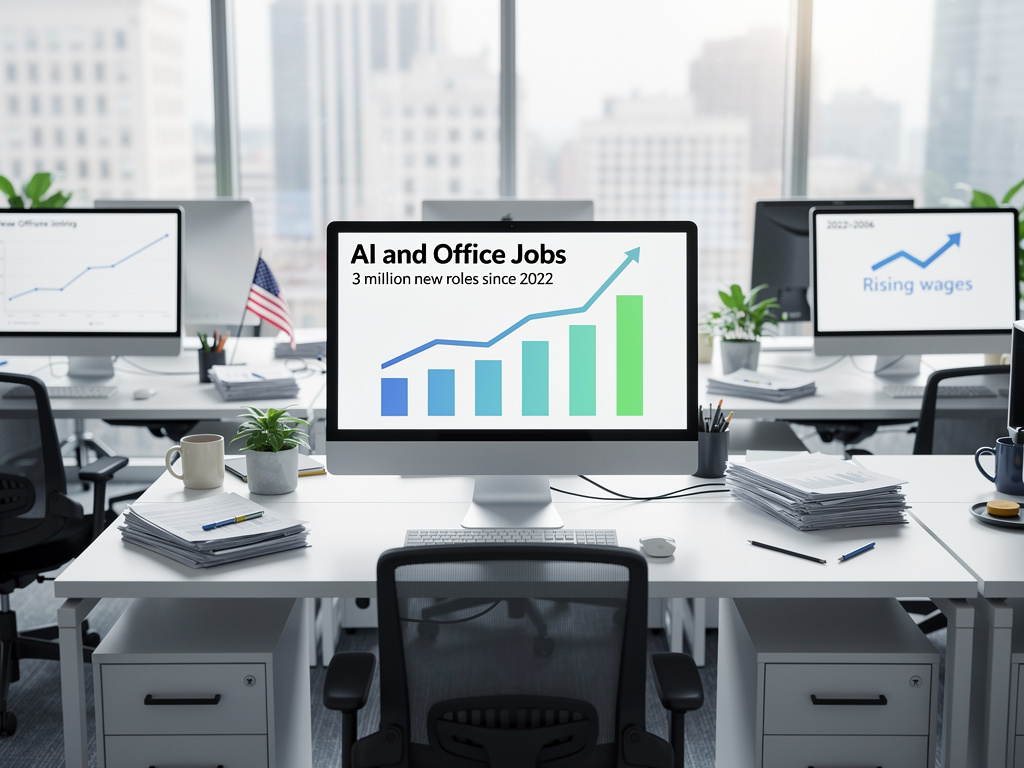
When OpenAI unleashed ChatGPT on the world in late November 2022, a chorus of economists, technologists, and futurists warned that the age of the office worker was drawing to a close. Artificial intelligence, they declared, would hollow out the professional class — rendering accountants, analysts, copywriters, and middle managers obsolete within years, if not months. Two and a half years later, the data tells a strikingly different story: the United States has added approximately 3 million white-collar jobs since ChatGPT’s debut, and the workers filling those roles are earning more than ever.
The figures, reported by Warp News, draw on Bureau of Labor Statistics data and present a direct challenge to the prevailing narrative that generative AI is an imminent existential threat to knowledge work. Rather than displacing office professionals en masse, the technology appears — at least for now — to be coexisting with a labor market that continues to expand in precisely the sectors many predicted would contract.
A Labor Market That Refuses to Cooperate With the Forecasts
The disconnect between prediction and reality is stark. In early 2023, Goldman Sachs published a widely cited report estimating that generative AI could expose 300 million full-time jobs globally to automation, with legal, administrative, and business operations roles among the most vulnerable. The McKinsey Global Institute projected that up to 30 percent of hours worked in the U.S. economy could be automated by 2030, with white-collar professions bearing a disproportionate share of the disruption. Media coverage amplified these forecasts, often framing AI not as a tool but as a replacement.
Yet the employment numbers have moved stubbornly in the opposite direction. According to BLS data, professional and business services employment has climbed steadily since late 2022. Financial activities, information services, and healthcare administration — all categories squarely in the crosshairs of AI disruption predictions — have posted net gains. The unemployment rate for workers with a bachelor’s degree or higher has remained well below the national average, hovering near historic lows for much of 2024 and into 2025.
Wages Rising Alongside Headcount
It is not merely that more white-collar workers are being hired. They are also being paid more. As Warp News noted, wage growth for office-based professionals has outpaced inflation over the period since ChatGPT’s launch. The Employment Cost Index for white-collar occupations has shown consistent quarterly increases, and median weekly earnings for full-time workers in management, professional, and related occupations reached record nominal levels in the first quarter of 2025.
This wage growth suggests that demand for skilled office workers is not softening — it is intensifying. Employers are competing for talent that can work alongside AI tools, integrate them into existing workflows, and exercise the judgment that large language models still conspicuously lack. The premium on human expertise, particularly in roles requiring complex decision-making, client relationships, and regulatory navigation, appears to be growing rather than shrinking.
Why the Predictions Missed: The Augmentation Effect
Several factors help explain why the dire forecasts have not materialized. The most significant is what economists call the augmentation effect — the tendency for new technologies to enhance worker productivity rather than simply eliminate workers. When a financial analyst can use AI to process data sets in minutes rather than hours, the analyst does not become redundant. Instead, the analyst becomes more valuable, capable of delivering insights faster and taking on a greater volume of strategic work. The firm, in turn, may hire additional analysts to capitalize on the expanded capacity.
History offers instructive parallels. The introduction of spreadsheet software in the 1980s was expected to decimate the accounting profession. Instead, it made financial analysis cheaper and more accessible, dramatically expanding the demand for people who could perform it. ATMs were supposed to eliminate bank tellers; instead, by reducing the cost of operating a branch, they led banks to open more branches and hire more tellers for customer-facing roles. The pattern is remarkably consistent: automation of specific tasks within a job rarely leads to the elimination of the job itself, at least not in the near term.
The AI Adoption Curve Is Slower Than Headlines Suggest
Another critical factor is the pace of actual AI adoption in the workplace. While media coverage has focused on the capabilities of frontier models, the reality on the ground in most American offices is considerably more measured. Surveys from the Census Bureau’s Business Trends and Outlook Survey have consistently shown that only a modest fraction of U.S. firms report using AI in their operations in any meaningful capacity. Even among large enterprises, deployment tends to be experimental and confined to specific functions rather than transformative at an organizational level.
Corporate technology adoption has always been slower than consumer adoption. Enterprise software procurement cycles, regulatory compliance requirements, data security concerns, integration challenges with legacy systems, and institutional inertia all act as brakes on the speed at which even revolutionary technologies penetrate the workplace. The gap between what AI can theoretically do in a demo and what it reliably does inside a Fortune 500 company’s compliance-heavy workflow remains substantial.
New Roles, New Demands, and the Shifting Composition of Office Work
The growth in white-collar employment is not simply a continuation of pre-AI trends. The composition of office work is shifting. Demand has surged for roles that did not exist or barely existed before 2022: AI prompt engineers, machine learning operations specialists, AI ethics and governance professionals, and data annotation managers. Companies across industries are building out AI strategy teams, hiring consultants to assess automation opportunities, and staffing up compliance departments to navigate the emerging regulatory environment around artificial intelligence.
At the same time, traditional white-collar roles are being redefined rather than eliminated. Marketing professionals are expected to understand how to leverage generative AI for content production. Financial analysts are evaluated on their ability to use AI-powered modeling tools. Human resources departments are deploying AI for resume screening while hiring more specialists to manage the human implications of these tools. The net effect has been additive: AI creates new categories of work while reshaping existing ones, and both dynamics contribute to employment growth.
The Caution That Still Lingers
None of this means the warnings about AI-driven displacement are permanently wrong — only that they have been premature. Technology-driven labor market disruptions have historically unfolded over decades, not quarters. The mechanization of agriculture took nearly a century to reduce farm employment from roughly 40 percent of the U.S. workforce to under 2 percent. The offshoring of manufacturing jobs accelerated over a 30-year period. If AI does eventually reshape white-collar work as profoundly as some predict, the process is likely to be gradual, uneven, and mediated by policy, institutional adaptation, and the development of new industries that are difficult to foresee today.
There are also legitimate concerns about quality and wage polarization within white-collar work. While aggregate numbers show growth and rising wages, some subcategories of office work — particularly routine data entry, basic content production, and certain categories of customer service — have shown signs of softening demand. The benefits of the AI era may accrue disproportionately to highly skilled professionals who can harness the technology, while workers in more routine cognitive roles face genuine pressure. This bifurcation, rather than wholesale displacement, may be the more accurate near-term story.
What the Numbers Mean for the AI Narrative
The addition of 3 million white-collar jobs in the United States since ChatGPT’s launch is not merely a statistical footnote. It is a significant data point that should temper the apocalyptic framing that has dominated public discourse about artificial intelligence and employment. The evidence, as it stands in mid-2025, suggests that AI is functioning more as a productivity tool than a job killer for office professionals — boosting output, enabling new forms of work, and increasing the economic value of human judgment and expertise.
This does not mean policymakers and business leaders should be complacent. Investments in workforce retraining, education reform, and social safety nets remain critical to ensuring that the benefits of AI are broadly shared. But the current data demands a more nuanced conversation than the one that has prevailed — one that acknowledges the remarkable resilience and adaptability of the American labor market, even in the face of transformative technological change. The white-collar workforce is not vanishing. It is evolving, growing, and, by most measures, thriving.


 WebProNews is an iEntry Publication