
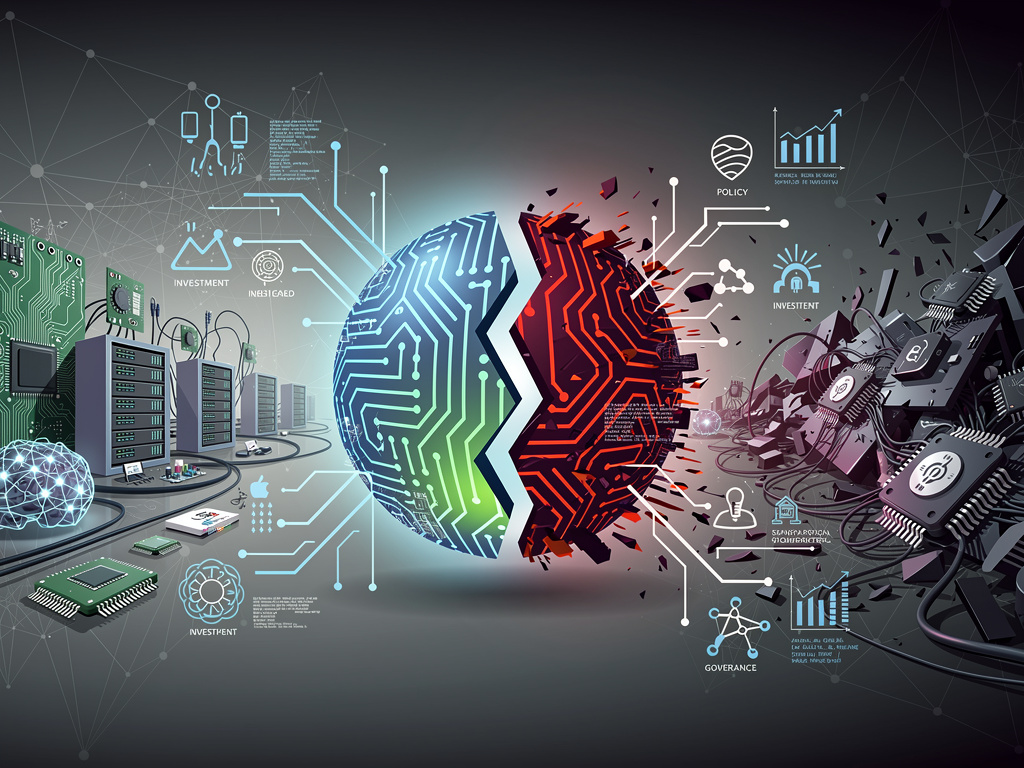
The artificial intelligence debate has fractured along lines that don’t map neatly onto the usual political or ideological boundaries. Optimists and pessimists aren’t splitting left versus right, or young versus old, or technical versus non-technical. The fault lines run deeper than that — and they’re getting harder to bridge.
A recent analysis by MIT Technology Review laid out the case that opinion on AI is so divided in part because people are reacting to fundamentally different versions of the technology — different use cases, different time horizons, different assumptions about who controls the systems and who benefits from them. The piece argued that the divergence isn’t a failure of communication. It’s a reflection of genuine uncertainty about where AI is headed and what it will mean when it arrives.
That uncertainty is real. But it doesn’t fully explain the intensity of the disagreement.
The Optimists, the Doomers, and Everyone Stuck in Between
On one side, you have executives at major AI labs — OpenAI, Google DeepMind, Anthropic, Meta — who describe a future where AI systems accelerate scientific discovery, democratize access to expertise, and generate trillions of dollars in economic value. Sam Altman has repeatedly framed artificial general intelligence as the most important technological development in human history. Demis Hassabis at DeepMind talks about AI solving protein folding and drug discovery as just the beginning.
On the other side, a coalition of researchers, ethicists, and even some of those same lab leaders warn that the technology poses existential risks. Not hypothetical ones. Real, near-term dangers: mass displacement of workers, concentration of power in a handful of companies, erosion of truth in public discourse, and the possibility — however debated — that sufficiently advanced systems could become uncontrollable.
And then there’s the vast middle. People who use ChatGPT to draft emails and aren’t sure what all the fuss is about.
The divide matters because it shapes policy. It shapes investment. It shapes how governments regulate — or don’t regulate — systems that are already embedded in hiring decisions, medical diagnoses, criminal sentencing, and military targeting.
As MIT Technology Review pointed out, part of the problem is that the term “AI” itself has become so broad as to be nearly meaningless. A spam filter is AI. A system that generates photorealistic video from a text prompt is AI. A hypothetical superintelligence that outperforms humans at every cognitive task is also AI. When people argue about whether AI is good or bad, they’re often not arguing about the same thing at all.
This isn’t a new observation. But it’s become more consequential as the technology has advanced rapidly over the past three years. The gap between what AI can do today and what people imagine it might do tomorrow has created a kind of rhetorical no-man’s-land where almost any claim — utopian or dystopian — can sound plausible if you squint hard enough.
Consider the labor market question. Goldman Sachs estimated in 2023 that generative AI could affect 300 million jobs globally. The International Labour Organization has published research suggesting that AI is more likely to augment jobs than eliminate them outright, at least in the near term. Both claims can be true simultaneously, depending on the industry, the country, and the specific tasks involved. But they lead to wildly different policy prescriptions.
So who’s right?
Nobody knows. That’s the honest answer. And it’s the answer that almost nobody in the debate wants to give, because uncertainty doesn’t generate funding, doesn’t attract followers, and doesn’t win arguments in congressional hearings.
The Institutional Fractures
The disagreement has become institutional. OpenAI’s own history is a case study: founded as a nonprofit dedicated to ensuring AI benefits humanity, it restructured into a capped-profit entity, then faced a dramatic boardroom crisis in late 2023 when directors who prioritized safety clashed with those who prioritized speed. The organization has since moved further toward a conventional corporate structure, with Altman consolidating control. Former board members and departed researchers — including co-founder Ilya Sutskever, who left to start Safe Superintelligence Inc. — represent a faction that believes the company lost its way.
This isn’t just corporate drama. It reflects a genuine philosophical split about how fast to push the technology forward and who should be making those decisions.
Anthropic, founded by former OpenAI researchers Dario and Daniela Amodei, has positioned itself as the safety-focused alternative. But it’s also raised billions in venture capital and is racing to build increasingly powerful models. The tension between safety rhetoric and competitive pressure is palpable across the industry.
Government responses have been fragmented too. The European Union passed the AI Act, the most comprehensive regulatory framework to date. The United States has taken a lighter touch, with executive orders that have shifted significantly between administrations. China is pursuing its own approach — heavy investment paired with state control over deployment. These different regulatory philosophies reflect different assumptions about the technology’s trajectory and risks.
MIT Technology Review’s analysis emphasized that the divided opinion isn’t simply a matter of people having different values. It’s that people have different mental models of how the technology works, how fast it’s improving, and what the realistic ceiling of capability looks like. AI researchers themselves disagree sharply on these questions. Some believe current architectures — large language models trained on internet text — are approaching fundamental limits. Others believe scaling laws will continue to hold, and that each order-of-magnitude increase in compute will yield meaningful capability gains.
If you believe we’re near the ceiling, the policy conversation is about managing a powerful but bounded tool. If you believe we’re on an exponential curve toward superhuman capability, the conversation is about something else entirely.
The public, meanwhile, is forming opinions based on direct experience with consumer-facing products that are impressive but clearly flawed. ChatGPT hallucinates. Image generators produce six-fingered hands. AI customer service bots are often worse than the humans they replaced. These everyday encounters create a baseline skepticism that contrasts sharply with the breathless predictions coming from Silicon Valley.
But everyday experience can also be misleading. The Wright Flyer barely stayed aloft for 12 seconds. Sixteen years later, planes were crossing the Atlantic.
Recent reporting has added new dimensions to the debate. Concerns about AI-generated misinformation have intensified ahead of election cycles worldwide. Deepfake audio and video have already been used in political campaigns and fraud schemes. The technology’s ability to produce convincing synthetic media at scale has outpaced the development of reliable detection tools.
At the same time, AI applications in science and medicine continue to show genuine promise. DeepMind’s AlphaFold has been used by researchers worldwide to predict protein structures. AI systems are being deployed to identify potential drug candidates, analyze medical imaging, and model climate scenarios. These aren’t speculative applications — they’re happening now, producing measurable results.
The problem is that both things are true simultaneously. AI is producing real benefits in specific domains. And AI is creating real harms in others. The technology doesn’t have a single valence. It’s a general-purpose capability being applied in thousands of different ways by millions of different actors with different intentions.
Where the Conversation Goes From Here
The divided opinion on AI isn’t going to resolve itself. If anything, it’s likely to deepen as the technology becomes more capable and more embedded in daily life. The people building these systems have financial incentives to emphasize the upside. The people studying the risks have professional incentives to emphasize the downside. And the people using the technology — all of us, increasingly — are forming opinions based on partial information and personal experience.
What would help is more honesty about uncertainty. More willingness to say “we don’t know” without treating that as a weakness. More recognition that the optimistic and pessimistic cases aren’t mutually exclusive — that AI can be both enormously beneficial and genuinely dangerous, depending on how it’s built, deployed, and governed.
The MIT Technology Review piece got something fundamentally right: the division isn’t a bug in public discourse. It’s a feature of a technology that is genuinely ambiguous in its implications. The challenge isn’t to resolve the disagreement. It’s to make good decisions in the face of it.
That requires better institutions, better information, and better incentives. It requires technologists who take seriously the concerns of people outside their companies. It requires policymakers who understand the technology well enough to regulate it without strangling it. And it requires a public conversation that can hold complexity — that can acknowledge both promise and peril without collapsing into cheerleading or panic.
We’re not there yet. Not close. But the quality of the debate matters, because the decisions being made right now — about investment, regulation, deployment, and governance — will shape how this technology develops for decades. Getting it wrong in either direction carries enormous costs.
The stakes are high enough that we should probably stop arguing past each other and start arguing with each other. There’s a difference. The first produces heat. The second, occasionally, produces light.


 WebProNews is an iEntry Publication