
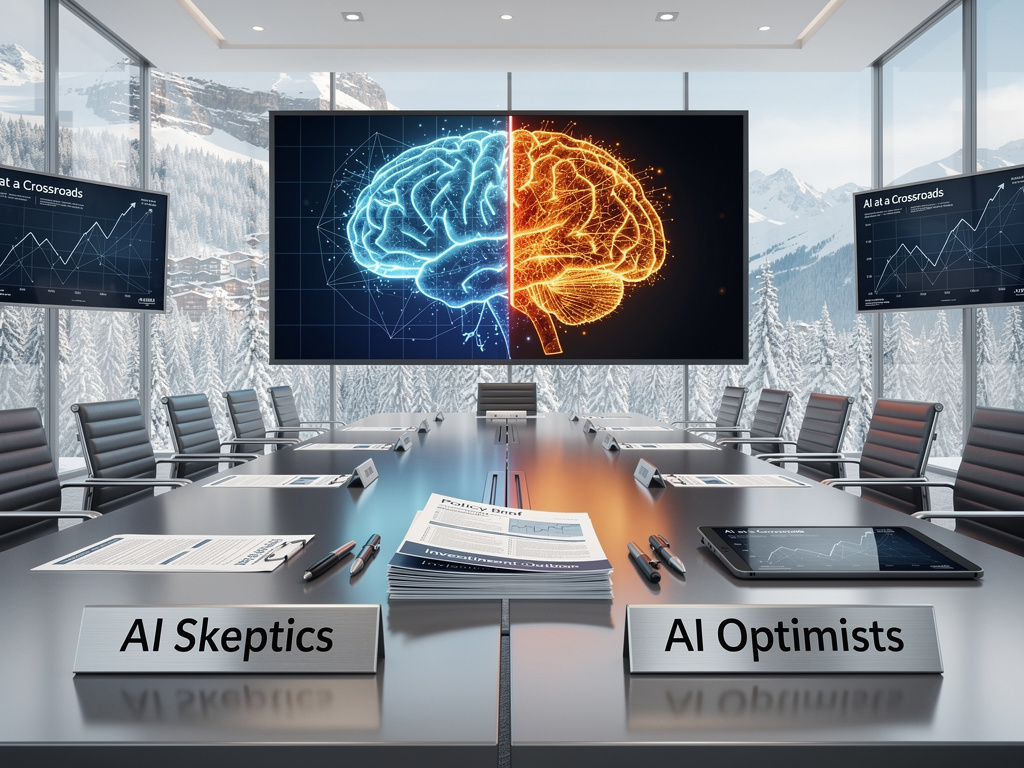
DAVOS, Switzerland—Amid the snow-capped peaks and closed-door meetings of the World Economic Forum, a stark and consequential rift has emerged among the architects of artificial intelligence. While the public remains captivated by the seemingly magical abilities of chatbots, the industry’s leading minds are deeply divided on a fundamental question: Is the current path of AI leading toward human-level intelligence, or is it a detour down a dead-end street?
The debate, which played out across several panels, pits the zealous optimism of pioneers like OpenAI’s Sam Altman against the deeply entrenched skepticism of luminaries such as Meta’s Yann LeCun. This is not merely an academic squabble. The answer will dictate the flow of hundreds of billions in capital, shape corporate strategy for the world’s largest technology firms, and define the regulatory conversations taking place from Washington to Brussels. The clash in the Alps revealed that for all the technology’s progress, there is no consensus on its ultimate destination or the time it will take to get there.
A Sobering Diagnosis from the Skeptics
At the center of the more cautious camp is Mr. LeCun, a Turing Award winner whose work on neural networks underpins much of the modern AI revolution. He delivered a blunt assessment that cut through the prevailing hype. According to a report from Slashdot, Mr. LeCun argued that today’s large language models (LLMs), the technology behind systems like ChatGPT, will never achieve true intelligence. He characterized them as an “off-ramp” from the superhighway to Artificial General Intelligence (AGI), stating they are “sorely lacking” the ability to reason, plan, or understand the physical world in a meaningful way.
This technical critique suggests that simply scaling up existing models with more data and computing power—the strategy that has defined the last several years of AI development—will yield diminishing returns. Mr. LeCun believes these systems cannot form the “world models” necessary for common-sense reasoning, a capability even a house cat possesses. “The hype is getting a little bit out of hand,” he remarked in a separate session covered by ZDNet, advocating for entirely new architectures that can learn and reason more like humans and animals.
Pragmatism Over Prophecy
Sharing a similar, albeit more pragmatic, skepticism is Andrew Ng, the co-founder of Google Brain and Coursera. His focus is less on the distant dream of AGI and more on the immediate, pressing flaws of current systems. Mr. Ng, now CEO of Landing AI, sees the pursuit of AGI as a potentially unhelpful distraction from the real work of making AI reliable for businesses. He pointed to the persistent problem of “hallucinations,” where models invent false information, as a critical barrier to widespread enterprise adoption.
For Mr. Ng, the conversation needs to shift from building ever-larger, monolithic models to engineering robust and verifiable AI systems. “I think we’re now at a point where the bottleneck is shifting from the model to the system you wrap around the model,” he told Fortune magazine at the forum. This perspective reframes the challenge not as a race to consciousness, but as a complex engineering discipline focused on accuracy, safety, and practical application. In his view, the industry must solve today’s problems before it can credibly claim to be on the verge of creating a new form of intelligence.
The Case for Imminent Transformation
In stark contrast to this cautious outlook is a powerful contingent that believes the rapid, often surprising, progress of LLMs is a clear sign that AGI is no longer a distant sci-fi concept. Daphne Koller, a Stanford professor and CEO of biotech firm Insitro, represents a more optimistic view. While acknowledging the limitations of current systems, she suggested that the timeline to human-level capabilities could be as short as a few years to a decade. She pointed to the emergent properties of scaled models—abilities that were not explicitly programmed but appeared as the systems grew—as evidence of a promising trajectory.
This sentiment is most forcefully championed by OpenAI CEO Sam Altman. While Mr. LeCun sees a dead end, Mr. Altman sees a path that is accelerating. Speaking at a Bloomberg event in Davos, he acknowledged the immense challenges ahead, particularly the staggering energy requirements for future models. He stated that a breakthrough in energy, such as nuclear fusion, would be critical to power the development of true AGI. According to Reuters, Mr. Altman emphasized that the societal impact will be so profound that it “changes the world.” His entire posture suggests a belief that AGI is not a matter of if, but when—and that “when” is coming soon.
Divergent Timelines Dictate Corporate Strategy
This fundamental disagreement in timelines has profound implications for corporate R&D and investment. Meta, guided by Mr. LeCun’s vision, is investing heavily in foundational research into alternative AI architectures, playing a longer game that bets on a fundamental scientific breakthrough. This approach contrasts sharply with the strategy at OpenAI and its partner, Microsoft, which is predicated on the belief that scaling the current paradigm will continue to unlock new capabilities and lead directly to AGI. Their multi-billion-dollar partnership is a massive wager on the continued viability of the transformer architecture that powers LLMs.
The divide also affects the talent war raging across Silicon Valley. Researchers and engineers are forced to place their own bets, choosing to work at labs that align with their scientific convictions. An engineer who believes in Mr. LeCun’s thesis might gravitate toward Meta AI or Google’s DeepMind to work on novel architectures, while one who shares Mr. Altman’s optimism might seek to join the scaling efforts at OpenAI or Anthropic. The outcome of this debate will create clear winners and losers among the tech giants currently pouring their fortunes into the AI race.
The Unsettled Science of Intelligence
Underlying the entire debate is the fact that there is no universally accepted definition of intelligence, let alone a roadmap for replicating it in silicon. The clash at Davos highlights that the very benchmarks for success are contested. Is intelligence the ability to pass the bar exam, a task at which GPT-4 excels? Or is it the ability of a child to learn how the world works by observing it, a feat no current AI can perform? This lack of a clear target makes it difficult to assess progress objectively.
The disagreement is not just about engineering; it is a profound scientific and philosophical quandary. Without a consensus on what intelligence is, the debate over timelines risks becoming a dialogue of the deaf, with each side using different yardsticks to measure the same phenomenon. The luminaries gathered in Davos are not just building technology; they are grappling with one of science’s oldest and most intractable questions, and their differing answers are now shaping the future of a trillion-dollar industry.
Navigating the High-Stakes Uncertainty
For the global leaders, investors, and policymakers who attend Davos, this expert disagreement is a source of profound uncertainty. If Mr. LeCun and Mr. Ng are correct, the current generative AI boom may be followed by a period of disillusionment—a new “AI winter”—when the limitations of the technology become clear and investment returns fail to materialize. This scenario would call for a regulatory focus on near-term risks like bias and misinformation.
However, if Mr. Altman and Ms. Koller are right, society may have only a few years to prepare for a technology that could reshape the global economy and the very nature of human work. This possibility demands immediate and serious global coordination on safety, ethics, and economic transition. The starkly different futures envisioned by AI’s own creators leave the rest of the world in a difficult position: preparing for a technological plateau and a world-altering revolution at the same time.


 WebProNews is an iEntry Publication