
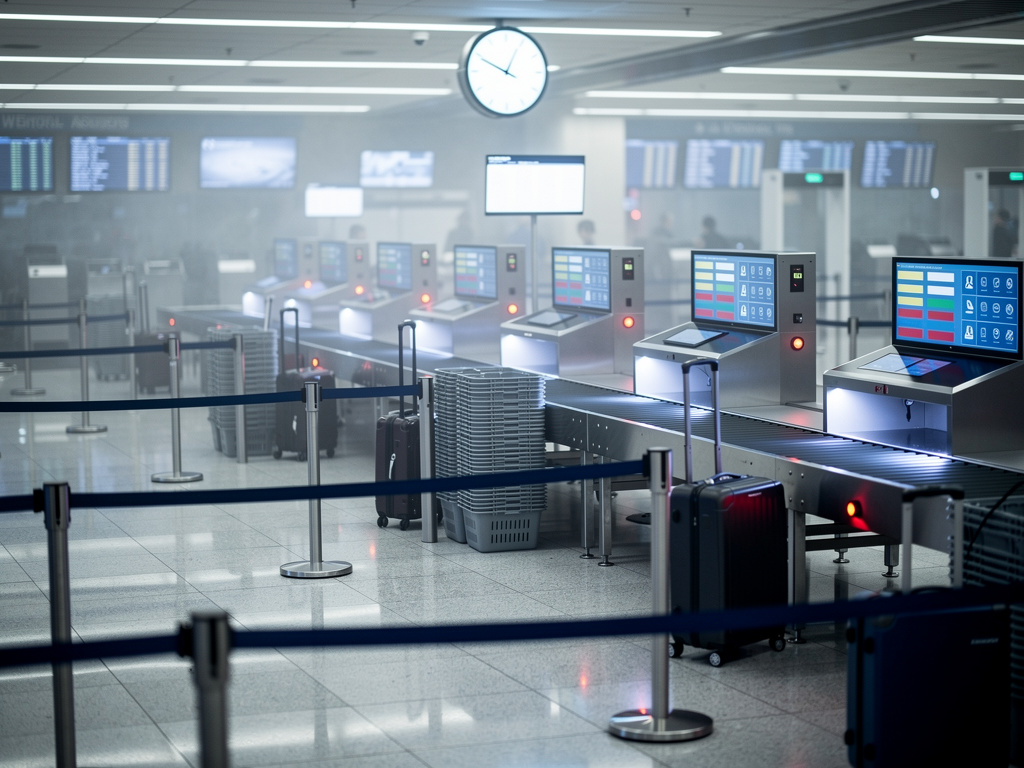
Scott Kirby has seen this movie before. The United Airlines CEO went public last week with a blunt warning: if Congress fails to strike a deal and the Department of Homeland Security loses its funding, the consequences for air travel won’t be abstract budget politics. They’ll be visceral — hours-long TSA lines, stranded passengers, and a cascading disruption across the world’s busiest aviation network.
“The last time there was a prolonged government shutdown, TSA workers — who are not highly paid — started calling in sick because they weren’t getting paid,” Kirby told reporters, as detailed by Business Insider. “And wait times at TSA went to four, five, six hours.”
He wasn’t exaggerating. The 2018-2019 government shutdown — the longest in U.S. history at 35 days — turned airports into bottlenecks. TSA agents, classified as essential workers, were required to show up. Many didn’t. Absentee rates spiked to roughly 10% at some airports, according to TSA’s own figures at the time. The result was predictable and ugly: security checkpoints operating at reduced capacity, snaking lines that spilled out of terminal buildings, and travelers missing flights they’d booked months in advance.
Now the threat is back.
Congressional negotiations over government funding have once again stalled, with DHS appropriations caught in a broader political standoff. The department funds not just TSA but also Customs and Border Protection, the Coast Guard, FEMA, and the Secret Service. A lapse in funding would force tens of thousands of federal employees to work without paychecks — or stop working altogether if they’re deemed non-essential.
For the airline industry, the TSA piece is existential. The agency screens roughly 2.5 million passengers per day during peak travel periods. There is no private backup. No workaround. If TSA lines collapse, the entire commercial aviation system seizes up, regardless of how many planes an airline has ready to fly.
Kirby’s comments carry particular weight because United is the largest airline in the world by available seat miles and operates out of major hubs — Newark, Chicago O’Hare, Denver, Houston, San Francisco — that are already prone to congestion. A TSA slowdown at any one of those airports sends ripple effects across United’s network and, by extension, across every carrier with connecting traffic through those cities.
But this isn’t just a United problem. Airlines for America, the industry’s primary trade group, has repeatedly warned that government shutdowns impose real financial costs on carriers. Flights get canceled. Passengers rebook or demand refunds. Corporate travel managers pull back. The demand destruction is swift and difficult to recover from, especially during high-travel periods.
The timing makes the current standoff particularly dangerous. Spring break travel is already underway. Easter is approaching. And summer — the airline industry’s most profitable season — is only weeks from its booking peak. Airlines plan capacity and pricing months in advance based on demand forecasts that assume a functioning federal infrastructure. A shutdown rewrites those assumptions overnight.
There’s a labor dimension here that deserves more attention. TSA screeners earn a median annual salary of roughly $47,000, according to federal pay data. Many live in high-cost metropolitan areas near major airports. Missing even one paycheck creates genuine financial hardship. During the 2018-2019 shutdown, food banks set up distribution points at airports to feed unpaid federal workers. Some TSA agents reportedly drove for Uber between shifts to cover bills. Asking these workers to maintain perfect attendance while Congress debates funding is, as Kirby put it, unrealistic.
The Transportation Security Administration has made some structural improvements since that last shutdown. Administrator David Pekoske pushed through a pay equity initiative in 2022 that brought TSA screener compensation more in line with other federal employees under the General Schedule pay system. That helped with retention and morale. But it doesn’t solve the fundamental problem: if the government shuts down, paychecks stop, and no pay raise can offset zero income.
Airlines have limited tools to prepare. They can pre-position staff at airports, send push notifications urging passengers to arrive earlier, and adjust schedules at the margins. But they can’t screen passengers themselves. They can’t open additional security lanes. They are, in the most literal sense, dependent on a government agency functioning properly for their core product to work.
Some in the industry have quietly revived discussions about privatizing airport security screening, a model used in several countries including Canada, the United Kingdom, and Germany. The argument is straightforward: private contractors, funded by passenger security fees rather than congressional appropriations, wouldn’t be subject to shutdown politics. The counterargument — that privatization could reduce accountability and introduce profit motives into a sensitive national security function — has kept the idea from gaining traction in Washington.
Wall Street is watching. Airline stocks have been volatile in 2026, buffeted by fluctuating fuel prices, tariff uncertainty, and now the specter of a funding lapse. Investors remember what happened to airline equities during the last prolonged shutdown. Delta, American, United, and Southwest all saw share price declines as the disruption dragged on and forward bookings softened.
And it’s not just airlines at risk. Airport concessionaires, ground handling companies, rental car agencies, and hotels near major airports all take hits when passenger volumes drop. The economic ripple effects extend far beyond the terminal.
Kirby was careful to frame his comments as a call for bipartisan action rather than an attack on either party. “This isn’t a political statement,” he said, according to Business Insider. “It’s a practical one. If you don’t fund DHS, the system breaks down.”
He’s right. And the system breaking down isn’t a hypothetical. It’s a documented historical event with a clear causal chain: no funding leads to no pay, which leads to absenteeism, which leads to longer lines, which leads to missed flights, which leads to canceled flights, which leads to billions in economic damage.
Congress has been here before and found last-minute solutions — continuing resolutions, short-term funding patches, eleventh-hour deals struck after midnight. The pattern is familiar. So is the brinksmanship. What’s different this time is that the airline industry is running at higher load factors than it was in 2019, meaning there’s less slack in the system to absorb disruption. Planes are fuller. Airports are more crowded. The margin for error is thinner.
The major carriers have all invested heavily in operational resilience since the meltdowns of 2022, when Southwest Airlines’ holiday debacle and widespread industry cancellations exposed how fragile airline operations had become. They’ve upgraded technology, improved crew scheduling systems, and built larger operational buffers. None of that matters if the front door to the airport — the TSA checkpoint — is effectively closed.
So what happens next? If history is a guide, the political calculus shifts once the pain becomes visible. Long TSA lines generate local news coverage. Local news coverage generates constituent complaints. Constituent complaints generate pressure on lawmakers. The question is how much disruption occurs before that feedback loop produces a deal.
For Kirby and his counterparts at Delta, American, Southwest, JetBlue, and Alaska, the answer to that question has direct financial consequences measured in the hundreds of millions. They’ve done what they can: sounded the alarm, engaged lobbyists, and prepared contingency plans. Now they wait — along with the millions of Americans who simply want to board a plane and get where they’re going.
The airline industry doesn’t ask for much from the federal government. It doesn’t receive direct subsidies in normal times. It pays fees, taxes, and surcharges that fund the very agencies now at risk of going dark. What it needs, above all else, is for the government to keep the lights on at airport security. That shouldn’t be a controversial request. And yet here we are.


 WebProNews is an iEntry Publication