
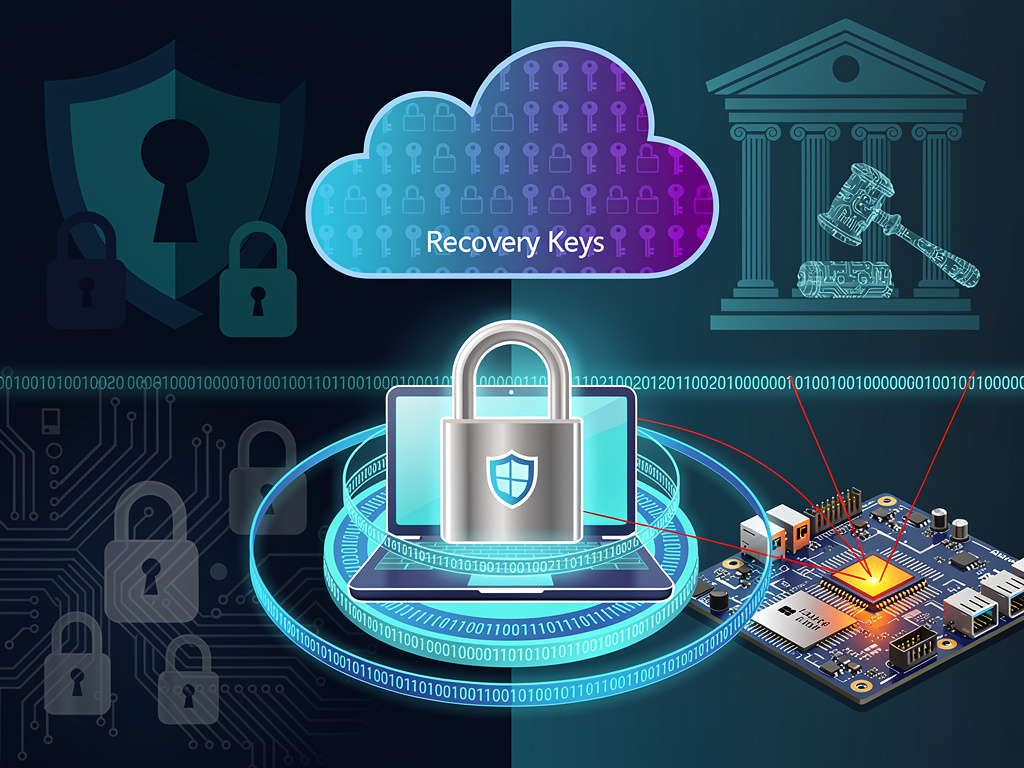
NEW YORK—In the sprawling digital infrastructure that underpins the global economy, few tools are as quietly ubiquitous as Microsoft’s BitLocker. Integrated into billions of Windows devices, this full-disk encryption feature stands as the first line of defense for corporate secrets, government data, and personal files. Yet, for over a decade, a persistent question has shadowed this digital fortress: Is there a secret way in? The debate, once centered on whispers of government backdoors, has evolved into a far more complex and tangible discussion about physical vulnerabilities, cloud conveniences, and the immense legal pressure exerted on tech giants.
The seeds of this deep-seated suspicion were sown in the wake of the Snowden revelations. In 2013, reports surfaced suggesting that Microsoft had collaborated with intelligence agencies, sparking concerns that BitLocker might contain a deliberate weakness. At the time, Microsoft issued a firm and unequivocal denial, stating, “Microsoft does not provide any government with direct or unfettered access to our customer’s data,” a position it has maintained ever since. As reported by The Verge, the company specifically refuted claims of providing encryption keys or a ‘backdoor’ to the government, attempting to quell a rising tide of user distrust.
A Decade of Scrutiny and Denial
The initial controversy revolved around technical specifics, such as the use of a random number generator that some security experts deemed potentially flawed. Microsoft has since updated its encryption standards, now defaulting to the more robust XTS-AES 256-bit encryption in newer operating systems. However, the core tension—between a corporation’s pledge to protect user data and its legal obligation to comply with state-level demands—has only intensified. For corporate IT managers and federal security officers, understanding the true resilience of BitLocker is not an academic exercise; it is a critical component of risk management.
While the specter of a secret software ‘backdoor’ has largely faded from the conversation among security professionals, it has been replaced by a series of very real, physical attack vectors. The modern threat to BitLocker is less about cryptographic genius and more about hardware-level cunning. Researchers have repeatedly demonstrated that with brief physical access to a device, the encryption can be compromised, challenging the notion of BitLocker as an impenetrable shield against sophisticated adversaries.
The Evolving Nature of the Threat
A notable example of this evolved threat involves the Trusted Platform Module (TPM), the dedicated security chip that BitLocker relies on to store encryption keys securely. In early 2024, a security researcher demonstrated a method to bypass BitLocker on numerous laptops by physically probing the connection between the TPM and the CPU. As detailed by Tom’s Hardware, this technique, costing only about $10 in hardware, allows an attacker to ‘sniff’ the decryption key as it’s passed during the boot-up process. While it requires technical skill and physical access, it shatters the illusion of absolute security for unattended devices, a scenario all too common for business travelers and field agents.
This type of vulnerability underscores a fundamental shift in the security conversation. The focus has moved from questioning the integrity of Microsoft’s code to scrutinizing the hardware implementations of its partners and the inherent weaknesses of a physically accessible system. For law enforcement and intelligence agencies, exploiting such hardware-level flaws provides a potential pathway to data on a seized device without ever needing to compel cooperation from Microsoft.
The Cloud Conundrum: A Key Under the Doormat?
Perhaps the most significant change in the BitLocker environment over the past decade has been its deep integration with the cloud. In a push for user-friendliness, Windows now strongly encourages, and sometimes requires, users to back up their 48-digit BitLocker recovery key to their personal Microsoft Account. This convenience, however, creates a powerful new avenue for government access that bypasses on-device security entirely. If a user’s device is seized, law enforcement can serve a warrant not to the individual, but directly to Microsoft for the recovery key stored in its cloud infrastructure.
This practice effectively moves the point of legal pressure from a local device to a centralized corporate server. According to a detailed analysis by PCMag on the automatic device encryption in Windows 11, this cloud backup is often enabled by default, with many users unaware that the key to their encrypted data resides on a server accessible via legal order. This creates a dichotomy where the encryption on the physical disk remains strong, yet the primary recovery method is subject to subpoena, a subtlety often lost on the average user but well understood by federal investigators.
Microsoft’s Transparency and the Legal Tightrope
In response to growing privacy concerns, Microsoft, along with other tech titans, began publishing regular transparency reports. These documents provide a statistical overview of the government demands for user data they receive. According to Microsoft’s own Law Enforcement Requests Report, the company received 25,054 legal demands for consumer data from U.S. law enforcement in the second half of 2023 alone, impacting 49,603 accounts. While these reports offer a glimpse into the scale of government surveillance, they are constrained by legal restrictions, often preventing the company from disclosing the full nature of the requests, particularly those involving national security.
This places Microsoft in a precarious position. The company must project an image of unwavering commitment to user privacy to maintain its global customer base, particularly in Europe where data protection laws are stringent. Simultaneously, as a U.S.-based corporation, it must comply with lawful warrants and gag orders from its home government. This balancing act means that while the company may not provide a ‘backdoor,’ its vast repositories of user data, including BitLocker recovery keys, remain a prime target for legally sanctioned access.
From Theory to Forensic Practice
In the world of digital forensics, the challenge of defeating BitLocker is a daily reality. Forensic firms and law enforcement agencies utilize sophisticated tools that exploit known weaknesses and user oversights. Companies like ElcomSoft market software that can analyze memory dumps or hibernation files to extract encryption keys, a technique that works if a computer is captured in a running or hibernating state. As noted in a report by security firm Sophos, these methods don’t ‘break’ the AES encryption itself but rather cleverly circumvent it by finding the key where it is temporarily stored in a vulnerable state.
This practical reality highlights the gap between theoretical cryptographic strength and real-world operational security. The FBI and other agencies have invested heavily in developing these capabilities, understanding that in many cases, human or procedural error provides an opening. An employee leaving a laptop in sleep mode instead of shutting it down, or an organization failing to clear a TPM before decommissioning a device, can be all the advantage an investigator needs to bypass an otherwise secure system.
The Enduring Question of Trust
Ultimately, the debate over BitLocker’s security has matured. The simple narrative of a potential government backdoor has given way to a more nuanced understanding of a complex system with multiple points of potential failure. The integrity of the core encryption is rarely questioned by experts; instead, the focus is on implementation flaws, hardware vulnerabilities, the centralizing effect of cloud backups, and the unavoidable reality of legal compliance.
For industry insiders, from chief information security officers to federal IT administrators, the lesson is clear: BitLocker is a powerful tool, not a panacea. Its effectiveness is contingent on proper configuration, user awareness, and robust physical security protocols. The trust equation is no longer a simple binary of whether one trusts Microsoft’s code. It now involves trusting hardware manufacturers, cloud infrastructure, and the intricate legal framework that governs them all. The golden key to BitLocker-protected data may not be a hidden line of code, but a court order, a soldering iron, or a forgotten password saved in the cloud.


 WebProNews is an iEntry Publication