
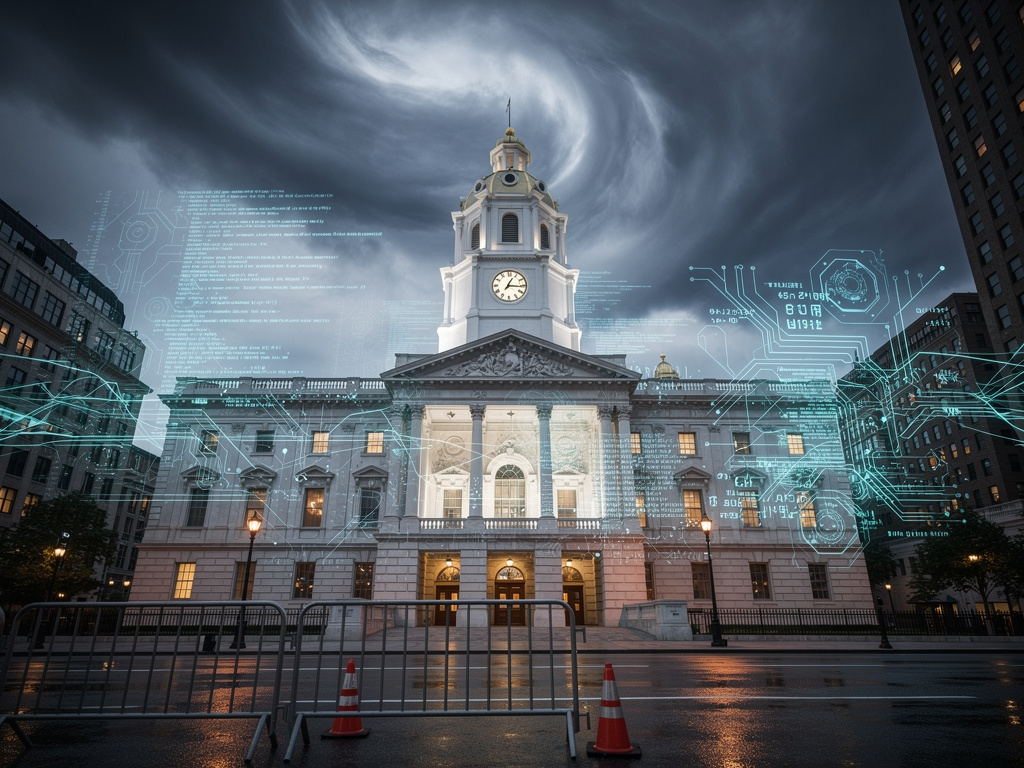
In the annals of New York City political controversy, the catalysts for crisis have ranged from the grandiose to the absurd. But rarely has a single animated image — a GIF, no less — threatened to upend a mayoral administration before it even found its footing. Yet that is precisely the situation confronting Mayor Zohran Mamdani, whose young tenure at City Hall has been rocked by revelations surrounding his chief technology officer, Lisa Gelobter, and a GIF that has become a symbol of deeper questions about transparency, digital governance, and the cultural fault lines of modern politics.
The controversy, first reported in detail by The New York Times, centers on Gelobter — a technologist with a storied career in Silicon Valley and the federal government — and a GIF she circulated internally that critics say was dismissive of concerns raised by community advocates about the city’s approach to digital surveillance and data privacy. What might have been a fleeting moment of irreverence in a private Slack channel has instead metastasized into a full-blown political firestorm, raising pointed questions about the culture inside Mamdani’s City Hall and the administration’s willingness to take public criticism seriously.
A Technologist’s Pedigree Meets the Rough-and-Tumble of City Politics
Lisa Gelobter is no ordinary political appointee. Her résumé reads like a history of the modern internet itself. She is widely credited with contributing to the development of the GIF animation format during her early career, and she went on to hold senior roles at Hulu, BET, and the U.S. Digital Service under the Obama administration. When Mamdani tapped her to serve as New York City’s chief technology officer shortly after his inauguration, the appointment was heralded as a signal that the new mayor — a democratic socialist who had campaigned on a platform of radical transparency and community empowerment — was serious about modernizing city government.
But the very qualities that made Gelobter a celebrated figure in tech circles — her bluntness, her impatience with bureaucratic inertia, her Silicon Valley sensibility — have proven to be liabilities in the deeply relational world of New York City governance. According to The Times, the GIF in question was shared in an internal communications channel after a contentious public hearing in which community organizers from neighborhoods in the Bronx and Brooklyn challenged the administration’s plans to expand the use of algorithmic tools in city agencies, including the Department of Social Services and the NYPD’s predictive policing programs.
The GIF Heard Round the Boroughs
The animated image — reportedly a looping clip of a person sarcastically applauding — was accompanied by a brief comment from Gelobter that, according to sources who spoke to The Times, appeared to mock the testimony of community members who had spoken passionately about the potential for algorithmic bias to disproportionately harm Black and Latino New Yorkers. When screenshots of the exchange leaked, the reaction was swift and unsparing.
City Council members, including several who had been aligned with Mamdani’s progressive agenda, publicly demanded an explanation. Council Member Shahana Hanif, who chairs the Committee on Technology, called the incident “deeply troubling” and said it reflected a “fundamental disconnect between this administration’s rhetoric about centering community voices and the reality of how those voices are treated behind closed doors.” The criticism cut particularly deep because Mamdani had built his political identity on the promise of a government that would be genuinely accountable to working-class New Yorkers and communities of color.
An Administration on the Defensive
The mayor’s office initially attempted to downplay the controversy, releasing a statement describing the GIF as an “informal, offhand moment” that did not reflect the administration’s values or its commitment to community engagement. But as pressure mounted, Mamdani himself addressed the matter during a press conference at City Hall, calling the incident “regrettable” and affirming that Gelobter had his “full confidence.” He stopped short of issuing a formal apology, a decision that further inflamed critics.
For Gelobter, the episode has been a bruising introduction to the particular intensity of New York City politics. In a brief statement released through the mayor’s office, she expressed regret for the “distraction” caused by the leaked message and emphasized her deep personal commitment to equity in technology. “My entire career has been about making technology work for people who have been left out,” she said, according to The New York Times. “I understand why this caused pain, and I take that seriously.”
Deeper Fissures Over Algorithmic Governance
But the GIF controversy is, in many ways, merely the surface expression of a much more substantive and consequential debate about the role of technology in city government. New York City has been grappling for years with questions about how algorithms are used to make decisions that affect millions of residents — from child welfare investigations to housing allocation to policing. Under the previous administration of Eric Adams, the city passed landmark legislation requiring audits of automated decision-making tools, but enforcement was widely criticized as toothless.
Mamdani campaigned on a promise to go further, pledging to create a robust framework for algorithmic accountability that would give affected communities a meaningful voice in how these tools are designed and deployed. The appointment of Gelobter was meant to be the embodiment of that promise. Instead, the GIF incident has given ammunition to those who argue that even ostensibly progressive administrations are susceptible to the technocratic arrogance that has long characterized Silicon Valley’s relationship with the communities it claims to serve.
The Political Calculus for Mamdani
The political stakes for Mamdani are considerable. As the first democratic socialist to lead New York City since the days of Fiorello La Guardia — and as a mayor who won a hard-fought primary by assembling a coalition of progressive activists, labor unions, and communities of color — he can ill afford to be seen as dismissive of the very constituencies that put him in office. The GIF controversy has provided an opening for rivals both within and outside his coalition to question whether his administration’s commitment to participatory governance is genuine or merely performative.
Several prominent community organizations, including the Surveillance Technology Oversight Project and the grassroots coalition Communities Against Digital Policing, have called for Gelobter’s resignation, arguing that the incident is symptomatic of a broader pattern of disregard for community input in the administration’s technology policy. “This isn’t about a GIF,” said Albert Fox Cahn, executive director of the Surveillance Technology Oversight Project. “This is about whether the people most affected by these technologies will have a real seat at the table or just a seat in the audience.”
The Irony of the Medium and the Message
There is, of course, a rich irony in the fact that the controversy involves a GIF — a format that Gelobter herself helped bring into existence. The Graphics Interchange Format, developed in 1987 by CompuServe and refined by engineers including Gelobter in its early animated iterations, has become one of the most ubiquitous forms of digital expression, a lingua franca of internet culture used billions of times daily to convey humor, sarcasm, solidarity, and everything in between. That a technology born of Gelobter’s own ingenuity should become the instrument of her political undoing is the kind of narrative twist that even the most inventive screenwriter might hesitate to deploy.
Yet the episode also underscores a broader truth about the nature of digital communication in public life. In an era when internal messages can be leaked instantly and context is often the first casualty, the informal cultures that thrive inside organizations — the jokes, the shorthand, the GIFs — carry enormous reputational risk. What reads as harmless banter among colleagues can, when stripped of context and projected onto the public stage, become an indictment of an entire institution’s values.
What Comes Next for City Hall’s Tech Agenda
For now, Gelobter remains in her post, and the Mamdani administration has announced a series of “listening sessions” with community groups to address concerns about the city’s technology agenda. The City Council’s Committee on Technology has scheduled oversight hearings for later this month, where Gelobter is expected to testify. Council members have signaled that they intend to press the administration on specific policy commitments, including the creation of an independent community advisory board with binding authority over the deployment of algorithmic tools in city agencies.
Whether the GIF controversy proves to be a passing squall or a defining crisis for the Mamdani administration will depend in large part on the substance of what comes next. If the listening sessions and oversight hearings lead to meaningful policy changes — real mechanisms for community oversight, enforceable transparency requirements, and genuine accountability for algorithmic harms — then the episode may ultimately be remembered as a painful but productive turning point. If, on the other hand, the administration’s response amounts to little more than symbolic gestures and carefully worded statements, the GIF will remain what it has already become for many New Yorkers: a symbol of the gap between progressive promises and the messy, often disappointing reality of governing.
In the end, the story of Lisa Gelobter and the GIF is not really a story about technology at all. It is a story about power — who wields it, who is subject to it, and whether the people who build the tools of governance are willing to be held accountable by the people those tools are meant to serve. For a city that has always been a crucible for the tensions between ambition and equity, it is a story that is far from over.


 WebProNews is an iEntry Publication