
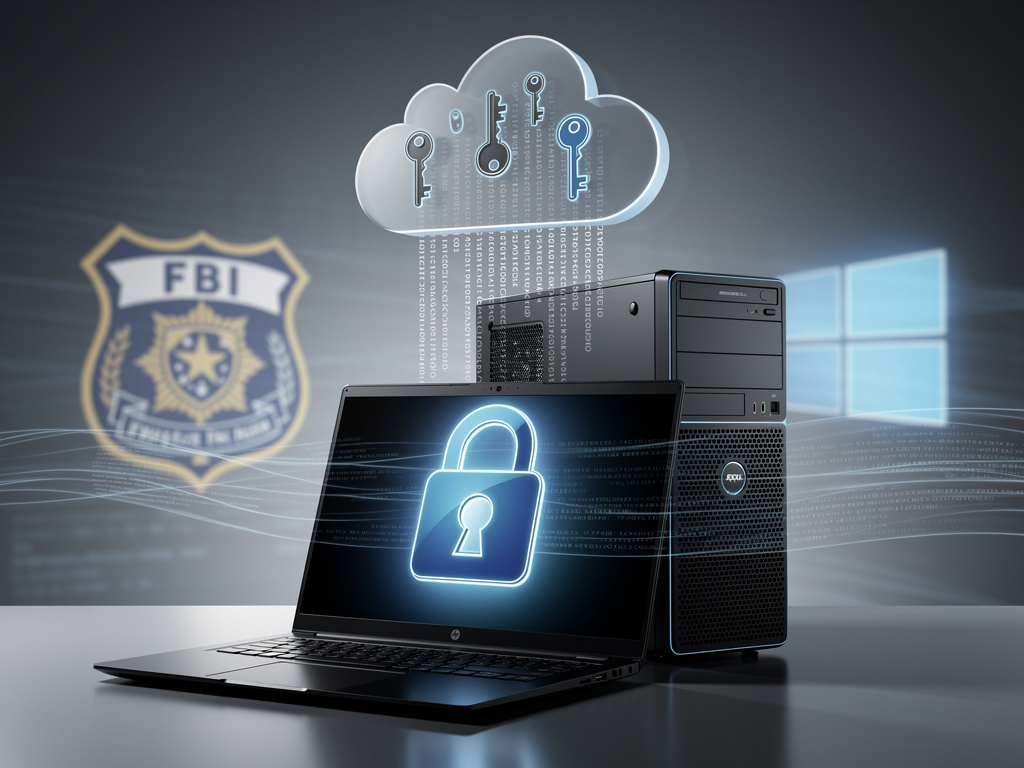
WASHINGTON—In a revelation sending shockwaves through the cybersecurity and corporate worlds, a bombshell report alleges that Microsoft Corp. has provided federal law enforcement with a method to bypass the company’s widely used BitLocker encryption, effectively granting access to data that millions of users believed was securely locked. The disclosure, stemming from a detailed analysis of recently unsealed court documents, challenges the fundamental promises of data security made by one of the world’s largest technology providers and re-ignites a fierce, long-simmering debate over privacy and government access.
The central claim, first brought to light in a comprehensive investigation by Forbes, details how the Federal Bureau of Investigation, in a high-profile domestic terrorism case, was able to decrypt data on a suspect’s Windows-powered laptop that was protected by BitLocker. The unsealed documents reportedly reference “technical assistance” from Microsoft that went far beyond the typical handover of user account information, alluding to a mechanism that allowed agents to access the device’s encrypted hard drive. This development suggests a level of cooperation that has, until now, remained firmly behind a wall of corporate secrecy and legal classification.
A Question of Keys and Consent
At the heart of the issue is not a mythical “master key” in the traditional sense, but a feature that has been part of Windows for years: the BitLocker recovery key. When users set up BitLocker, particularly on modern devices, they are strongly encouraged—and in some cases defaulted—to back up their 48-digit recovery key to their personal Microsoft account. Security experts have long pointed to this cloud-based backup as a potential weak link. While convenient for users who forget their password, it also centralizes a critical piece of security data on Microsoft’s servers, making it a prime target for lawful government requests. As explained by publications like PCMag, this recovery key is the ultimate override for accessing an encrypted volume.
The process, as pieced together from the court filings and anonymous sources cited in the report, appears to involve the FBI serving a warrant not for the user’s data, but for the recovery key stored in their Microsoft account. Armed with this key, agents can unlock the encrypted drive on a seized device. While Microsoft can argue this is simply complying with a legal warrant for data it holds—similar to handing over emails or cloud-stored documents—critics argue it is a distinction without a difference. For the end user, the result is the same: an encryption shield they trusted has been rendered useless by the very company that provided it.
The Specter of the CLOUD Act
This situation is supercharged by the legal framework established by the CLOUD Act of 2018. The legislation explicitly grants U.S. authorities the power to compel tech companies to provide requested data stored on their servers, regardless of where in the world that data resides. This has created immense tension between U.S. tech giants and international customers and governments, who fear their data is subject to American surveillance. The law provides a clear legal pathway for the FBI to demand a BitLocker recovery key from Microsoft, as detailed by analysis from institutions like the Brookings Institution. Microsoft is left with little legal ground to refuse such a request.
Microsoft’s own transparency reports reveal a staggering volume of government demands. The company’s most recent Law Enforcement Requests Report shows it receives tens of thousands of legal demands for consumer data globally each year, affecting tens of thousands of users. While the company contests a portion of these, it complies with the vast majority. The new allegations suggest that these requests now quietly include the keys to what many considered their most private digital safes.
Echoes of an Old War
The tension between Silicon Valley’s privacy pledges and Washington’s security demands is not new. The industry-shaking standoff between Apple and the FBI in 2016 over access to the San Bernardino shooter’s iPhone brought the debate to a boil. The FBI demanded Apple build a special version of its operating system to bypass security features, a request Apple CEO Tim Cook publicly decried as “the software equivalent of cancer.” That case, extensively covered by outlets like Wired, ended when the FBI paid a third-party firm to hack the phone, but the underlying question was never resolved.
Unlike the Apple case, which involved a demand to create a new vulnerability, the BitLocker issue revolves around exploiting an existing feature by design. This makes Microsoft’s legal position more precarious and its public relations challenge more complex. The company has long advocated for strong encryption, yet its default system architecture for BitLocker recovery appears to have provided law enforcement with the very access it has been seeking for decades. The government’s relentless push for what critics call an encryption backdoor continues to be a point of major contention, with privacy advocates warning that any such access for the “good guys” will inevitably be exploited by malicious actors, as chronicled by Ars Technica.
The Corporate Fallout and Eroding Trust
The implications for the corporate sector are profound. BitLocker is a cornerstone of enterprise security strategies, used to protect sensitive intellectual property, financial data, and customer information on millions of company laptops. Its use is often mandated to comply with data protection regulations like GDPR and HIPAA. The news that these encrypted devices may be accessible to law enforcement through a warrant served to Microsoft—without the company’s knowledge—undermines years of security architecture and compliance efforts.
Chief Information Security Officers (CISOs) at major corporations are now likely scrambling to review their data protection policies. The immediate fallout could see a significant shift in how enterprises manage encryption keys. Companies may accelerate moves to enforce policies that prevent or block the backup of BitLocker keys to employee Microsoft accounts, opting instead for on-premise key management solutions. This would give them sole control over access, but also places a greater burden of responsibility on their IT departments. The revelation fundamentally erodes the circle of trust between businesses and their primary technology partner.
An Unfolding Crisis for Redmond
For Microsoft, this is a multi-front crisis. It damages its reputation as a guardian of user data, potentially driving customers to competitors or open-source encryption tools like VeraCrypt, which offer no cloud-based recovery mechanism. It also creates a diplomatic firestorm, as foreign governments and multinational corporations must now question whether their data, even when encrypted on their own devices, is safe from the reach of U.S. intelligence and law enforcement agencies.
The coming weeks will likely see intense scrutiny from lawmakers in both the U.S. and Europe, as well as pointed questions from enterprise customers who have built their security infrastructure on the assumption of BitLocker’s integrity. Microsoft’s response has been carefully worded, emphasizing its obligation to comply with the law while denying the existence of a universal backdoor. But as the details continue to emerge from the shadows of classified court proceedings, a carefully worded statement may not be enough to restore the trust that has been so deeply compromised.


 WebProNews is an iEntry Publication