
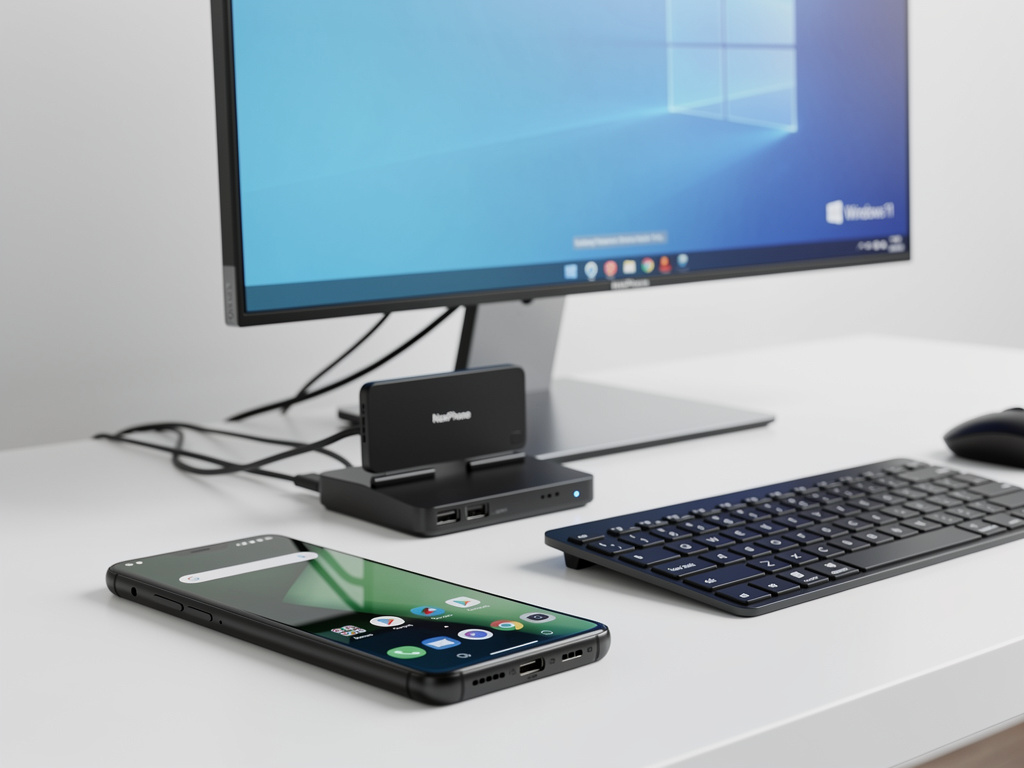
In the crowded and fiercely competitive world of mobile technology, a small company is chasing a ghost that has haunted the industry for over a decade: the dream of a single, pocketable device that can seamlessly transform into a full-featured personal computer. Nex Computer, a company known for its ‘lapdock’ accessories that turn smartphones into laptops, has unveiled its most ambitious project yet—the NexPhone. It’s a device that promises not just a desktop-like experience, but the ability to run Android, Linux, and, most audaciously, a full version of Windows 11.
The concept, known as convergence, is a graveyard of ambitious projects from giants like Microsoft, Canonical, and Motorola. Each attempted to bridge the gap between mobile and desktop, only to be thwarted by technical limitations, software ecosystem gaps, or a market that simply wasn’t ready. Now, Nex Computer is betting that advancements in mobile processing power and a more mature software environment have finally made the all-in-one dream attainable. The company plans to launch the device via a crowdfunding campaign, a high-stakes gambit that will serve as a direct referendum on whether consumers are finally ready to replace their laptops with a phone.
At its core, the NexPhone presents itself as a high-end Android smartphone. However, its true identity is revealed when connected to an external display. The device is being designed to offer a “Linux on Demand” feature, providing a desktop environment for developers and power users. The most disruptive promise, as detailed by tech outlet Liliputing, is the ability to boot into a full-fledged Windows 11 environment when docked to one of the company’s NexDock or NexMonitor peripherals. This dual-boot capability aims to deliver a no-compromise workstation, moving far beyond the limited, mobile-centric desktop modes offered by competitors.
A Multi-OS Strategy Built on Raw Power
To accomplish this feat, Nex Computer is aiming for flagship-level hardware. While final specifications are contingent on the crowdfunding campaign’s timing and success, the company has signaled its intent to use a top-tier ARM processor, potentially a future Qualcomm Snapdragon 8-series chip, coupled with substantial RAM and fast internal storage. This raw power is critical, as running multiple operating systems, especially a demanding one like Windows 11, requires significant computational resources. The ability to run Windows on an ARM-based mobile chip has become more viable with Qualcomm’s recent advancements and Microsoft’s continued development of Windows on ARM, but performance and application compatibility remain significant hurdles for any contender in this space.
The technical implementation is what sets the NexPhone apart from its predecessors. Unlike Samsung’s DeX, which projects a customized Android-based desktop, the NexPhone plans to offer native operating systems. According to a report from Tom’s Hardware, this functionality is strictly tied to its docked state, a crucial distinction that preserves the device’s primary function as an Android phone when mobile, while unlocking its workstation potential when stationary. This approach could mitigate battery drain and performance issues that would arise from running a desktop OS on the go, a key failing of earlier convergence attempts.
This ambitious multi-boot system is a complex software engineering challenge. Seamlessly switching between Android, a Linux environment, and a full Windows 11 installation requires a robust bootloader and carefully managed system resources. As noted in a breakdown by CNX-Software, the phone will leverage virtualization and containerization for its Linux capabilities, a common approach for adding desktop-like functionality to Android. However, running a native instance of Windows 11 is a far greater challenge, one that will determine whether the NexPhone is a true productivity tool or merely a novel proof-of-concept.
Leveraging an Existing Ecosystem
Nex Computer isn’t entering this market from a standstill. The company has spent years building a niche but loyal following for its NexDock line—a series of clamshell laptop docks that consist of a screen, keyboard, trackpad, and battery, but rely on a connected smartphone for their processing power. This existing product line gives the NexPhone a strategic advantage; it launches with a ready-made ecosystem of peripherals designed specifically for its core use case. This integrated approach avoids the problem faced by earlier convergence devices, which often relied on users to cobble together a workstation with third-party docks and monitors.
The company’s official product page for the NexPhone showcases a vision where a single device is the hub of a user’s digital life, transforming its interface and capabilities based on the context of its use. In a user’s pocket, it is a standard Android phone. Placed on a NexMonitor at the office, it becomes a Windows 11 desktop. Tucked into a NexDock on a plane, it is a Linux laptop. This vision directly targets a specific class of user: the tech-savvy professional, the digital nomad, and the enterprise client looking to simplify device management and reduce hardware redundancy.
This strategy of building the ecosystem first is a reversal of the typical hardware launch playbook. By establishing the utility of its peripherals with existing Samsung and Motorola phones, Nex Computer has already validated the market for lapdocks. Now, it seeks to vertically integrate by providing the ideal smartphone to power that experience. This reduces the risk of launching into a vacuum and provides a clear upgrade path for its current customer base, who are already bought into the concept of a phone-powered workstation.
Echoes of a Difficult Past
Despite the compelling vision, the path Nex Computer is treading is littered with the abandoned projects of far larger companies. The Motorola Atrix 4G, launched in 2011 with its own lapdock, was a pioneering device but was hobbled by underpowered hardware and a clunky, custom Linux environment. Later, Microsoft’s Continuum for Windows Phone promised a similar PC-like experience but was doomed by the failure of the mobile operating system it was built upon and a severe lack of compelling applications. Even Canonical’s ambitious Ubuntu Edge smartphone, which raised millions in crowdfunding, ultimately failed to reach its funding goal and never shipped.
These historical precedents serve as a stark warning. The primary challenge has always been the software. Users expect their desktop experience to be flawless, with access to the same applications and performance they get from a dedicated laptop. While Samsung’s DeX has found a niche, it has not fundamentally altered the market because, as tech enthusiasts on forums like Slashdot often point out, it remains a mobile OS in a desktop shell. The NexPhone’s promise of a full Windows 11 experience is its greatest potential strength and its most significant point of potential failure. The performance of Windows on ARM, particularly regarding emulation for legacy x86 applications, will be under intense scrutiny.
The market has also evolved. The seamless integration between Apple’s iPhones and MacBooks, along with cloud-based services, has provided a different kind of convergence for many users. The question for Nex Computer is whether there is a large enough market of users who demand a single piece of hardware to do everything, rather than a suite of devices that work well together. The answer likely lies in execution. If the NexPhone can deliver a user experience that is 90% as good as a dedicated laptop, its convenience could win over a significant number of converts.
The Road Ahead is Paved with Uncertainty
By opting for a crowdfunding model, Nex Computer is both mitigating financial risk and engaging in a public stress test of its concept. The campaign’s success or failure will provide an unambiguous signal of market demand. However, this path is fraught with peril. Hardware crowdfunding is notorious for delays, broken promises, and products that fail to live up to their initial hype. Nex Computer will need to be transparent about its production timeline and manage expectations carefully, especially given the project’s technical complexity.
The competitive environment is more formidable than ever. Flagship smartphones from Samsung and Google already offer powerful processors and refined desktop modes. As noted by NotebookCheck, the NexPhone will need to match these devices on standard smartphone metrics like camera quality, battery life, and screen technology, all while delivering on its unique multi-OS promise. Falling short in any of these areas could relegate it to a niche gadget for hobbyists rather than a mainstream productivity tool.
Ultimately, the NexPhone represents a bold swing at a long-held industry dream. It is an attempt to create a device that is not just a jack-of-all-trades but a master of several. Its success hinges on flawless execution of a profoundly difficult technical challenge and on convincing a market, conditioned by years of failed attempts, that this time is different. The industry will be watching closely, not just to see if a small company can deliver a product that has eluded corporate giants, but to see if the ghost of convergence can finally be made real.


 WebProNews is an iEntry Publication