
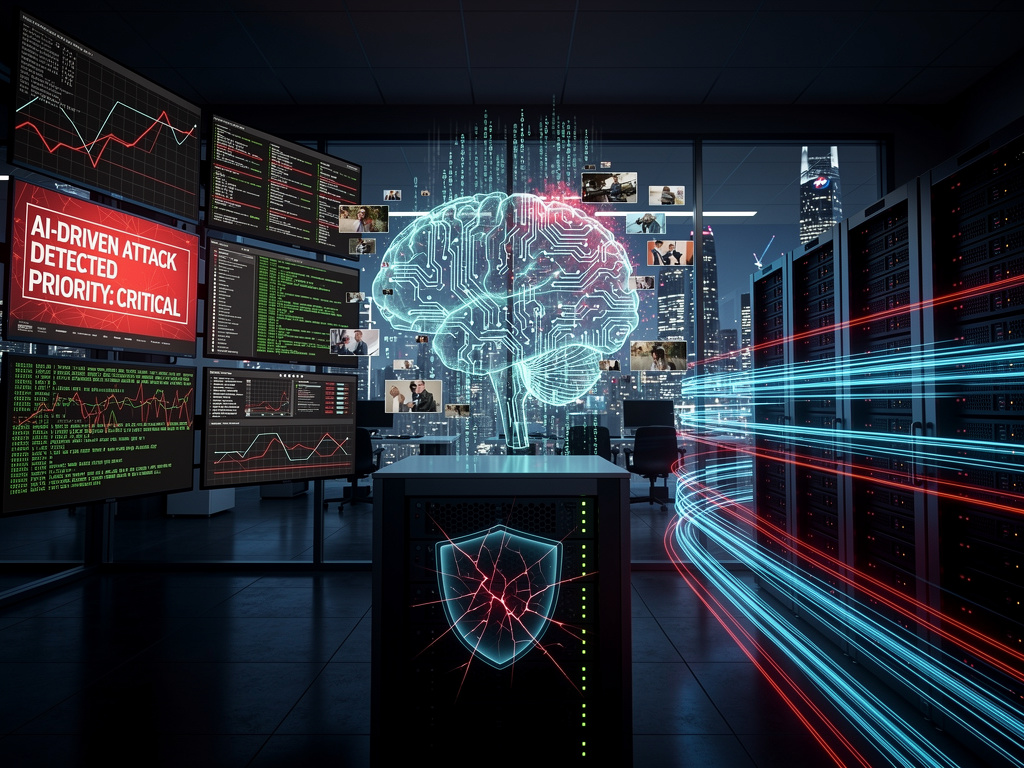
A senior finance worker at a multinational firm receives an email for a video conference with his UK-based chief financial officer. He joins the call. The CFO is there on screen, along with several other colleagues, their voices and faces familiar. They discuss a secret, time-sensitive transaction that requires immediate large-scale fund transfers. The worker, seeing and hearing his superiors, complies. Only later does he discover the truth: everyone on the call, including the CFO, was a sophisticated, AI-generated “deepfake.” The company was now out $25 million.
This incident, which Hong Kong police reported in early 2024, is not a scene from a science fiction film but a stark new reality for global business. As executives champion generative artificial intelligence for its potential to revolutionize productivity, a parallel and more sinister revolution is underway in the shadows. AI is being weaponized, dramatically lowering the barrier to entry for complex cybercrime and creating a class of intelligent, adaptive threats that are beginning to outpace traditional corporate defenses and human intuition.
The Democratization of Sophisticated Cybercrime
For years, crafting a convincing phishing email or social engineering script required linguistic skill, cultural awareness, and technical know-how. Generative AI models have commoditized these skills overnight. Threat actors can now generate flawless, context-aware, and highly personalized emails in any language, designed to manipulate specific employees by referencing their roles, projects, and professional networks. This automation of deceit is making every employee with an inbox a potential high-risk target.
The threat extends well beyond email. “AI is dramatically lowering the barrier to entry for threat actors and will enable a whole new wave of cyber criminals,” Don Fancher, a principal at Deloitte’s advisory practice, told TechRadar. This new wave is using AI not only to perfect their lures but also to write malicious code. While large language models typically have safeguards to prevent the creation of malware, determined actors are finding ways to bypass them, using AI as a tireless coding assistant to develop new exploits and customize existing malware to evade detection.
Deepfakes Move from Hollywood to the Boardroom
While AI-powered text and code present a significant challenge, the advent of convincing audio and video deepfakes represents a quantum leap in social engineering. The $25 million heist in Hong Kong, as detailed by CNN, serves as a chilling proof-of-concept for what security experts call Business Identity Compromise. Attackers no longer need to just spoof an email address; they can now spoof a person’s entire digital likeness, undermining the very trust that video calls were meant to establish.
This technology is rapidly becoming more accessible, moving from the domain of state-sponsored groups to commercially available tools. The implications for corporate security are profound. A faked video call from a CEO could authorize fraudulent wire transfers, manipulate stock prices, or extract sensitive intellectual property. The traditional “call to verify” security protocol becomes unreliable when an attacker can clone the executive’s voice with just a few seconds of audio scraped from a public earnings call or interview.
Automating the Attack Lifecycle at Unprecedented Speed
The most advanced threat actors are integrating AI into every stage of their operations. Nation-state groups linked to Russia, North Korea, and Iran are using large language models to research targets, improve their reconnaissance, and refine their malicious scripts, according to a recent report from Microsoft. This allows them to operate with greater speed, scale, and stealth than ever before.
Once inside a network, an AI-driven attack can operate at machine speed, far faster than a human security team can respond. The AI can be programmed to autonomously probe for vulnerabilities, move laterally across systems, identify and exfiltrate valuable data, and even adapt its tactics in real-time based on the defensive measures it encounters. This creates a dynamic and persistent adversary that doesn’t sleep, doesn’t make human errors, and can process environmental feedback to optimize its attack path on the fly.
The Corporate Response: Fighting Fire with Fire
Faced with an AI-powered threat, corporations are realizing their only viable defense is also AI. The cybersecurity industry is in the midst of a massive pivot, embedding machine learning and artificial intelligence into a new generation of defensive tools. These systems are designed to analyze trillions of signals across a company’s digital environment—from network traffic and endpoint activity to cloud configurations—to identify anomalous patterns indicative of a breach.
The logic is straightforward: no human team can possibly monitor the sheer volume of data required to spot a sophisticated, automated attack. AI-powered security platforms, however, can establish a baseline of normal activity and instantly flag deviations, allowing security teams to focus on genuine threats instead of being overwhelmed by false positives. This AI-vs-AI dynamic is the new front line in corporate cyber defense, a high-stakes arms race where the advantage is measured in milliseconds and processing power.
Rethinking Security Frameworks for an Intelligent Age
The rise of AI adversaries is forcing a fundamental rethink of established security doctrines. The old model of a hardened perimeter—a digital castle with a moat—is obsolete. Experts now champion a “zero-trust” architecture, which operates on the principle of “never trust, always verify.” Every user, device, and application must be continuously authenticated and authorized, regardless of whether they are inside or outside the corporate network. This approach helps contain breaches by making it significantly harder for an intruder, human or AI, to move laterally once they gain an initial foothold.
Alongside this technological shift, the human element remains paramount. Employee training must evolve beyond spotting poorly worded phishing emails to recognizing the subtle signs of a sophisticated, AI-driven social engineering attempt. This includes creating protocols to verify high-stakes requests through out-of-band channels and fostering a culture of healthy skepticism, even when a request appears to come from the highest levels of leadership. As one executive noted in a Forbes analysis, the C-suite itself must lead this charge, as they are now among the most impersonated targets.
A New Mandate for the Boardroom
The escalating threat has firmly placed cybersecurity on the boardroom agenda, not as an IT issue, but as a core business continuity risk. The U.S. Securities and Exchange Commission has underscored this shift with new rules requiring public companies to disclose material cybersecurity incidents within four days and to provide detailed information about their cybersecurity risk management and governance. According to the SEC, these regulations are designed to ensure investors receive “timely, consistent, and comparable information” about the cyber risks that companies face.
This regulatory pressure, combined with the clear and present danger demonstrated by attacks like the deepfake heist, creates a new imperative for corporate leadership. Boards must now ask pointed questions about their organization’s AI-readiness, not just in terms of adoption, but in terms of defense. The conversation has to move from “Are we secure?” to “How quickly can our automated defenses detect and respond to an AI-driven attack?” The answer will increasingly determine a company’s ability to operate, compete, and survive in an era where its greatest adversary may not be human at all.


 WebProNews is an iEntry Publication