
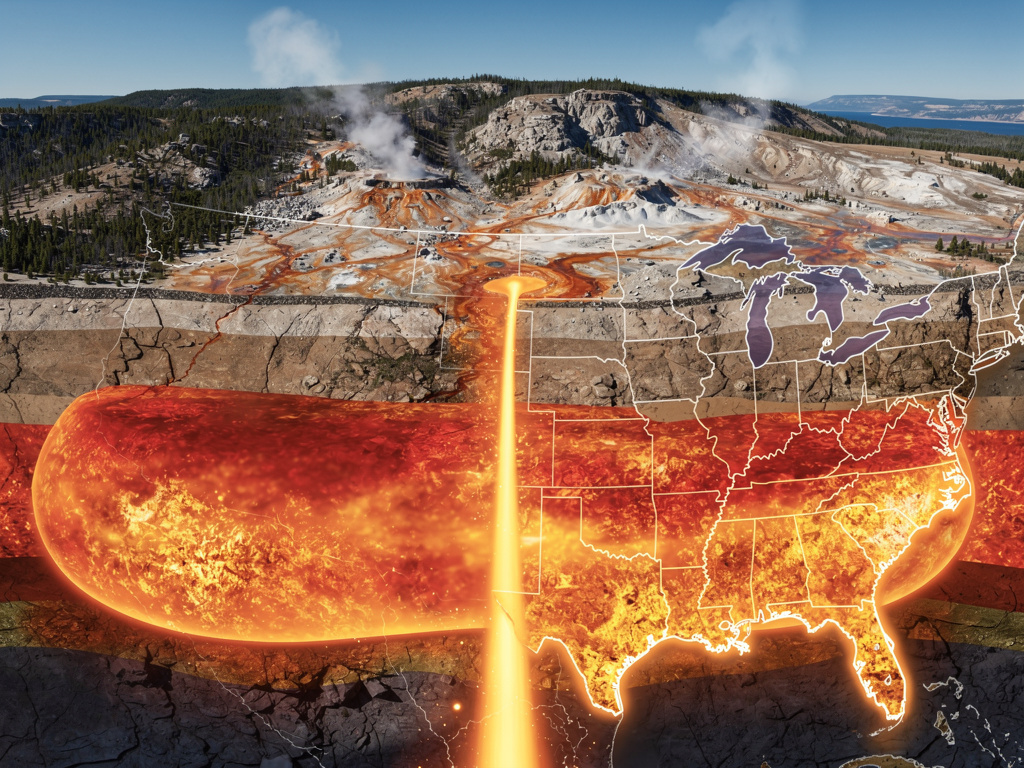
For decades, the prevailing theory about what keeps Yellowstone’s supervolcano alive was straightforward enough: a massive plume of hot rock rising from deep within the Earth’s mantle, feeding the magma chamber beneath one of America’s most iconic national parks. That theory, it turns out, was incomplete.
A new study published in the journal Science has found that Yellowstone’s volcanic system draws significant thermal energy not just from a deep mantle plume, but from a broad, previously unrecognized source of heat embedded in the upper mantle beneath the western United States. The findings reshape how geologists understand one of the most closely monitored volcanic systems on the planet — and they raise fresh questions about the thermal architecture underlying an enormous swath of North America.
The research, led by geophysicist Michael Ritzwoller of the University of Colorado Boulder, used an advanced seismic imaging technique to construct the most detailed thermal map yet of the mantle beneath the contiguous United States. What the team found was striking. Beneath much of the western U.S., at depths between roughly 60 and 200 kilometers, sits a vast reservoir of anomalously hot rock. Not a narrow plume. A sprawling thermal anomaly.
And Yellowstone sits right on top of it.
As Gizmodo reported, this upper-mantle heat source appears to contribute substantially to the energy budget that sustains Yellowstone’s magmatic activity. The researchers estimate that this shallow thermal reservoir may supply as much or more heat to the volcanic system as the deep plume that scientists have long considered the primary engine. The implication is significant: Yellowstone’s power source is not a single column of rising heat but a combination of deep and shallow thermal inputs working in concert.
Ritzwoller and his colleagues achieved their results by analyzing seismic waves generated by earthquakes around the world as those waves passed through the mantle beneath North America. Different temperatures and compositions alter the speed at which seismic waves travel. By measuring those variations with extraordinary precision across thousands of seismic stations, the team was able to infer temperature structures at depth — essentially taking the Earth’s temperature from the inside out.
The technique itself represents a significant advance. Previous seismic tomography studies could identify broad velocity anomalies — regions where waves moved faster or slower than expected — but translating those velocity differences into reliable temperature estimates required new computational methods. The Colorado-led team developed a framework that accounts for the complex interplay between temperature, pressure, mineral composition, and partial melting, allowing them to produce what they describe as a thermodynamically self-consistent model of the upper mantle.
What emerged was a picture that challenges the neat, textbook model of hotspot volcanism.
The traditional understanding of Yellowstone goes something like this: a plume of superheated material originates near the core-mantle boundary, roughly 2,900 kilometers below the surface, and rises buoyantly through the mantle like a lava lamp blob. When it reaches the base of the lithosphere — the rigid outer shell of the Earth — it spreads laterally and delivers heat to the crust above, powering volcanic activity. The North American tectonic plate, drifting slowly southwest over this stationary plume, has left a trail of progressively older volcanic features stretching from Yellowstone back to the Snake River Plain in Idaho.
That story isn’t wrong, exactly. But it’s not the whole story.
The new imaging reveals that the deep plume, while present, arrives into an upper mantle that is already anomalously hot across a huge area. This preexisting thermal anomaly — likely a consequence of tens of millions of years of tectonic activity, including ancient subduction processes and the progressive thinning of the lithosphere across the Basin and Range Province — means the plume doesn’t have to do all the heavy lifting. It’s feeding into a system that’s already primed.
Think of it this way: if the deep plume is a blowtorch, the upper-mantle thermal anomaly is an oven that’s already been preheated. The combination produces conditions far more favorable for sustained volcanism than either source alone.
This has direct implications for volcanic hazard assessment. Yellowstone last erupted catastrophically about 640,000 years ago, producing the Lava Creek Tuff and creating the massive caldera visible today. Smaller eruptions occurred roughly 174,000 and 70,000 years ago. The U.S. Geological Survey currently classifies a supereruption as extremely unlikely in any given year — a probability on the order of one in 730,000. Nothing in the new study changes that calculus in the near term.
But understanding where the heat comes from matters for long-term forecasting. If Yellowstone’s magmatic system is sustained by a distributed heat source rather than a single plume, the system’s thermal longevity could be greater than previously modeled. It also means that monitoring efforts — which currently focus heavily on the caldera itself and the inferred plume track — might benefit from a wider geographic lens.
The study also carries implications well beyond Yellowstone. The broad upper-mantle thermal anomaly the researchers identified underlies much of the mountainous West, including regions with their own geothermal activity. The Cascades volcanic arc, the Long Valley caldera in California, and the geothermal fields of Nevada all sit above portions of this hot zone. Understanding the thermal budget of the upper mantle beneath these areas could inform everything from geothermal energy development to seismic risk assessment.
Ritzwoller’s team isn’t the first to suggest that Yellowstone’s heat source might be more complex than a simple plume. A 2020 study published in Nature Geoscience identified a large low-velocity zone in the upper mantle beneath the western U.S. that hinted at widespread elevated temperatures. And researchers at the University of Texas at Austin have previously argued that the interaction between the Yellowstone plume and the remnants of the ancient Farallon plate — a tectonic slab that subducted beneath North America beginning around 180 million years ago — could create complex thermal patterns in the mantle.
What’s new here is the resolution. And the quantification.
The Colorado team’s thermal model doesn’t just show that the upper mantle is hot. It estimates how hot, with enough spatial detail to distinguish between regions of partial melt, elevated solid-state temperatures, and compositional anomalies. That level of detail allows researchers to begin partitioning the heat budget — calculating how much energy flows into Yellowstone’s magma chamber from the deep plume versus the shallow thermal reservoir.
Their conclusion: the shallow source is not a minor player. It may be the dominant one.
This finding is likely to generate debate within the volcanology community. Plume theory has been a cornerstone of hotspot geology since W. Jason Morgan proposed it in the early 1970s. While the theory has been refined and challenged over the decades — some researchers have questioned whether certain hotspots require plumes at all — Yellowstone has generally been considered one of the strongest cases for a deep-mantle plume. The new study doesn’t reject the plume’s existence, but it significantly downgrades its relative importance.
For the public, the most immediate question is always the same: is Yellowstone going to erupt? The answer remains the same too. Not anytime soon, based on every available indicator. The caldera shows no signs of imminent eruption. Ground deformation, seismicity, and gas emissions are all within normal ranges. The Yellowstone Volcano Observatory, a partnership among the USGS, the University of Utah, and other institutions, monitors the system continuously and publishes monthly updates.
But science doesn’t advance by answering only the urgent questions. Sometimes the most consequential discoveries are the ones that rewrite the background assumptions — the ones that change not what we expect to happen tomorrow, but how we understand what’s been happening for millions of years beneath our feet.
So here’s what’s changed. The furnace beneath Yellowstone is bigger, broader, and more structurally complex than the simple plume model suggested. The heat that keeps the supervolcano alive doesn’t come from one source. It comes from at least two, working together across vastly different depth scales. And the techniques that revealed this — high-resolution seismic thermometry applied across a continental-scale network of sensors — are still improving. Future studies, using denser seismic arrays and more sophisticated computational models, will almost certainly refine the picture further.
For now, Yellowstone sleeps. But the engine beneath it is more intricate than anyone realized. And understanding that engine — its fuel sources, its architecture, its capacity — is the only way to anticipate what it might eventually do.


 WebProNews is an iEntry Publication