
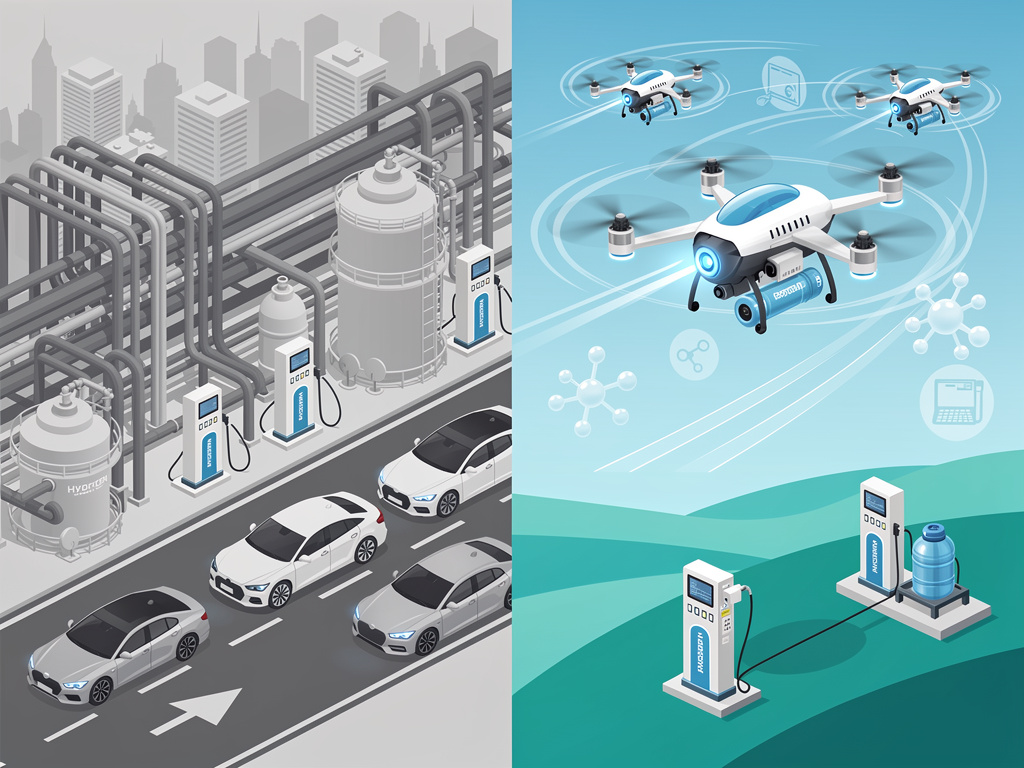
For more than two decades, hydrogen fuel cells were supposed to be the future of the automobile. Billions of dollars poured into research. Prototype after prototype rolled off assembly lines. And yet, the hydrogen car remains a commercial footnote — a technology perpetually five years away from mass adoption. Now, a growing number of aerospace and defense companies are betting that hydrogen’s real destiny was never on the highway. It was in the sky.
Intelligent Energy, a British hydrogen fuel cell manufacturer, has developed a system it claims can keep drones aloft for hours longer than conventional lithium-polymer batteries allow. As Digital Trends reported, the company’s fuel cell technology is being pitched as a direct replacement for the battery packs that currently limit most commercial and military drones to flight times measured in tens of minutes rather than hours. The physics are straightforward: hydrogen carries roughly three times the energy density of lithium batteries by weight. For aircraft, where every gram matters, that advantage is enormous.
The implications stretch far beyond hobbyist quadcopters. Long-endurance drones are critical for military surveillance, disaster response, infrastructure inspection, agricultural monitoring, and an emerging generation of delivery services. In each of these applications, the limiting factor has been the same: batteries die too quickly. A typical multirotor drone running on lithium-polymer cells gets somewhere between 20 and 45 minutes of useful flight time, depending on payload and conditions. Hydrogen fuel cells could push that past two or even four hours.
That’s not a marginal improvement. That’s a category shift.
Intelligent Energy isn’t alone in recognizing the opportunity. South Korean firm Doosan Mobility Innovation has been developing hydrogen-powered drone platforms for several years, and its DS30 system has demonstrated flight times exceeding two hours with meaningful payloads. In the United States, Plug Power and Ballard Power Systems — both veterans of the terrestrial fuel cell market — have signaled interest in aviation applications. And HyPoint, a California-based startup, has been developing what it calls a turbo air-cooled hydrogen fuel cell system specifically designed for aircraft, claiming power-to-weight ratios that would make vertical takeoff and landing (VTOL) air taxis viable.
The military is paying close attention. The U.S. Department of Defense has funded multiple programs exploring hydrogen-powered unmanned aerial vehicles (UAVs) for intelligence, surveillance, and reconnaissance missions. Longer loiter times mean fewer sorties, fewer crew rotations, and more persistent coverage of contested areas. The U.S. Army’s research laboratories have tested hydrogen fuel cell systems in small tactical drones, and NATO allies have conducted similar evaluations. For battlefield commanders, a drone that can stay overhead for four hours instead of 30 minutes isn’t just more convenient — it fundamentally changes operational planning.
But the commercial sector may be where hydrogen drones find their largest market first. Companies like Amazon, Wing (owned by Alphabet), and Zipline have invested heavily in drone delivery logistics. The constraint they all face is range. A battery-powered delivery drone can typically cover a radius of about 10 to 15 miles from its base before it needs to return and recharge. Hydrogen extends that radius dramatically, potentially making drone delivery viable in rural and suburban areas where the economics currently don’t work.
So why did hydrogen fail on the road?
The answer is infrastructure — or rather, the lack of it. A hydrogen car needs hydrogen fueling stations, and building those stations requires massive capital investment that nobody wanted to make until there were enough hydrogen cars on the road to justify the expense. Classic chicken-and-egg problem. Tesla and other battery electric vehicle makers solved the equivalent problem for EVs by building their own charging networks, but hydrogen fueling infrastructure is orders of magnitude more expensive and complex. Compressing or liquefying hydrogen, transporting it safely, and dispensing it at high pressure all require specialized equipment. As of mid-2025, California — the most hydrogen-friendly state in the U.S. — has fewer than 60 public hydrogen fueling stations. Many of them are frequently out of service.
Toyota, the most committed automaker in the hydrogen space, has sold only modest numbers of its Mirai sedan despite years of effort. Hyundai’s Nexo has fared similarly. BMW, Honda, and others have either shelved or dramatically scaled back their hydrogen passenger vehicle programs. The market has spoken, and it said batteries.
Drones sidestep the infrastructure problem almost entirely. A drone operator doesn’t need a network of public fueling stations. A single hydrogen storage tank at a launch site can service an entire fleet. The refueling process takes minutes, not hours — a significant advantage over battery recharging. And because drone operations are typically centralized (a warehouse, a military forward operating base, an agricultural hub), the logistics of hydrogen supply are manageable in a way they never were for consumer automobiles spread across an entire country.
The weight calculus is different too. In a car, the fuel cell system competes with battery packs that have gotten dramatically cheaper and lighter over the past decade. A Tesla Model 3 can travel 350 miles on a single charge, which is good enough for the vast majority of drivers. The energy density advantage of hydrogen matters less when you can simply install a bigger battery in a vehicle that sits on the ground. Gravity is forgiving.
Aircraft don’t have that luxury. Every additional kilogram of battery weight reduces payload capacity, flight time, or both. At small scales — drones weighing 5 to 50 kilograms — the weight penalty of batteries becomes acute. Hydrogen’s superior energy-to-weight ratio translates directly into longer flights, heavier payloads, or some combination of both. The physics that made hydrogen marginal for cars makes it compelling for aircraft.
There are real engineering challenges remaining. Hydrogen storage is one. The gas must be kept under high pressure (typically 350 to 700 bar) or at cryogenic temperatures, both of which require tanks that add weight and complexity. Carbon fiber composite tanks have brought the weight down considerably, but they’re expensive. And hydrogen, being the smallest molecule in existence, is notoriously difficult to contain — it can permeate through materials that would hold other gases without issue.
Safety is another concern, though perhaps less than popular imagination suggests. Hydrogen is flammable, but it’s also extremely light and disperses rapidly in open air. A hydrogen leak outdoors dissipates upward almost instantly, unlike gasoline vapors that pool at ground level. For outdoor drone operations, the fire risk profile is arguably better than for hydrocarbon fuels. Indoor operations or confined-space storage require more careful engineering, but the industry has decades of experience handling hydrogen safely in industrial settings.
Cost remains a barrier. Fuel cell stacks use platinum-group metals as catalysts, and while the amount required has decreased substantially over the years, it still makes fuel cells expensive relative to batteries. Intelligent Energy and its competitors are working to reduce platinum loading and explore alternative catalyst materials, but price parity with lithium batteries hasn’t been achieved. For military and high-value commercial applications, the performance premium justifies the cost. For consumer-grade drones, it doesn’t — at least not yet.
The hydrogen supply chain itself is evolving in ways that could benefit drone operators. Green hydrogen — produced by electrolyzing water using renewable electricity — has attracted tens of billions of dollars in investment globally. The U.S. Inflation Reduction Act includes generous production tax credits for clean hydrogen, and the European Union’s REPowerEU plan envisions massive scaling of electrolyzer capacity. As green hydrogen production grows and costs fall, the fuel economics for hydrogen drones improve accordingly.
And then there’s the regulatory environment. The Federal Aviation Administration has been cautious about approving hydrogen-powered aircraft of any kind, but the agency has granted experimental certificates for several hydrogen drone programs. In 2024, the FAA published updated guidance on the certification of fuel cell systems for unmanned aircraft, a signal that the regulatory pathway is becoming clearer. Europe’s EASA has taken similar steps. The regulatory frameworks aren’t complete, but they’re moving in the right direction.
Some analysts see hydrogen drones as a bridging technology — a stepping stone toward hydrogen-powered manned aircraft. Companies like ZeroAvia and Universal Hydrogen are developing hydrogen propulsion systems for regional commuter planes, aiming to decarbonize short-haul aviation. ZeroAvia has conducted test flights of a modified Dornier 228 twin-engine aircraft using hydrogen fuel cells, and Universal Hydrogen flew a modified De Havilland Dash 8 with a hydrogen powertrain in 2023. If hydrogen proves itself in the drone market, the technology, supply chains, and regulatory precedents established there could accelerate the path to manned hydrogen aviation.
The competitive dynamics are shifting fast. China’s EHang, a leading air mobility company, has explored hydrogen propulsion for its autonomous aerial vehicles. In Japan — where the government has made hydrogen a pillar of its energy strategy — multiple firms are developing hydrogen drone platforms for disaster relief and maritime surveillance. South Korea has committed substantial public funding to hydrogen aviation research.
Not everyone is convinced. Critics argue that battery technology is improving so rapidly that hydrogen’s energy density advantage will narrow before fuel cells can achieve the cost reductions needed for mass adoption. Solid-state batteries, lithium-sulfur chemistries, and other next-generation battery technologies promise significant improvements in energy density within the next five to ten years. If those technologies deliver, the window for hydrogen drones could close before it fully opens.
That’s a real risk. But it’s also a bet on timelines, and timelines in battery technology have a long history of slipping. Solid-state batteries have been “almost ready” for commercial production for most of the past decade. Hydrogen fuel cells, by contrast, are available now. They work. The question is whether the industry can scale production, reduce costs, and build out hydrogen supply infrastructure fast enough to establish a durable market position before batteries catch up.
For Intelligent Energy, the strategy is clear: target the applications where hydrogen’s advantages are most pronounced and the infrastructure barriers are lowest. Military drones operating from forward bases. Commercial inspection drones covering long linear assets like pipelines, railways, and power lines. Agricultural drones surveying thousands of acres per sortie. Delivery drones serving areas beyond the range of battery-powered alternatives. In each case, the value proposition is concrete and measurable — more flight time, more range, faster turnaround between flights.
The hydrogen car may have been a solution in search of a problem that batteries solved first. But the drone market presents a different equation entirely — one where the physics, the logistics, and the economics align in hydrogen’s favor. Whether that alignment holds depends on execution, investment, and the relentless pace of battery improvement. What’s clear is that hydrogen technology, after years of automotive disappointment, has found an application where its strengths actually matter. The fuel cell’s second act is airborne.


 WebProNews is an iEntry Publication