
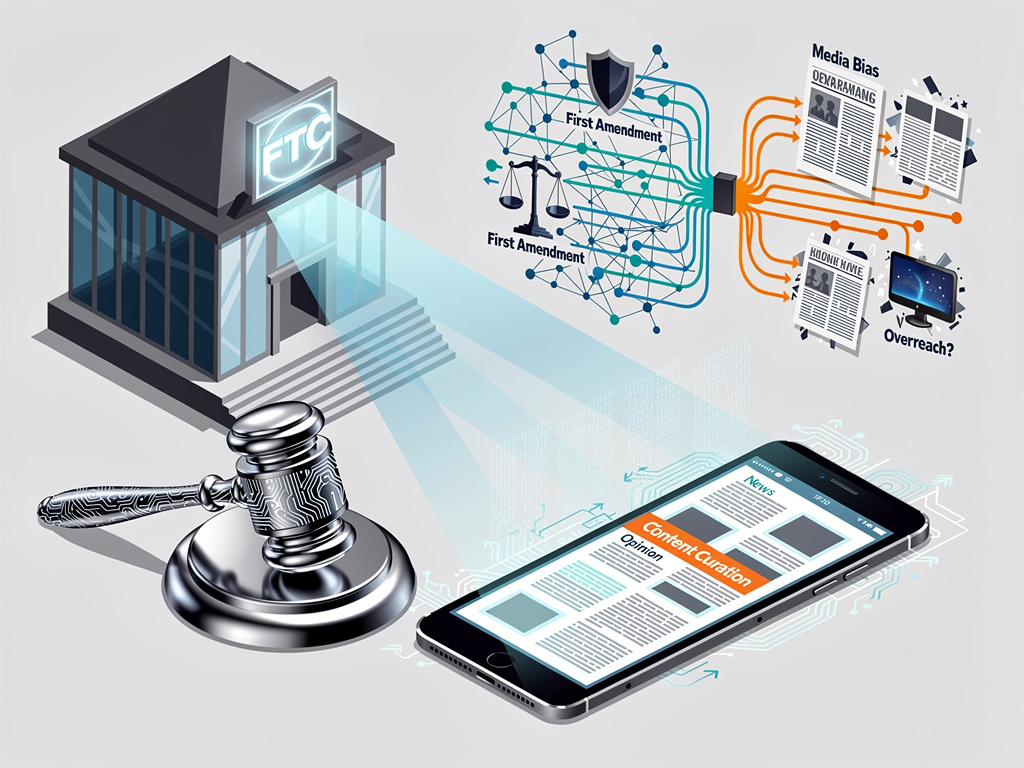
The Federal Trade Commission, under the leadership of Chairman Andrew Ferguson, has taken an extraordinary step into the fraught territory of media curation, issuing a formal request to Apple Inc. to stop what it characterizes as the preferential promotion of left-leaning news outlets through its Apple News platform. The move, rooted in a study that critics say cherry-picks data to support a predetermined conclusion, represents one of the most direct attempts by a federal regulatory body to influence how a technology company curates journalistic content — and it is raising alarm bells across the media and technology industries alike.
The February 2025 letter from the FTC to Apple cited research suggesting that Apple News disproportionately surfaces articles from outlets perceived as having a liberal editorial slant. But as AppleInsider reported, the study in question has drawn significant scrutiny for its methodology, its selective use of data, and the broader political context in which it is being wielded. The FTC’s intervention has quickly become a flashpoint in the ongoing national debate over perceived bias in Big Tech, government overreach, and the First Amendment rights of private companies.
A Study Under the Microscope
At the center of the controversy is a study that the FTC referenced in its communication with Apple. According to AppleInsider, the research analyzed the frequency with which certain news outlets appeared in Apple News recommendations and top story placements. The study concluded that outlets generally classified as left-of-center — including The New York Times, CNN, and The Washington Post — appeared with significantly greater frequency than their conservative counterparts.
However, media researchers and technology analysts have pointed out several critical flaws in the study’s design. First, the classification of outlets along a simple left-right spectrum is inherently reductive and contested. Major mainstream outlets with large newsrooms and broad readerships naturally generate more content and attract more engagement, which algorithmic systems tend to reward regardless of political orientation. Second, the study reportedly did not account for user personalization — a core feature of Apple News that tailors content recommendations based on individual reading habits, topic preferences, and engagement history. A user who frequently reads political analysis from The Atlantic will naturally see more of that content, not because of an institutional bias baked into the platform, but because the algorithm is responding to demonstrated interest.
The FTC’s Political Pivot Under Ferguson
The FTC’s decision to use this study as the basis for a formal request to Apple marks a notable shift in the commission’s priorities. Under Chairman Andrew Ferguson, who was appointed during the current administration, the FTC has increasingly turned its attention toward what it frames as anti-conservative bias in the technology sector. This represents a departure from the agency’s traditional focus on consumer protection, antitrust enforcement, and privacy regulation.
Ferguson has been vocal about his belief that major technology platforms systematically disadvantage conservative viewpoints. His tenure has seen the FTC open inquiries into content moderation practices at several major platforms, a posture that aligns with broader political pressure from Republican lawmakers who have long accused Silicon Valley of harboring liberal sympathies. The Apple News letter fits squarely within this agenda, but it also raises profound questions about the appropriate role of a regulatory agency in dictating editorial and curatorial decisions to private companies.
Apple’s Curation Model: Human Editors and Algorithms
Apple News occupies a unique position among digital news aggregators. Unlike purely algorithmic platforms such as Google News, Apple employs a team of human editors who select and curate the top stories that appear in the app’s prominent “Top Stories” section. This hybrid model — combining editorial judgment with algorithmic personalization — was designed explicitly to prioritize quality journalism and reduce the spread of misinformation, a problem that has plagued other platforms.
Apple has long touted this human-in-the-loop approach as a differentiator. The company has argued that its editorial team applies journalistic standards to story selection, favoring outlets with established track records of accuracy, sourcing, and editorial oversight. Critics of the FTC’s intervention note that this naturally tends to elevate legacy media organizations — which happen to be the same outlets that conservative critics label as left-leaning. The question, then, is whether prioritizing editorial quality constitutes political bias, or whether it simply reflects the reality that larger, more established newsrooms produce more content that meets rigorous journalistic standards.
First Amendment Implications and Industry Backlash
Legal scholars have been quick to note the constitutional dimensions of the FTC’s request. The First Amendment protects not only the right to publish but also the right to make editorial choices about what to publish, promote, or curate. Courts have historically extended these protections to technology platforms, recognizing that decisions about content curation are a form of protected speech. A 2024 Supreme Court ruling reaffirmed that platforms have First Amendment rights in their content moderation and curation decisions, a precedent that would appear to shield Apple from regulatory compulsion to alter its news recommendations.
The technology industry’s reaction has been one of deep concern. Trade groups and digital rights organizations have warned that the FTC’s approach, if successful, could set a precedent allowing government agencies to pressure platforms into adjusting their content algorithms to achieve politically desired outcomes. The Electronic Frontier Foundation and similar organizations have argued that this represents a form of government jawboning — the use of regulatory authority to coerce private companies into changing their behavior without formal legal action, thereby circumventing constitutional protections.
The Broader Political Context
The FTC’s move against Apple News does not exist in isolation. It is part of a broader campaign by the current administration to confront what it perceives as systemic liberal bias in media and technology. Congressional Republicans have held multiple hearings on alleged censorship of conservative voices on social media platforms, and several states have passed or proposed legislation aimed at regulating content moderation practices. The FTC’s letter to Apple represents the executive branch’s most direct foray into this territory.
Yet the evidence for systematic anti-conservative bias in technology platforms remains hotly contested. Multiple academic studies have found that conservative content performs exceptionally well on social media platforms, often generating higher engagement rates than comparable liberal content. Research from New York University’s Center for Social Media and Politics, among other institutions, has found little evidence of consistent anti-conservative bias in algorithmic content distribution. These findings complicate the narrative that the FTC is advancing and suggest that the agency’s position may be driven more by political imperatives than by empirical evidence.
What Apple Stands to Lose — and Gain
For Apple, the FTC’s request presents a delicate balancing act. The company has historically sought to maintain a relatively low political profile, positioning itself as a champion of user privacy and quality rather than wading into partisan battles. Complying with the FTC’s request could alienate its editorial team, undermine the journalistic integrity of Apple News, and set a dangerous precedent for government influence over content curation. Refusing to comply, on the other hand, could invite further regulatory scrutiny at a time when Apple is already facing antitrust challenges in multiple jurisdictions.
As of this writing, Apple has not issued a detailed public response to the FTC’s letter. The company’s silence may reflect a strategic calculation that engaging publicly with the request would only amplify the controversy. But industry observers expect that Apple will ultimately push back, citing both its First Amendment rights and the technical realities of how its news curation system operates.
A Regulatory Rubicon?
The FTC’s intervention into Apple News curation may prove to be a watershed moment in the relationship between government regulators and technology companies. If the commission follows through with enforcement action — or if Apple capitulates to the pressure — the implications would extend far beyond a single news aggregation app. Every platform that makes editorial or algorithmic decisions about content could find itself subject to similar political pressure, fundamentally altering the way digital media operates in the United States.
For now, the standoff between the FTC and Apple serves as a stark illustration of the tensions between political power, corporate autonomy, and press freedom in the digital age. The study at the heart of the dispute may be methodologically questionable, but the questions it has raised — about who gets to decide what news Americans see, and on what basis — are ones that will define the next chapter of the technology and media industries. As AppleInsider noted, the selective use of research to justify regulatory action is itself a story worth scrutinizing, one that speaks to the increasingly blurred lines between governance, ideology, and the information ecosystem that serves hundreds of millions of Americans every day.


 WebProNews is an iEntry Publication