
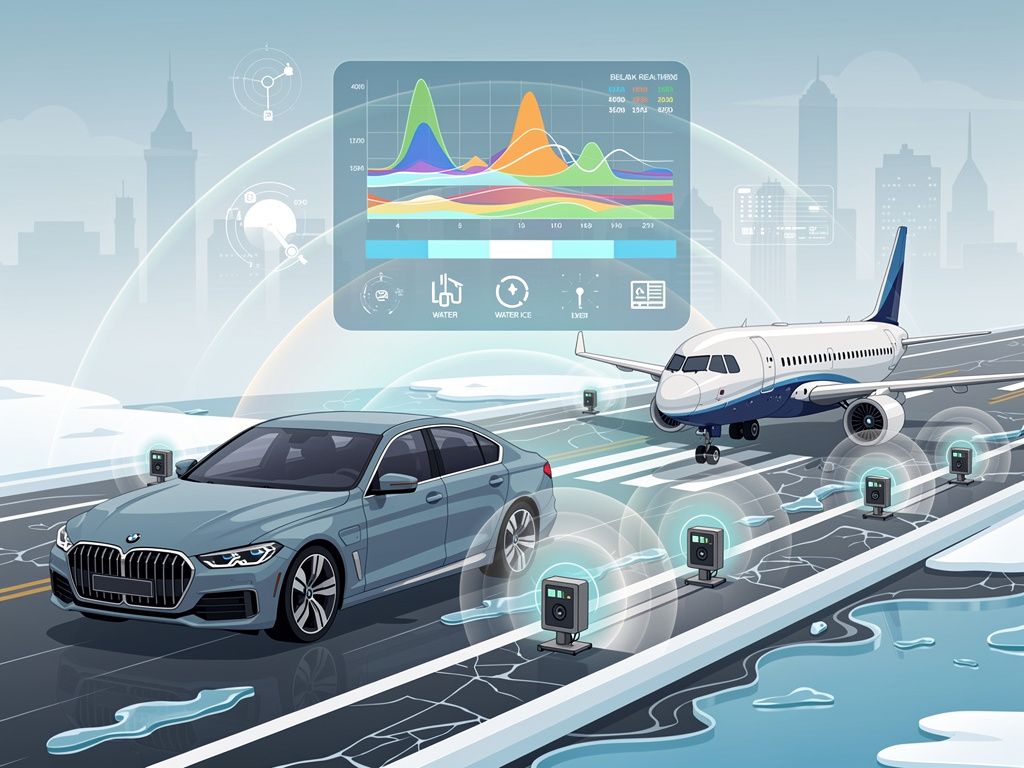
For decades, the automotive and aviation industries have relied on a dangerously imperfect proxy for safety: air temperature. The external thermometer on a modern dashboard or an aircraft’s sensor suite measures the ambient air, a metric that frequently diverges from the actual temperature of the asphalt or tarmac. This discrepancy creates a lethal window of vulnerability known to insurers and safety regulators as the "black ice gap," where road surfaces freeze before the air temperature drops, or remain frozen in shadowed areas long after the sun has warmed the atmosphere. This technological blind spot is responsible for thousands of fatalities annually, yet the sensor hardware required to identify surface friction in real-time has remained prohibitively expensive or scientifically elusive.
That technological stagnation is rapidly breaking. A new wave of sensor innovation, spearheaded by researchers at the University of Sheffield and highlighted in recent industry reports, is utilizing sub-terahertz waves to conduct remote spectroscopy of road surfaces. According to a recent report by Digital Trends, this technology moves beyond simple temperature guessing. Instead, it analyzes the spectral signature of the surface to definitively distinguish between dry asphalt, liquid water, and the deadly, transparent glaze of black ice. As the autonomous driving sector faces a reckoning regarding safety in inclement weather, this granular surface data is becoming the new gold standard for vehicle telemetry.
Bridging the gap between ambient guesswork and molecular certainty in surface analysis
The core of this innovation lies in the manipulation of the electromagnetic spectrum. Traditional automotive sensors, such as LiDAR and optical cameras, struggle significantly with transparent hazards. LiDAR passes through clear ice, often reading it as a puddle or dry road, while cameras lack the contrast sensitivity to detect thin ice layers against dark asphalt. The solution developed by the Sheffield team and currently being eyed by Tier 1 suppliers operates in the sub-terahertz range. These waves interact with water molecules at a fundamental level, detecting the specific vibration modes that differ between liquid water and the crystalline lattice structure of ice.
This capability transforms the vehicle from a passive observer of weather into an active mobile laboratory. By measuring the reflection and absorption rates of these waves, the sensor can calculate the dielectric properties of the road surface milliseconds before the tires make contact. This is a profound shift from the current "reactive" paradigm—where Electronic Stability Control (ESC) and Antilock Braking Systems (ABS) only engage after traction has been lost. This new hardware promises a "predictive" safety model, allowing the vehicle’s onboard computer to adjust torque distribution, suspension stiffness, and braking thresholds in anticipation of a low-friction event.
The critical missing link for Level 4 and Level 5 autonomous operating domains
The implications for the self-driving vehicle sector are existential. The National Highway Traffic Safety Administration (NHTSA) notes that weather-related vehicle accidents account for a staggering percentage of annual crashes, yet most autonomous vehicle (AV) testing occurs in the pristine, dry conditions of Arizona or California. For AVs to achieve mass adoption in northern climates, they must possess a friction-sensing capability that exceeds human intuition. Currently, an autonomous taxi cannot distinguish between a wet road (safe to drive) and a black ice patch (unsafe), forcing the system to either disengage or drive with paralyzing conservatism.
Integrating sub-terahertz sensors resolves this operational design domain (ODD) limitation. By feeding real-time friction coefficient data into the AV’s path-planning algorithms, the vehicle can execute micro-adjustments to its trajectory that a human driver would never perceive. Furthermore, this data does not remain siloed within a single vehicle. Through Vehicle-to-Everything (V2X) communication, a car detecting black ice on a highway overpass can instantly transmit that hazard data to following vehicles and municipal infrastructure, effectively creating a real-time heat map of road friction that updates dynamically as conditions evolve.
Revolutionizing aviation protocols and reducing the billion-dollar cost of runway delays
While automotive applications garner the headlines, the aviation industry stands to gain the most immediate economic benefit from this sensor evolution. Runway excursions—where a plane slides off the tarmac—remain a top safety concern for the Federal Aviation Administration (FAA). Currently, pilots rely on braking action reports from ground crews or preceding aircraft, a manual and often delayed information loop. The ability to mount sub-terahertz sensors on landing gear or wingtips would provide pilots with an instantaneous readout of runway conditions during the critical flare and touchdown phases.
Beyond safety, the efficiency gains are substantial. Airlines lose hundreds of millions of dollars annually to de-icing delays. Often, planes are doused in glycol-based de-icing fluid as a precaution because ground crews cannot verify if a thin layer of clear ice has formed on the wings. The technology highlighted by the University of Sheffield research could allow for precise, targeted de-icing. If a sensor can confirm a wing is dry or merely wet with liquid water, airlines could avoid the costly and environmentally taxing de-icing process, tightening turnaround times and reducing chemical runoff at major hubs.
Economic ripples across the insurance and municipal infrastructure sectors
The deployment of this technology will inevitably force a restructuring of insurance premiums and liability models. In the current market, accidents caused by black ice are often categorized under "at-fault" collisions where the driver is penalized for failing to control the vehicle, or "acts of God" depending on the policy. However, if a vehicle is equipped with sensors capable of detecting ice that the human eye cannot see, the liability framework shifts. Insurance carriers may soon incentivize—or mandate—the adoption of friction-sensing tech for commercial fleets operating in snow-belt regions, much like the mandates for dashcams and telematics tracking.
Furthermore, this sensor technology is not limited to mobile applications; it is increasingly being viewed as a static infrastructure solution. Municipalities spend vast portions of their budgets on salt and chemical treatments, often deploying them inefficiently based on broad weather forecasts. By embedding sub-terahertz sensors into roadside infrastructure or "smart" streetlights, cities could deploy salt trucks only to the specific bridges or intersections that are chemically transitioning to ice. This precision maintenance approach aligns with the broader smart city ecosystem, reducing corrosion on infrastructure and lowering the environmental impact of road salt.
Overcoming the hurdles of cost, integration, and harsh weather durability
Despite the promise, the path to commercialization faces significant engineering headwinds. The primary challenge, as noted in broader research from institutions like the University of Sheffield, is miniaturization and cost. Terahertz sources and detectors have historically been bulky and expensive, relegated to laboratory settings or high-end security scanners. For this technology to become standard on a mid-range sedan, the cost per unit must drop precipitously, likely requiring the development of silicon-based terahertz chips that can be mass-produced in standard semiconductor foundries.
Additionally, the sensors themselves must be ruggedized against the very environment they are designed to monitor. A sensor mounted in a wheel well or on a bumper is subjected to salt spray, mud, extreme vibration, and stone impacts. Ensuring that the delicate optics and emitters of a sub-terahertz system can maintain calibration over a 15-year vehicle lifecycle is a non-trivial materials science challenge. However, as the industry moves toward the software-defined vehicle, the value of the data these sensors provide—monetizable through safety subscriptions and fleet analytics—may drive the investment needed to solve these hardware limitations.


 WebProNews is an iEntry Publication