
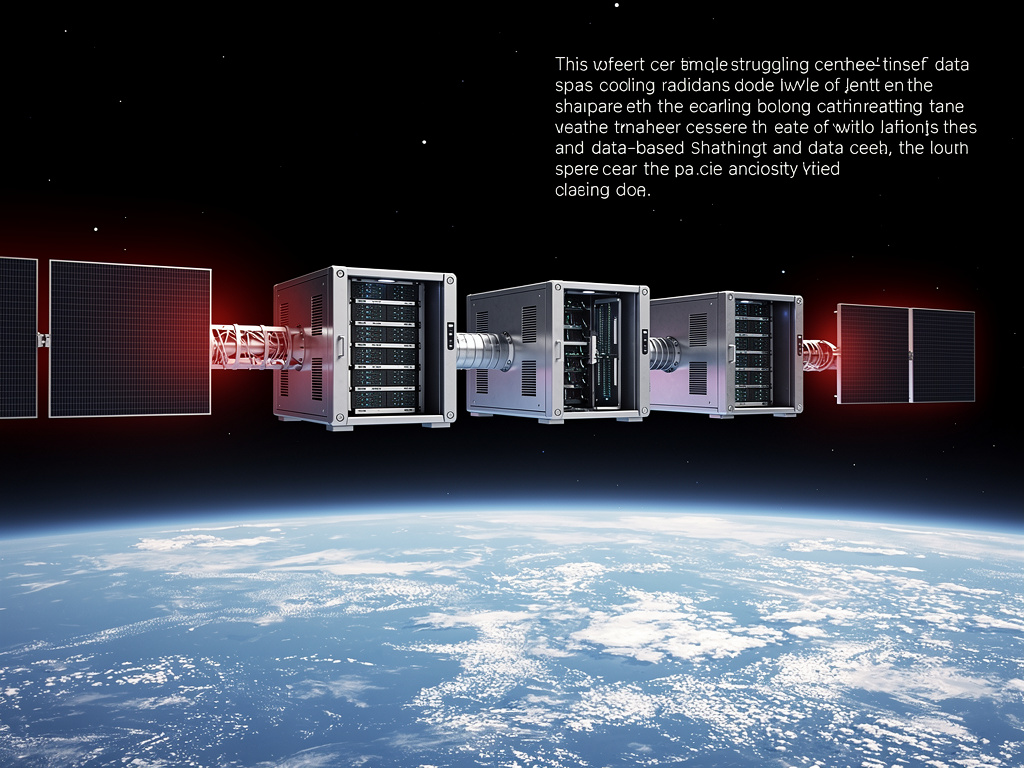
The race to build data centers in orbit has captivated the technology and aerospace industries alike, promising a future where computing power floats above the Earth, tapping into limitless solar energy and offering governments and enterprises a new paradigm for processing sensitive workloads. But according to the CEO of Voyager Technologies, one of the most fundamental engineering challenges — how to keep servers cool in the vacuum of space — remains stubbornly unsolved.
Charles Beames, the executive chairman and CEO of Voyager Technologies, has been candid about the obstacles facing the nascent space data center industry, even as his company and competitors pour billions into the concept. In remarks reported by CNBC, Beames acknowledged that while the vision of orbital computing is compelling, the thermal management problem is not merely a technical nuisance — it is a potentially existential barrier to making space-based data centers commercially viable at scale.
Why Cooling in Space Is Fundamentally Different From Cooling on Earth
On Earth, data centers rely on a combination of air cooling, liquid cooling, and increasingly sophisticated immersion cooling techniques to dissipate the enormous amounts of heat generated by thousands of densely packed processors. The atmosphere itself serves as a heat sink — warm air can be vented, cold air can be drawn in, and water can be evaporated to carry thermal energy away. Even the most advanced terrestrial facilities, from hyperscale campuses in Iowa to underground bunkers in Scandinavia, ultimately depend on the planet’s atmosphere and hydrosphere to absorb waste heat.
In space, none of these options exist. The vacuum of orbit offers no air to circulate and no water to evaporate. The only mechanism for shedding heat is thermal radiation — the emission of infrared energy from surfaces into the void. This process is governed by the Stefan-Boltzmann law and is inherently slow compared to convective or conductive cooling. A server rack that can be cooled in seconds on Earth might take orders of magnitude longer to reach thermal equilibrium in orbit, creating a fundamental mismatch between the rate at which modern processors generate heat and the rate at which that heat can be expelled into space.
Voyager Technologies and the Orbital Ambition
Voyager Technologies, headquartered in Washington, D.C., has positioned itself as a diversified space company with interests spanning satellite services, space stations, and orbital infrastructure. The company has been assembling a portfolio of space assets and capabilities, and its leadership has been vocal about the commercial potential of putting computing workloads into orbit. The logic is straightforward on paper: space offers abundant solar energy, physical security from terrestrial threats, and the potential for reduced latency on certain global communications pathways. For classified government workloads and sensitive enterprise data, the physical inaccessibility of an orbital platform offers a security advantage that no terrestrial facility can match.
But Beames, as reported by CNBC, has not shied away from the hard truths. The cooling problem, he indicated, is not something that can be waved away with incremental improvements to existing radiator technology. Current spacecraft thermal management systems — the radiator panels and heat pipes used on the International Space Station, for example — were designed for workloads measured in kilowatts, not the megawatts that even a modest data center demands. Scaling these systems by two or three orders of magnitude introduces engineering challenges that have no proven solutions today.
The Physics of Radiative Heat Rejection at Scale
To understand the magnitude of the problem, consider the numbers. A single modern AI training cluster can consume 10 to 50 megawatts of electrical power, virtually all of which is ultimately converted to heat. On Earth, this heat is managed by industrial-scale cooling plants that may themselves consume several additional megawatts. In space, rejecting 10 megawatts of thermal energy through radiation alone would require enormous radiator surfaces — potentially acres of deployable panels, each operating at high temperatures to maximize radiative efficiency. The engineering challenges of deploying, maintaining, and protecting such structures in the orbital environment are staggering.
The problem is compounded by the thermal environment of low Earth orbit itself. Spacecraft in LEO experience rapid cycling between direct sunlight and Earth’s shadow, with external surface temperatures swinging by hundreds of degrees over the course of a single 90-minute orbit. This thermal cycling stresses materials, complicates radiator design, and means that the cooling system’s performance varies dramatically depending on the spacecraft’s orientation and orbital position. Engineers must design for worst-case conditions — full sunlight, maximum computational load — which drives radiator sizes even larger.
Competitors and the Broader Push for Orbital Computing
Voyager is far from alone in pursuing the space data center concept. Several startups and established aerospace firms have announced plans or conducted studies on orbital computing platforms. Lumen Orbit, a startup that emerged from Y Combinator, has been developing plans for small-scale orbital computing nodes, focusing initially on Earth observation data processing in orbit to reduce the bandwidth costs of downlinking raw satellite imagery. Other companies have explored the idea of using the cold of deep space — specifically, radiators pointed away from both the Earth and the Sun — as a thermal sink, though this approach introduces pointing and attitude control complexities.
The interest from hyperscale cloud providers has also been notable, if cautious. Microsoft’s Azure Space initiative and Amazon’s Project Kuiper have explored the edges of space-based computing, though neither has committed to full orbital data center deployments. The U.S. Department of Defense, through agencies like the Space Development Agency and DARPA, has funded research into resilient orbital computing architectures, driven by the strategic imperative to maintain data processing capabilities even in scenarios where terrestrial infrastructure is compromised. The demand signal is real, but the supply-side engineering remains daunting.
Emerging Thermal Technologies and Their Limitations
Researchers and engineers have proposed several advanced cooling concepts that could, in theory, close the gap. Droplet radiators, which release streams of tiny liquid droplets into space to radiate heat before being recollected, have been studied by NASA and academic institutions for decades. These systems offer dramatically higher surface-area-to-mass ratios than solid panel radiators, potentially reducing the structural burden on an orbital platform. However, droplet radiators introduce their own challenges: fluid loss, contamination of the orbital environment, and the complexity of recapturing droplets in microgravity.
Another approach involves phase-change materials and advanced heat pipes that can transport thermal energy more efficiently from computing hardware to radiator surfaces. Liquid metal cooling loops, using substances like gallium-based alloys, offer high thermal conductivity and could serve as the backbone of a space-rated cooling system. Some researchers have also explored the concept of using the structure of the spacecraft itself — its hull, solar panel supports, and other surfaces — as supplementary radiators, embedding thermal channels throughout the platform’s architecture. Each of these approaches shows promise in laboratory settings, but none has been demonstrated at the scale required for a commercially relevant data center.
The Economic Equation: Launch Costs, Power, and Thermal Mass
The cooling challenge is not purely a physics problem — it is also an economic one. Every kilogram of radiator mass that must be launched into orbit adds to the cost of the facility. Even with the dramatic reductions in launch costs driven by SpaceX’s Falcon 9 and Starship programs, Blue Origin’s New Glenn, and other next-generation vehicles, the economics of lofting hundreds of tons of thermal management hardware remain punishing. Beames and other industry leaders have noted that the business case for space data centers depends on achieving a favorable ratio of computing capability to total system mass, and the cooling system is currently the largest single driver of that mass budget.
Power generation, by contrast, is a relatively more tractable problem. Solar panels in orbit receive unfiltered sunlight and can generate electricity at efficiencies that exceed terrestrial installations, particularly when freed from atmospheric absorption and weather variability. Advanced solar arrays, including those using concentrator designs and multi-junction cells, can deliver power densities that make megawatt-class generation feasible within the mass constraints of current launch vehicles. The irony is that generating power in space is becoming easier precisely as the ability to reject the resulting waste heat remains stubbornly difficult.
National Security Dimensions and Government Interest
The strategic implications of space-based data centers extend well beyond commercial cloud computing. The U.S. military and intelligence community have expressed growing interest in orbital computing as a means of ensuring continuity of operations in contested environments. A data center in orbit is immune to the physical attacks, natural disasters, and infrastructure failures that can disable terrestrial facilities. It can also provide low-latency processing for satellite constellations, reducing the need to downlink data to ground stations that may themselves be vulnerable.
This national security dimension adds urgency to the cooling problem. Government customers are often willing to pay premium prices for capability, but they also demand reliability and performance guarantees that the current state of space thermal management cannot provide. As Beames suggested in his remarks covered by CNBC, solving the cooling challenge is not optional — it is the gating factor that will determine whether space data centers transition from concept to operational reality within this decade or remain a tantalizing but unrealized vision for years to come.
What Comes Next for the Industry
The space data center sector finds itself at an inflection point. Investment is flowing, government interest is intensifying, and the theoretical advantages of orbital computing are well understood. But the thermal management barrier looms large, and no company — including Voyager Technologies — has yet demonstrated a cooling solution that can support data center-class workloads in the orbital environment. The next two to three years will likely see a wave of technology demonstration missions aimed at validating advanced radiator concepts, droplet systems, and hybrid cooling architectures in actual space conditions.
For now, the honest assessment from leaders like Beames serves as a necessary corrective to the hype that often accompanies frontier technology sectors. The space data center is not an impossible dream, but it is a dream that requires solving one of the hardest thermal engineering problems ever attempted. The companies and research institutions that crack this challenge will not merely build a new kind of data center — they will unlock an entirely new domain for human computation, one that floats silently above the clouds, radiating its waste heat into the infinite cold of the cosmos.


 WebProNews is an iEntry Publication