
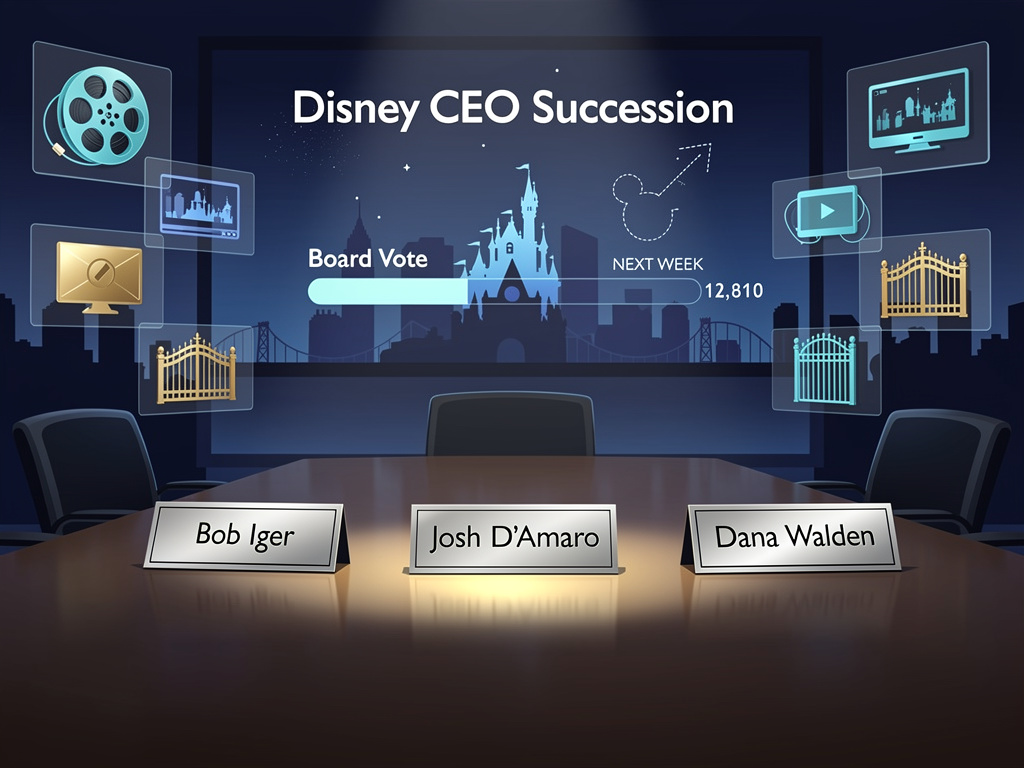
Disney Chief Executive Bob Iger has privately informed associates that he intends to step down before his contract officially expires on December 31, 2025, setting in motion what may be the most carefully choreographed leadership transition in modern entertainment history. According to The Wall Street Journal, the entertainment giant’s board of directors is scheduled to convene next week at Disney’s Burbank headquarters, where they are expected to vote on Iger’s successor—a decision that will shape the future of one of the world’s most iconic media empires.
The timing of Iger’s departure represents a significant shift from his original commitment to remain through year’s end. In private conversations over recent months, the 74-year-old executive has expressed readiness to step away from the daily grind of managing a $170 billion entertainment conglomerate. People familiar with these discussions say Iger has grown particularly frustrated by operational conflicts, including recent controversies at Disney’s ABC network involving the brief suspension of late-night host Jimmy Kimmel.
A Billionaire’s Retirement Vision Takes Shape
Iger’s motivations for an earlier-than-planned departure extend beyond corporate boardrooms and into personal aspirations that reflect his status as one of entertainment’s most successful executives. The CEO has told multiple associates he wants to dedicate more time to sailing his new superyacht, the Aquarius, which was completed and delivered last summer. The vessel represents a significant upgrade from his previous yacht, signaling Iger’s readiness to embrace a lifestyle befitting his decades of corporate success.
Beyond maritime pursuits, Iger has expressed desire to work more closely with his wife, Willow Bay, who serves as dean of the USC Annenberg School for Communication and Journalism. The couple also purchased Angel City FC, a National Women’s Soccer League team, in 2024, providing another avenue for Iger’s post-CEO energies. These personal projects suggest a leader ready to transition from the relentless demands of running a global media empire to pursuits that offer greater flexibility and personal fulfillment.
The Two-Horse Race for Disney’s Crown
While the final timing of Iger’s departure remains fluid and subject to change, sources close to the company indicate the succession race has narrowed to two internal candidates: Josh D’Amaro, chairman of Disney Experiences, and Dana Walden, co-chair of Disney Entertainment. D’Amaro oversees the company’s lucrative theme parks division, consumer products, and videogames, while Walden brings extensive television expertise to a company increasingly focused on streaming and content production.
Both executives presented comprehensive visions for Disney’s future to the board in August, as previously reported by The Wall Street Journal. Industry insiders and people familiar with board deliberations suggest D’Amaro has emerged as the front-runner, though the final decision rests with a board that has approached this succession with unprecedented caution following the tumultuous Chapek era.
Lessons Learned from a Failed Succession
The specter of Bob Chapek’s brief and troubled tenure looms large over the current succession process. In February 2020, Iger stepped down as CEO after 15 years, handing control to Chapek, who had distinguished himself leading Disney’s theme parks division. Iger remained as executive chairman for more than 18 months, ostensibly to advise Chapek and ensure a smooth transition.
Instead, the Covid-19 pandemic exposed deep rifts between the two executives. Their clashes grew increasingly frequent and intense, creating organizational chaos at the century-old entertainment company. The dysfunction culminated in November 2022 when Disney’s board ousted Chapek and made the extraordinary decision to bring Iger back for a second stint as CEO—a move that shocked the industry and raised questions about the board’s judgment in selecting Chapek initially.
Iger has told at least one associate that he wants to give his successor a “fresh start” and believes lingering until the contract’s December 31 expiration would hinder whoever the board selects. This thinking reflects hard-won wisdom from the Chapek experience, where Iger’s extended presence as executive chairman created ambiguity about ultimate decision-making authority and contributed to the dysfunction that followed.
James Gorman’s Steady Hand on the Tiller
The current succession process bears little resemblance to the 2020 transition. Disney’s board, now chaired by former Morgan Stanley CEO James Gorman, has carefully orchestrated the selection while maintaining tight operational security. This approach contrasts sharply with 2020, when Iger himself served as board chairman and drove the decision to name Chapek as successor—a conflict of interest that likely contributed to the flawed selection.
Gorman brings extensive experience managing high-stakes leadership transitions from his time at Morgan Stanley, where he successfully orchestrated his own succession. His methodical approach has included engaging external coaches to work with internal candidates and ensuring Iger provides mentorship without dominating the selection process. In a recent public filing, Disney’s board confirmed it would announce its decision during the current quarter and detailed the comprehensive preparation internal candidates are receiving.
The D’Amaro Advantage in Disney’s Succession Calculus
Josh D’Amaro’s position as apparent front-runner reflects several strategic advantages. His leadership of Disney Experiences—which includes the company’s theme parks, the most consistently profitable segment of Disney’s business—demonstrates operational excellence at scale. The parks division has delivered strong financial performance even as Disney’s traditional media businesses face secular decline and its streaming operations work toward sustained profitability.
D’Amaro’s background also includes significant international experience, having served as president of Disneyland Resort and later Walt Disney World Resort before ascending to his current role. This operational depth contrasts with Chapek’s narrower experience base and suggests D’Amaro would bring both strategic vision and tactical execution capability to the CEO role. His visibility within the company and rapport with cast members—Disney’s term for employees—also position him well to unite an organization that experienced significant turbulence during the Chapek interregnum.
Dana Walden’s Content Expertise and Streaming Credentials
Dana Walden represents a different but equally compelling profile for Disney’s future. As co-chair of Disney Entertainment, she oversees the company’s content production and streaming operations at a time when traditional linear television continues its decline and streaming services battle for subscriber growth and profitability. Walden’s extensive television background includes successful stints at Fox Broadcasting Company and 20th Century Fox Television before Disney’s acquisition of Fox assets.
Her content expertise could prove crucial as Disney navigates the ongoing transformation of media consumption. The company’s streaming services—Disney+, Hulu, and ESPN+—have become central to its strategy, and Walden’s leadership would signal a commitment to content-driven growth. However, some board members may view her narrower operational experience compared to D’Amaro as a potential limitation for a CEO role that requires managing diverse business units from theme parks to cruise lines to consumer products.
The Mentorship Model and Transition Timeline
Regardless of who receives the board’s vote next week, Iger is expected to remain as CEO for several months after the announcement to mentor his successor. This approach attempts to capture the benefits of Iger’s experience and institutional knowledge while avoiding the authority conflicts that plagued the Chapek transition. The mentorship period would allow the new CEO to build relationships with key stakeholders, understand strategic initiatives in flight, and develop their own leadership team before assuming full responsibility.
People with knowledge of Iger’s plans suggest he could retain a role on Disney’s board and possibly maintain some advisory capacity at the company after the CEO transition. Such an arrangement would provide continuity while clearly delineating decision-making authority—a lesson learned painfully during Iger’s executive chairman period under Chapek. The exact structure of any post-CEO role remains under discussion and will likely depend on the board’s preferences and the new CEO’s comfort level.
Strategic Challenges Awaiting Disney’s Next Leader
Whoever assumes Disney’s top job inherits a company at a critical juncture. The traditional media businesses that generated reliable cash flow for decades continue their structural decline as audiences shift to streaming and digital platforms. Disney’s direct-to-consumer streaming operations have recently achieved profitability, but face intense competition from Netflix, Amazon Prime Video, Warner Bros. Discovery’s Max, and other well-funded rivals.
The theme parks business, while currently strong, faces questions about pricing power and attendance sustainability after years of aggressive price increases. Disney’s film studio has experienced both triumphs and expensive failures, raising questions about franchise management and creative risk-taking. The company’s relationship with Florida’s government remains contentious following political battles over the Reedy Creek Improvement District, adding regulatory uncertainty to the parks division’s outlook.
The Broader Context of Media Industry Transformation
Disney’s succession drama unfolds against a backdrop of unprecedented disruption across the media and entertainment sector. Traditional media companies have seen their market valuations compressed as investors question the viability of linear television and cable networks. The streaming wars have proven far more expensive and less profitable than many executives anticipated, forcing companies to prioritize profitability over subscriber growth.
Meanwhile, technology giants like Apple, Amazon, and Google leverage their platform advantages and deep pockets to compete for audience attention and content rights. The rise of user-generated content on platforms like YouTube, TikTok, and Instagram has fragmented audiences and created new competitors for entertainment dollars and viewing time. Disney’s next CEO must navigate this complex environment while maintaining the creative excellence and brand integrity that have defined the company for a century.
The Legacy Question and Iger’s Place in Corporate History
Bob Iger’s impending departure invites assessment of one of the most consequential CEO tenures in modern business history. His first stint from 2005 to 2020 included transformative acquisitions of Pixar, Marvel, Lucasfilm, and 21st Century Fox assets that fundamentally reshaped Disney’s content portfolio and competitive position. He successfully launched Disney+ and began the company’s pivot toward direct-to-consumer distribution, even as that transition has proven more challenging than initially anticipated.
However, Iger’s legacy also includes the failed Chapek succession and his decision to return as CEO—a move that, while stabilizing the company, raised questions about succession planning and board governance. His extended tenure, spanning nearly two decades across two separate periods, has left some wondering whether Disney has become too dependent on a single leader’s vision and relationships. The success or failure of his chosen successor will ultimately shape how historians evaluate Iger’s complete impact on the company.
As Disney’s board prepares to vote next week, the decision will reverberate far beyond Burbank. The entertainment industry watches closely, knowing that Disney’s strategic direction under new leadership could influence broader industry trends. For Iger, the vote represents a final act in a storied career—one last opportunity to shape Disney’s future before sailing off into retirement aboard the Aquarius, his legacy secure but still being written by whoever takes the helm of the Magic Kingdom.


 WebProNews is an iEntry Publication