
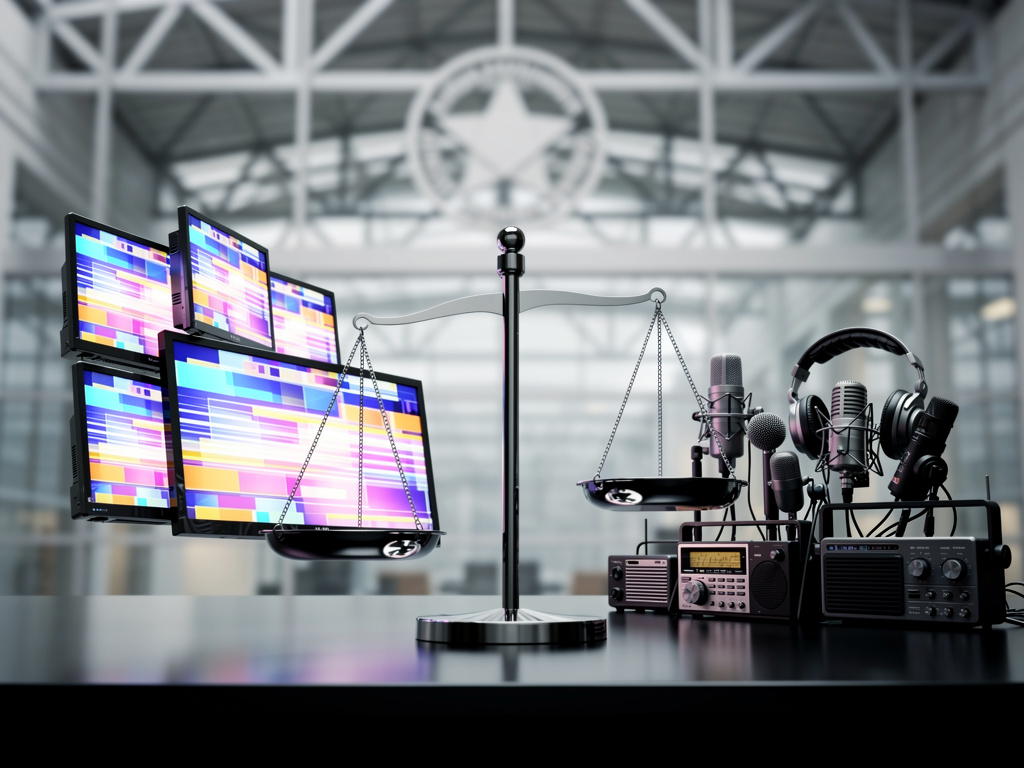
When the Federal Communications Commission under Chairman Brendan Carr announced it would aggressively enforce the long-dormant equal time rule against broadcast television networks, the move was framed as a principled stand for fairness on the public airwaves. But a closer examination of how the policy is being applied — and, more pointedly, where it is not — reveals a selective enforcement strategy that conveniently exempts the medium most dominated by conservative voices: talk radio.
The equal time rule, codified in Section 315 of the Communications Act of 1934, requires broadcast licensees to provide equivalent airtime to competing political candidates if they give or sell time to one candidate. The rule has existed for decades, but enforcement had largely become an afterthought in modern broadcasting. That changed when the Trump-era FCC signaled it would use the provision as a cudgel against networks perceived as hostile to the administration, while leaving friendly outlets untouched.
A Rule Revived With Surgical Precision
As Ars Technica reported, the FCC’s renewed interest in equal time enforcement has been directed almost exclusively at television broadcasters — specifically those whose news programming the Trump administration has criticized. The commission has issued warnings and opened inquiries into networks that aired lengthy interviews or town halls with Democratic candidates without offering comparable time to Republican opponents.
Yet the same standard has not been applied to talk radio, a medium where conservative hosts dominate the airwaves with programming that regularly features Republican candidates, officeholders, and their surrogates for extended, often friendly, segments. Shows hosted by figures such as Mark Levin, Sean Hannity, and others routinely provide what amounts to free promotional airtime for Republican politicians. Under a consistent application of Section 315, these appearances could trigger equal time obligations for rival candidates. But the FCC under Carr has shown no interest in pursuing such cases.
The Bona Fide News Exemption and Its Elastic Boundaries
The legal architecture that enables this selective approach rests on a set of exemptions built into the equal time rule itself. Section 315 carves out exceptions for appearances by candidates on bona fide newscasts, bona fide news interviews, bona fide news documentaries, and on-the-spot coverage of bona fide news events. These exemptions were designed to ensure that routine journalism would not be hamstrung by equal time demands every time a sitting president or candidate appeared in a news segment.
The question of what constitutes a “bona fide news interview” has always been somewhat subjective, and the FCC has historically applied the standard with considerable flexibility. Talk radio programs have long claimed protection under this exemption, arguing that their interview segments qualify as news programming. The FCC has generally accepted this framing without rigorous scrutiny, according to Ars Technica’s reporting. Critics argue that the same deference is not being extended to television programs that the current commission finds politically inconvenient.
Talk Radio’s Dominance and the Scale of the Imbalance
The scale of conservative talk radio’s reach makes the enforcement gap particularly significant. According to industry data, conservative talk programming dominates AM and FM radio across the United States, with syndicated shows reaching tens of millions of listeners weekly. iHeartMedia, Cumulus Media, and other major radio conglomerates carry conservative programming across hundreds of stations, creating a broadcast infrastructure that dwarfs any single television network’s political programming in terms of cumulative hours of candidate-adjacent content.
During election cycles, Republican candidates have long treated conservative talk radio as a primary communications channel, appearing on shows for segments that can run 20 minutes or longer — far exceeding the length of typical television news interviews. These appearances are often conducted in a sympathetic format, with hosts who openly advocate for the candidate’s election. If a television network conducted an equivalently long, equivalently friendly interview with a Democratic candidate, the current FCC posture suggests it would face scrutiny. The asymmetry is difficult to explain on purely legal grounds.
First Amendment Scholars Sound the Alarm
Legal experts and First Amendment scholars have raised pointed concerns about the FCC’s approach. The selective enforcement of content-based regulations on broadcasters raises serious constitutional questions, particularly when the pattern of enforcement correlates with the political orientation of the targeted outlets. The Supreme Court upheld the constitutionality of the equal time rule in large part because it was content-neutral — it applied to all candidates and all broadcasters equally. A regime that enforces the rule against disfavored outlets while ignoring violations by favored ones undermines the very rationale that sustained its constitutionality.
Andrew Jay Schwartzman, a veteran telecommunications attorney and lecturer at Georgetown Law, has been among those warning that politically motivated enforcement of broadcast regulations could erode both press freedom and public trust in the regulatory process. Other media law scholars have noted that the FCC’s enforcement discretion, while broad, is not unlimited — and that a pattern of viewpoint-discriminatory enforcement could be vulnerable to legal challenge.
The Broader Campaign Against Broadcast Networks
The equal time push does not exist in isolation. It is part of a broader pattern of regulatory pressure that the Trump administration has directed at media outlets it considers adversarial. The FCC under Carr has also pursued investigations into network license renewals, raised questions about broadcast ownership structures, and made public statements that critics say are designed to chill unfavorable coverage. These actions have been concentrated on television networks, particularly ABC, CBS, and NBC, while radio broadcasters have faced no comparable scrutiny.
This pattern has drawn comparisons to the Fairness Doctrine, a separate and now-defunct FCC policy that required broadcasters to present contrasting viewpoints on controversial issues. The Fairness Doctrine was eliminated in 1987 under the Reagan administration, in part because conservative critics argued it was being used to suppress right-leaning viewpoints on the airwaves. The irony that a Republican-led FCC is now selectively reviving a related regulatory tool — but only against outlets perceived as left-leaning — has not been lost on media observers.
Industry Response and the Chilling Effect
Broadcast television executives have largely responded to the FCC’s posture with caution, in some cases altering programming decisions to avoid triggering regulatory action. Several networks have reportedly reconsidered plans for candidate town halls and extended interview formats during the current election cycle, opting instead for shorter segments that are more clearly protected under the bona fide news exemptions. This chilling effect — where the mere threat of enforcement alters editorial behavior — is precisely the outcome that First Amendment advocates have warned about.
Radio broadcasters, by contrast, have continued their programming without modification. Conservative talk show hosts have not reported any FCC inquiries into their candidate interview practices, and industry trade groups representing radio broadcasters have not issued the kind of cautionary guidance that their television counterparts have circulated. The disparity in regulatory pressure has created a two-tier system of broadcast regulation that maps neatly onto political alignment.
What Comes Next for Equal Time Enforcement
The question now is whether the FCC’s selective approach will face a meaningful legal or political check. Democratic members of the commission have publicly objected to the enforcement pattern, but they lack the votes to alter it. Congressional Democrats have called for hearings on the matter, but Republican control of relevant committees makes such oversight unlikely in the near term.
Legal challenges remain a possibility. If a television broadcaster targeted by an equal time enforcement action can demonstrate that comparable violations by radio broadcasters were knowingly ignored, it could form the basis of a selective enforcement defense — an argument that the government applied a neutral law in a discriminatory manner. Such a challenge would require detailed evidence of the FCC’s decision-making process, which could be obtained through discovery in litigation or through Freedom of Information Act requests.
For now, the FCC’s equal time enforcement stands as a case study in how a facially neutral regulation can be transformed into a partisan instrument through selective application. The rule itself is neither inherently liberal nor conservative — it simply requires that competing candidates receive comparable access to the airwaves. But when enforcement targets only one side of the political spectrum while granting the other a de facto exemption, the principle of equal time becomes anything but equal.


 WebProNews is an iEntry Publication