
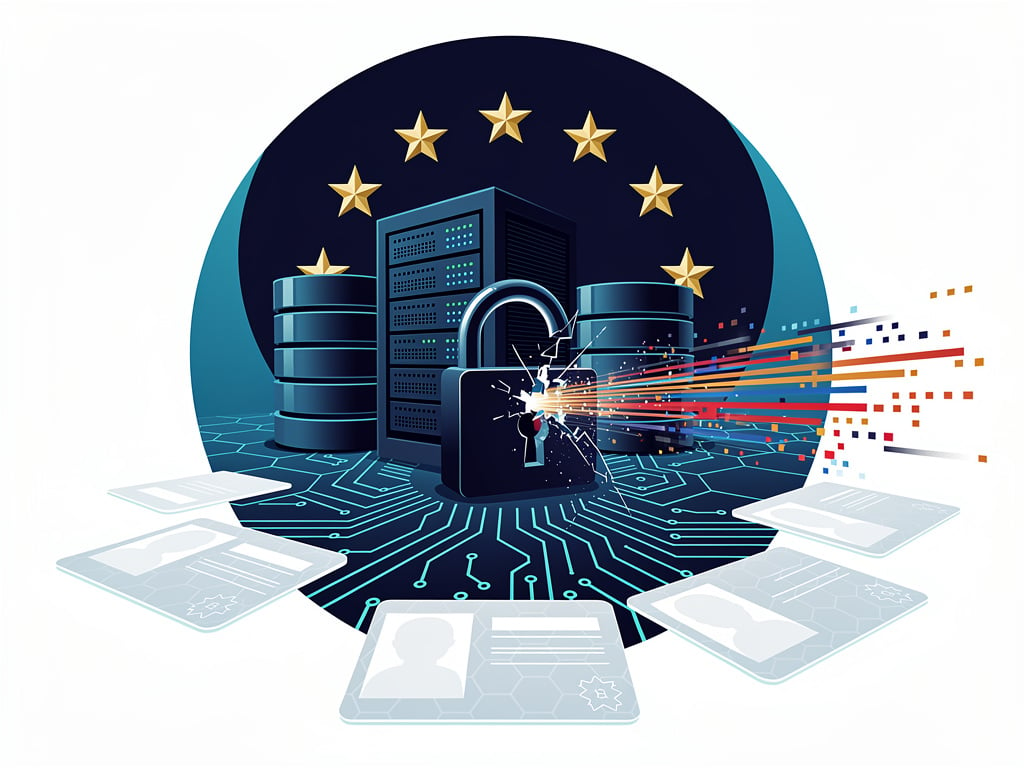
The European Commission, the executive arm of the European Union, suffered a significant cybersecurity breach that compromised personal data belonging to more than a thousand staff members and other individuals. The institution confirmed the incident only after details began to surface publicly, raising pointed questions about transparency, institutional cybersecurity preparedness, and the widening gap between the EU’s ambitious data protection regulations and its own internal practices.
The breach targeted the Commission’s recruitment database, known as EURES, which stores information submitted by job applicants and current staff. According to Mashable, attackers gained unauthorized access to the system and exfiltrated names, email addresses, and other personal details of approximately 1,159 individuals. The stolen data reportedly included identification documents uploaded as part of the hiring process — a particularly sensitive category of personal information that could be weaponized for identity theft or targeted phishing campaigns.
What makes this breach especially uncomfortable for Brussels is timing. The EU has spent years positioning itself as the global standard-bearer for data protection. The General Data Protection Regulation, or GDPR, which took effect in 2018, gave the bloc’s regulators the power to levy fines of up to 4% of a company’s global annual revenue for mishandling personal data. The Commission itself has repeatedly urged member states and private companies to invest in cybersecurity infrastructure and adopt rigorous protocols.
And yet here it is, dealing with its own data security failure.
The Commission disclosed the breach to affected individuals via email, as reported by Mashable, but the notification came weeks — possibly months — after the intrusion was first detected internally. That delay is significant. Under GDPR, organizations that experience a data breach are generally required to notify the relevant supervisory authority within 72 hours of becoming aware of the incident. While EU institutions technically fall under a separate regulation — Regulation 2018/1725, which governs data processing by EU institutions and bodies — the spirit and substance of the notification requirements are similar. The European Data Protection Supervisor, the body responsible for overseeing EU institutions’ compliance with data protection rules, was reportedly informed.
But the broader public was not. Not quickly, anyway.
The attack fits a pattern that cybersecurity analysts have been warning about for years. Government institutions, international organizations, and large bureaucracies remain high-value targets precisely because they store vast quantities of sensitive personal data and often rely on legacy IT systems that haven’t kept pace with modern threat vectors. The Commission employs tens of thousands of people across its various directorates-general and agencies, and its recruitment processes generate enormous volumes of personal documentation — passports, CVs, cover letters, references. That’s a treasure trove for threat actors.
No group has publicly claimed responsibility for the breach as of this writing. The Commission has not publicly attributed the attack to any specific nation-state or criminal organization, though European institutions have faced persistent cyber threats from Russian, Chinese, and North Korean-linked groups in recent years. In 2021, the European Medicines Agency was hit by a cyberattack that resulted in the theft of COVID-19 vaccine-related documents, an incident later attributed to Chinese-linked hackers by European intelligence officials. The European Banking Authority suffered a breach the same year tied to vulnerabilities in Microsoft Exchange Server.
So the Commission is hardly alone. But it is uniquely exposed to criticism because of its regulatory posture.
The institutional response has been measured to the point of opacity. A Commission spokesperson confirmed the breach and said appropriate measures had been taken to contain the incident and prevent further unauthorized access. Affected individuals were advised to remain vigilant against phishing attempts and to monitor their accounts for suspicious activity — standard post-breach guidance that has become almost ritualistic in its familiarity. The Commission also said it was working with CERT-EU, the Computer Emergency Response Team for EU institutions, to investigate the scope and origin of the attack.
CERT-EU has itself sounded alarms in recent months about the state of cybersecurity across EU bodies. In its most recent threat landscape report, the team noted a sharp increase in spear-phishing campaigns targeting EU staff, as well as a rise in exploitation of known vulnerabilities in widely used software platforms. The report urged institutions to accelerate the adoption of multi-factor authentication, improve endpoint detection capabilities, and conduct more frequent penetration testing. Whether the Commission had fully implemented those recommendations before the EURES breach occurred remains unclear.
Privacy advocates have been blunt in their assessment. The breach exposes a credibility gap, they argue. If the Commission expects private companies to meet exacting standards on data protection — and punishes them financially when they fall short — it must hold itself to at least the same standard. The fact that recruitment applicants, many of them young professionals seeking their first EU posting, had their identity documents compromised adds a layer of personal harm that goes beyond abstract policy debate.
There’s also a question of scale. The 1,159 affected individuals represent a relatively small number compared to the mega-breaches that regularly hit private-sector companies. But in government cybersecurity, the sensitivity of the data often matters more than the volume. Identity documents can be used to create fraudulent accounts, bypass know-your-customer checks at financial institutions, or construct convincing impersonation schemes. For individuals whose passport data was exposed, the consequences could linger for years.
The European Commission’s handling of this incident will likely face scrutiny from the European Parliament, where several members have already expressed concern about cybersecurity governance within EU institutions. In March 2024, the Parliament itself acknowledged it had been targeted by a sophisticated cyberattack ahead of the European elections, with the institution’s president warning that foreign interference operations were intensifying. That attack, attributed to a pro-Russian hacking group known as APT28 or Fancy Bear, underscored the extent to which European institutions have become frontline targets in a broader geopolitical contest over information and influence.
The recruitment database breach is different in character — less espionage, more data theft — but it reinforces the same underlying vulnerability. EU institutions process enormous amounts of personal data across borders and jurisdictions, often using IT infrastructure that was designed for interoperability rather than security. Modernizing those systems is expensive, politically complex, and perpetually competing with other budget priorities.
And the threat environment isn’t getting any easier. Cybercriminal groups have become more professionalized, with ransomware-as-a-service models lowering the barrier to entry for attackers. Nation-state actors continue to probe European networks for intelligence and leverage. The convergence of these trends means that breaches like the one affecting the Commission’s recruitment system are likely to become more frequent, not less.
For the Commission, the path forward involves more than just patching a database vulnerability. It requires a reckoning with institutional culture. Cybersecurity can’t be treated as a back-office IT function in an organization that writes the rules for a continent. The GDPR was built on the principle that personal data deserves serious protection. The Commission’s own breach is a test of whether that principle applies when the institution holding the data is also the one that wrote the law.
The affected individuals deserve answers. So does the public. How the Commission responds in the coming weeks — with transparency or with bureaucratic deflection — will say a great deal about whether Europe’s data protection ambitions are matched by its institutional capacity to live up to them.


 WebProNews is an iEntry Publication