
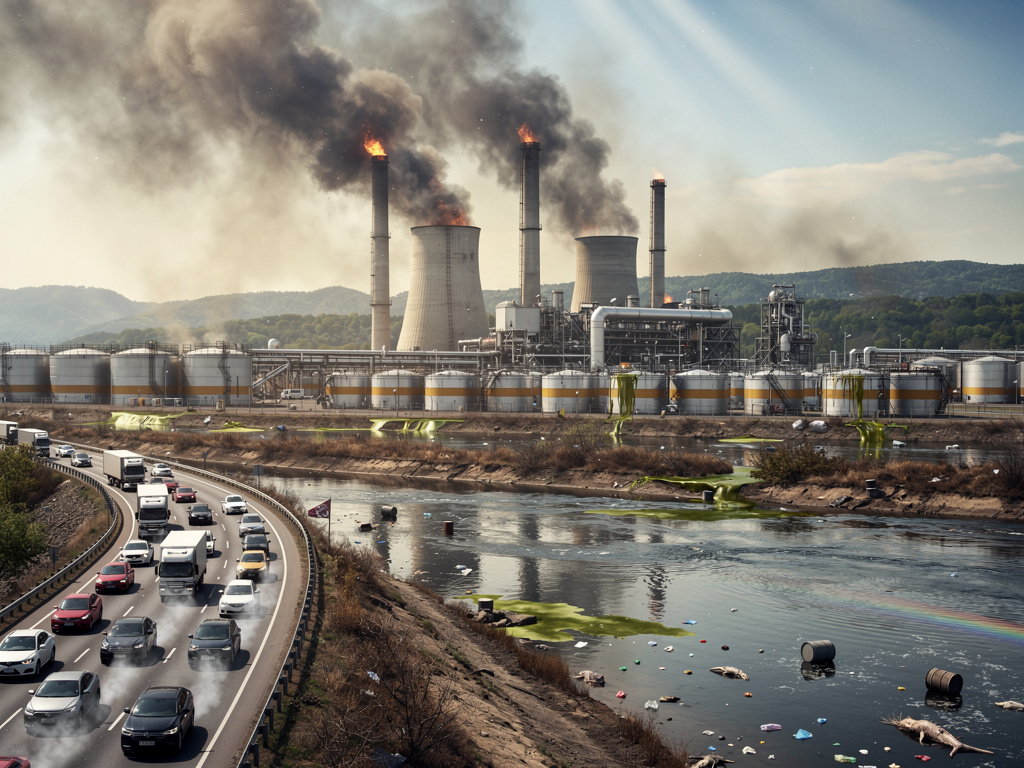
The Environmental Protection Agency has moved to dismantle a sweeping array of pollution regulations, rolling back or weakening rules that have governed industrial emissions, water quality, and chemical safety in the United States for years. The scope is staggering. In a series of actions that have accelerated in recent weeks, the agency under the Trump administration has targeted restrictions on everything from coal ash disposal to mercury emissions from power plants, signaling a fundamental reorientation of the federal government’s relationship with environmental enforcement.
The changes aren’t happening in a vacuum. They arrive as communities across the country grapple with worsening air quality, contaminated water systems, and the persistent health effects of industrial pollution — problems that disproportionately affect low-income neighborhoods and communities of color. And they represent, according to environmental advocates and former EPA officials, the most aggressive deregulatory push the agency has ever undertaken.
As Futurism reported in a detailed accounting of the administration’s actions, the EPA has moved to weaken or eliminate regulations covering power plant emissions, vehicle tailpipe standards, water pollution limits, and protections against hazardous chemicals. The publication cataloged a long list of rollbacks that, taken individually, might each warrant significant public debate. Taken together, they amount to a wholesale retreat from the agency’s core mission.
Start with the air. The EPA has moved to relax mercury and air toxics standards for coal- and oil-fired power plants, rules that were originally put in place because mercury is a potent neurotoxin that accumulates in fish and poses severe risks to developing children. The agency has also taken aim at the Clean Power Plan’s successor regulations, which sought to limit carbon dioxide emissions from the electricity sector. These weren’t obscure bureaucratic provisions. They were the primary federal mechanisms for controlling some of the most dangerous pollutants that Americans breathe.
Then there’s water. The administration has narrowed the definition of which waterways fall under federal protection, effectively removing Clean Water Act safeguards from millions of acres of wetlands and thousands of miles of streams. The practical consequence: industries that previously needed permits to discharge pollutants into these waters no longer face the same oversight. For communities downstream, the implications are direct and personal.
Vehicle emission standards have been another major target. The EPA moved to roll back tailpipe pollution limits that were set during the Obama administration, replacing them with weaker requirements that would allow cars and trucks to emit more carbon dioxide and conventional pollutants per mile driven. California, which has long maintained its own stricter standards under a Clean Air Act waiver, saw the administration attempt to revoke that authority — a move that triggered immediate legal challenges and a confrontation with one of the world’s largest sub-national economies.
The chemical safety front is equally consequential. Rules governing the use of per- and polyfluoroalkyl substances — the so-called “forever chemicals” that have contaminated drinking water supplies serving millions of Americans — have faced pressure. The EPA under the Biden administration had moved to set enforceable limits on PFAS in drinking water for the first time. The current administration’s posture toward those standards has raised alarms among public health researchers who have spent years documenting the links between PFAS exposure and cancer, thyroid disease, and immune system dysfunction.
So who benefits? Industry groups have largely applauded the changes. The American Petroleum Institute, the National Mining Association, and various manufacturing trade organizations have argued that the previous regulatory framework imposed excessive costs, stifled economic growth, and in some cases exceeded the EPA’s statutory authority. They contend that many of the rolled-back rules were legally vulnerable and economically unjustified.
But the cost-benefit calculus looks very different depending on where you stand — literally. Research published in peer-reviewed journals has consistently shown that the health benefits of Clean Air Act regulations, measured in avoided premature deaths, hospitalizations, and lost workdays, have exceeded compliance costs by ratios of 10 to 1 or more. A 2011 EPA study estimated that the Clean Air Act’s provisions would prevent 230,000 premature deaths annually by 2020. Rolling back the rules doesn’t eliminate those costs. It shifts them — from corporate balance sheets to hospital bills, insurance premiums, and shortened lives.
Former EPA administrators from both parties have expressed concern. William Reilly, who led the agency under George H.W. Bush, has previously warned against dismantling environmental protections that took decades to build. Christine Todd Whitman, EPA chief under George W. Bush, has been similarly vocal. Their objections aren’t partisan posturing. They reflect an institutional memory of why these rules exist in the first place — often because rivers caught fire, children were poisoned by lead, and entire communities were rendered uninhabitable by unchecked industrial contamination.
The legal battles are far from settled. Environmental organizations including the Sierra Club, Earthjustice, and the Natural Resources Defense Council have filed or joined lawsuits challenging many of the rollbacks. Several have scored early victories in federal courts, with judges finding that the EPA failed to follow required administrative procedures or adequately justify its decisions. But litigation is slow, and in the meantime, the relaxed standards are the operative rules governing pollution in the United States.
State-level responses have been uneven. California, New York, and a handful of other states have moved to maintain or strengthen their own environmental standards, creating a patchwork of regulations that varies dramatically by geography. Other states, particularly those with economies heavily dependent on fossil fuel extraction or heavy manufacturing, have welcomed the federal retreat. The result is a fragmented system where the protections available to an American citizen depend heavily on which side of a state line they happen to live on.
There’s a workforce dimension too. The EPA itself has been subject to significant staff reductions and reorganizations under the current administration. Career scientists and enforcement officials have departed in substantial numbers, either through buyouts, reassignments, or simple attrition driven by frustration. Institutional knowledge — the kind that takes years to develop and can’t be easily replaced — is walking out the door. And the agency’s enforcement actions against polluters have declined markedly, according to data tracked by the Environmental Integrity Project.
The international ramifications are significant. The United States’ withdrawal from the Paris climate agreement, combined with the domestic rollback of emissions regulations, has weakened its standing in global climate negotiations. Other nations have pointed to American backsliding as justification for their own reluctance to adopt more aggressive decarbonization targets. It’s a dynamic that climate scientists say is particularly dangerous given the narrowing window for avoiding the worst consequences of global warming.
Not all the changes have proceeded smoothly from the administration’s perspective. Courts have blocked several rollback attempts on procedural grounds. Congressional Democrats have used oversight hearings to spotlight the health consequences of weakened protections. And public opinion polling consistently shows that majorities of Americans — including significant numbers of Republican voters — support maintaining or strengthening environmental regulations, particularly those related to clean air and water.
The tension between public sentiment and policy direction raises questions about the durability of the current approach. Environmental regulations have historically operated on a ratchet — tightening over time as scientific understanding of pollution’s effects improves and as cleaner technologies become available. The current administration is attempting to reverse that ratchet, and the question is whether the reversal will stick through subsequent administrations or whether it represents a temporary deviation from a longer-term trajectory.
For the communities living near power plants, refineries, chemical facilities, and superfund sites, the debate is not abstract. It’s measured in asthma rates, cancer clusters, and contaminated well water. The EPA was created in 1970 precisely because those harms had become impossible to ignore. Whether the agency continues to address them — or steps aside — will shape the health and environment of the country for generations.
What’s clear is that the scale of the current rollback effort is without modern precedent. Previous administrations of both parties adjusted environmental regulations at the margins, sometimes loosening requirements in one area while tightening them in another. The breadth of what’s happening now is categorically different. It represents a bet that the economic benefits of deregulation will outweigh the environmental and health costs — a bet that will be paid off, or not, in the lungs and bloodstreams of ordinary Americans long after the current political moment has passed.


 WebProNews is an iEntry Publication