
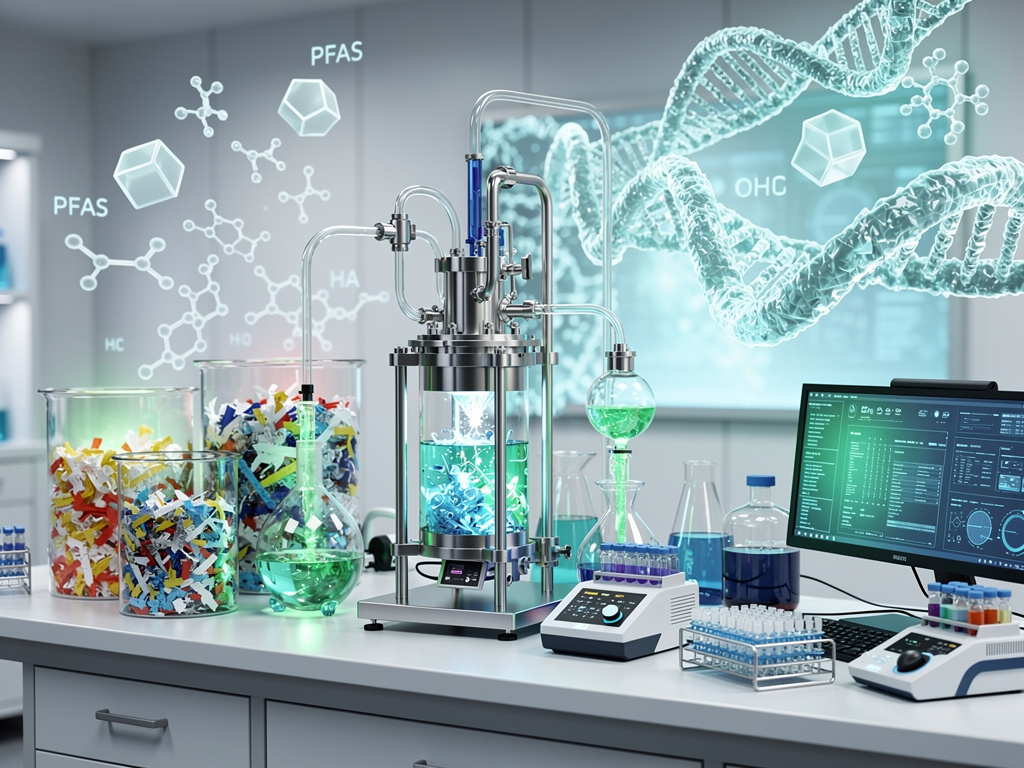
Somewhere in a London lab, engineered enzymes are chewing through nylon — one of the most stubbornly unrecyclable plastics on the planet. The company behind this work, Epoch Biodesign, just raised $12 million to prove it can do this at industrial scale. If it succeeds, the implications stretch far beyond a single polymer.
Nylon is everywhere. Clothing, carpets, car parts, fishing nets, food packaging. Global production exceeds 8 million metric tons per year, and the vast majority of nylon waste ends up incinerated or buried in landfills. Unlike PET — the plastic in water bottles, which has attracted significant enzymatic recycling investment — nylon has remained chemically resistant to biological breakdown. Mechanical recycling degrades its quality. Chemical recycling processes exist but are energy-intensive and expensive. The material is, for practical purposes, a one-way ticket to the waste stream.
Epoch Biodesign thinks biology can solve this.
Engineering Enzymes That Nature Never Made
Founded in 2022 and spun out of research at the University of Oxford, Epoch Biodesign designs synthetic enzymes — proteins engineered from scratch to catalyze specific chemical reactions that don’t occur naturally. The company’s co-founders, CEO Thomas Heap and CSO Anthony Green, have built a platform that combines computational protein design with laboratory evolution to create enzymes tailored for industrial chemistry problems.
Their first target: nylon-6, the most common form of nylon, widely used in textiles and automotive components. The enzyme Epoch has developed breaks nylon-6 back down into caprolactam, its chemical building block. Caprolactam can then be repolymerized into virgin-quality nylon. A true circular loop, at least in theory.
The $12 million seed round was led by Union Square Ventures, with participation from Mosaic Ventures, Braavos Capital, and several angel investors, as reported by The Next Web. That’s a substantial seed for a company still in early-stage development, signaling strong conviction from investors that enzymatic recycling’s moment is arriving.
“We’re not tweaking enzymes found in nature,” Heap told The Next Web. “We’re building them from the ground up.” That distinction matters. Most enzymatic recycling efforts — including the well-known work by French company Carbios on PET plastics — rely on discovering natural enzymes and then improving them through directed evolution. Epoch’s approach starts with computation, designing protein structures in silico before ever touching a test tube. The company claims this gives it the ability to target chemical bonds that evolution never had reason to address.
And nylon’s amide bonds are exactly that kind of target. Tough. Stable. Largely ignored by biological systems.
The science is grounded in recent advances in protein structure prediction and design, accelerated by tools like DeepMind’s AlphaFold and the broader explosion of machine learning applied to molecular biology. Epoch isn’t alone in pursuing computational enzyme design — companies like Arzeda in Seattle and Basecamp Research in London are working adjacent territory — but its specific focus on waste plastics gives it a clear commercial thesis.
So why nylon first? Because the economics could work. Virgin caprolactam prices fluctuate but generally sit between $1,500 and $2,000 per metric ton. If enzymatic recycling can produce caprolactam at or below those prices while consuming less energy than virgin production, the business case writes itself. Nylon manufacturers get a cheaper, lower-carbon feedstock. Waste processors get a new revenue stream. And the millions of tons of nylon waste currently rotting in landfills or floating in oceans become a resource rather than a liability.
That’s the pitch. The reality is considerably more complicated.
Enzymatic processes work beautifully in controlled laboratory settings. Scaling them to handle tons of heterogeneous, contaminated post-consumer waste is a different beast entirely. Nylon waste comes mixed with dyes, additives, other polymers, and physical contaminants. Pre-treatment and sorting add cost and complexity. Enzyme stability at industrial temperatures and over extended reaction times remains an engineering challenge. And the economics must account not just for the enzyme’s catalytic efficiency but for the entire process chain — collection, sorting, pre-treatment, reaction, purification, and repolymerization.
Carbios, which went public in 2021 and is currently building its first commercial PET recycling plant in France, has spent over a decade getting from lab proof-of-concept to industrial demonstration. Its journey offers both inspiration and a cautionary timeline for Epoch. The French company’s enzymatic PET recycling technology works — it can break down PET bottles and polyester textiles into their monomers — but commercialization has been slow, expensive, and dependent on partnerships with major brands like L’Oréal and Nestlé Waters.
Epoch is far earlier in its development arc. But the company benefits from a decade of advances in protein engineering that Carbios didn’t have when it started.
A Market Hungry for Solutions
The timing of Epoch’s raise isn’t accidental. Regulatory pressure on plastic waste is intensifying across Europe, the UK, and parts of Asia. The EU’s Packaging and Packaging Waste Regulation, adopted in 2024, mandates minimum recycled content thresholds for plastic packaging. Extended producer responsibility schemes are expanding. Brands face growing consumer and regulatory scrutiny over their plastic footprints, and many have made recycled-content commitments they currently have no way to meet — especially for materials like nylon that lack viable recycling pathways.
The fashion industry, in particular, is desperate. Nylon is a staple of activewear, swimwear, and outerwear. Brands like Patagonia, Adidas, and Stella McCartney have invested in recycled nylon programs, but the supply of recycled nylon is thin and mostly comes from pre-consumer waste or collected fishing nets — a limited and logistically challenging feedstock. An enzymatic process that could handle post-consumer nylon textiles at scale would unlock an entirely new source of recycled material.
Automotive is another major market. Nylon-6 and nylon-6,6 are used extensively in engine components, cable ties, air intake manifolds, and other under-the-hood parts. As automakers face their own sustainability mandates and seek to reduce lifecycle emissions, recycled nylon inputs become strategically valuable.
But Epoch’s ambitions extend beyond nylon. The company has described its enzyme design platform as applicable to multiple “hard-to-recycle” waste streams, including other plastics, forever chemicals (PFAS), and pharmaceutical residues. The nylon program is a beachhead — a first proof point intended to demonstrate the platform’s commercial viability before expanding to other targets.
This platform narrative is key to understanding the $12 million valuation and the interest from a firm like Union Square Ventures, which typically invests in network-effect businesses and is better known for backing Twitter, Tumblr, and Coinbase than biotech startups. USV’s thesis here appears to be that Epoch’s computational enzyme design platform, if validated, could become a general-purpose tool for industrial biotransformation — a picks-and-shovels play on the growing demand for biological solutions to chemical problems.
That’s a big if. Platform stories are seductive in venture capital, but they require at least one killer application to prove out. Nylon recycling is Epoch’s chosen proving ground.
The competitive picture is also evolving. Several groups are working on enzymatic or biological approaches to nylon degradation. Researchers at Osaka University published work in 2023 identifying natural nylon-degrading bacteria, though the reaction rates were far too slow for commercial use. Academic labs in Germany and the United States have explored engineered enzymes for polyamide hydrolysis. And larger chemical companies, including BASF and Ascend Performance Materials, have invested in chemical recycling technologies for nylon that don’t rely on enzymes but could compete for the same feedstock.
Epoch’s advantage, if it holds, is speed of enzyme development. Traditional directed evolution — mutating natural enzymes and screening for improved variants — is powerful but slow. Computational design, augmented by machine learning, can explore vastly larger protein sequence spaces and converge on functional designs faster. The question is whether computationally designed enzymes can match or exceed the performance of naturally evolved ones when it comes to stability, specificity, and catalytic rate under real-world conditions.
Early results, at least according to the company, are promising. But peer-reviewed data on Epoch’s specific enzymes remains limited, and independent validation will be critical as the company moves toward pilot-scale demonstrations.
The Road From Lab Bench to Loading Dock
With $12 million in hand, Epoch plans to scale its team, expand laboratory capacity, and begin pilot-scale testing of its nylon recycling process. The company currently has around 20 employees and operates out of facilities in London. Heap has indicated that a commercial demonstration could come within the next two to three years, though such timelines in biotech are notoriously optimistic.
The path forward will require partnerships. Waste management companies control access to nylon feedstock. Chemical companies and nylon producers are the buyers of recycled caprolactam. Brands and OEMs create the demand pull for recycled nylon products. Epoch will need to build relationships across this value chain — or partner with an established player that already has them.
Financing will also need to escalate. Pilot plants are expensive. Commercial-scale bioreactors more so. Epoch’s seed round gets it through the next phase of development, but a Series A of considerably larger size will likely be needed within 18 to 24 months. The climate tech funding environment, while cooler than its 2021 peak, remains receptive to companies with strong technical differentiation and clear paths to revenue.
And the broader tailwinds are real. Governments are tightening regulations on plastic waste. Corporations are making binding commitments to recycled content. Consumers — particularly younger demographics — are paying attention. The supply of recycled nylon is structurally insufficient to meet projected demand. Something has to give.
Whether Epoch Biodesign is the company that breaks through remains uncertain. The science is early. The engineering challenges are formidable. The competitive dynamics are shifting. But the core proposition — that designed biology can solve recycling problems that physics and chemistry alone cannot — is increasingly credible. And in a world generating millions of tons of nylon waste annually with no good way to deal with it, even a partial solution would be worth billions.
The enzymes are hungry. The question is whether they can eat fast enough.


 WebProNews is an iEntry Publication