
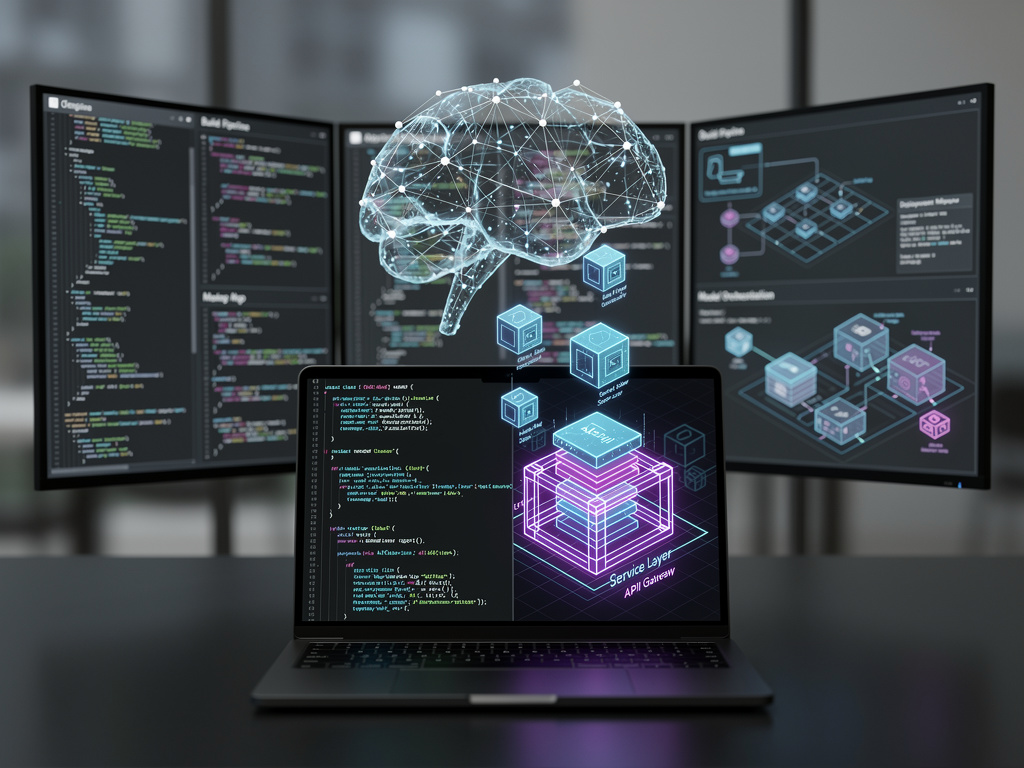
For decades, the image of a software developer has been one of tireless typing, fingers flying across a keyboard to translate complex logic into precise, syntactical commands. But for a growing number of engineers like Jérémy Pinto, that image is becoming a relic. He no longer “writes” code in the traditional sense. Instead, he describes his new process as something more akin to art than transcription: he sculpts it.
In a detailed account of his evolving workflow, Pinto argues that generative AI has fundamentally altered his interaction with the machine, shifting his role from a line-by-line author to a high-level director of a powerful, if sometimes flawed, digital apprentice. “My job is now to take a block of marble (a rough idea, a business need) and, using my tools (AI prompts, my own intelligence), sculpt it into a statue (the final product),” he writes in a post on his personal blog, Jerpint.io. This metaphor captures a seismic shift occurring across the software development domain, where the core creative act is moving from implementation to intention.
From Blank Page to Interactive Dialogue
The traditional coding process often begins with a blinking cursor on a blank screen, a void the developer must fill with structure, logic, and syntax. The new method, as Pinto and others practice it, starts not with a line of code, but with a line of conversational English. Using AI-native code editors like Cursor, which integrates large language models (LLMs) such as GPT-4 directly into the development environment, the programmer initiates a dialogue. They might ask the AI to “scaffold a new React component with state management for a user login form” or “refactor this Python function to be more efficient and handle edge cases.”
The AI responds in seconds with a block of functional code. This initial output is the rough block of marble. The developer’s work then becomes a cycle of refinement: they test the code, identify flaws or missing features, and issue new, more specific prompts to chisel away at the problems. This iterative conversation—prompt, generate, test, refine—replaces hours of manual typing. It’s a process that emphasizes critical thinking, system design, and deep domain knowledge over rote memorization of syntax.
A Productivity Boom With Unprecedented Adoption
This evolving paradigm is not a niche experiment. It’s being rapidly institutionalized by the very tools developers use every day. GitHub, the world’s largest host of source code and a subsidiary of Microsoft, has seen explosive growth of its AI pair programmer, Copilot. The tool, which suggests lines and entire functions of code in real-time, is already used by over 1.5 million developers. The productivity claims are staggering; in a recent survey, GitHub found that developers reported completing tasks up to 55% faster when using Copilot.
This isn’t just about speed; it’s about changing the nature of the work itself. “We see developers being more in the flow, they are happier because they can focus on the ‘what’ versus the ‘how’,” explained GitHub CEO Thomas Dohmke in a Forbes interview. By offloading the boilerplate and syntactical heavy lifting to AI, developers can allocate more cognitive energy to architectural decisions and solving novel business problems, effectively elevating their role from digital bricklayer to project architect.
The New Essential Skillset: Prompting Over Programming
The implications of this shift are profound, prompting some industry leaders to question the very foundations of technical education. Nvidia CEO Jensen Huang made waves with his assertion that the future is not in learning to code, but in learning to prompt. “Everybody in the world is now a programmer. This is the miracle of artificial intelligence,” Huang stated at the World Governments Summit, as reported by Reuters. His point is that human language is becoming the new programming language, and the most valuable skill will be the ability to clearly and effectively articulate a problem for an AI to solve.
This has given rise to a new discipline known as “prompt-driven development,” where the quality of the natural language input directly dictates the quality of the machine’s output. As described by industry publication InfoWorld, this methodology involves treating prompts as a core part of the software development lifecycle, requiring skills in clarity, context-setting, and iterative questioning. The best engineers in this new model are not necessarily the fastest typists, but the clearest communicators and most discerning critics of AI-generated output.
A Tool, Not an Oracle
However, the transition is not without significant friction and risk. For every success story, there are cautionary tales of AI “hallucinations,” where the model confidently generates code that is subtly—or catastrophically—wrong. The AI lacks true understanding; it is a sophisticated pattern-matching machine. This means the human developer’s expertise is more critical than ever, not to write the code, but to validate it. An experienced engineer can spot a flawed algorithm or an inefficient database query in the AI’s suggestion, while a novice might accept it without question.
This dynamic was a central theme in online discussions following Pinto’s article, where seasoned developers noted that the “sculpting” approach is only effective if the sculptor deeply understands the material. Without a firm grasp of programming fundamentals, a developer cannot effectively guide the AI or distinguish between a masterpiece and a cleverly disguised mess. The AI can generate a thousand lines of code in an instant, but it cannot, on its own, guarantee that the code aligns with complex business logic or long-term strategic goals.
The Unseen Risks of AI-Generated Code
Beyond simple bugs, a more insidious threat lurks within AI-generated code: security vulnerabilities. AI models are trained on vast datasets of public code, including code that is outdated, flawed, or insecure. A 2022 study by researchers at Stanford University found that developers using AI assistants were significantly more likely to produce insecure code than their manual-coding counterparts. The study, detailed by Stanford’s Institute for Human-Centered Artificial Intelligence, highlighted that the convenience and authority of AI suggestions can lull developers into a false sense of security, leading them to accept code with subtle but serious vulnerabilities.
This raises critical questions about accountability and the potential for skill atrophy, particularly among junior developers. If newcomers to the field learn to code primarily by prompting an AI, they may never develop the deep, intuitive understanding of security principles and low-level mechanics that comes from building systems from the ground up. The “black box” nature of LLMs means that even when the code works, the developer may not fully comprehend *why* it works, creating a fragile foundation of knowledge that could crumble under the pressure of a complex debugging or security-hardening task.
Reshaping the Modern Software Team
The rise of the code sculptor is already beginning to reshape the composition and workflow of technology organizations. The productivity gains suggest that smaller, more senior-led teams can accomplish what once required much larger groups. The bottleneck in development is shifting away from the time it takes to write code and toward the time it takes to define problems, review outputs, and integrate disparate AI-generated modules into a coherent, reliable system.
Project management methodologies may also need to adapt. Rapid prototyping becomes trivial, allowing teams to iterate on ideas at an unprecedented rate. However, this also places a greater emphasis on robust quality assurance and automated testing pipelines to catch the inevitable errors and security flaws in AI-generated code. The most effective teams will be those that successfully blend human architectural oversight with AI-driven implementation speed, creating a new symbiotic relationship between engineer and machine.
The Human in the Director’s Chair
Looking ahead, the logical evolution of this trend points toward more autonomous AI agents that can take on larger and more complex tasks with less human intervention. Tools like Cursor are early steps in a journey toward an AI that acts less like a pair programmer and more like a junior member of the development team. It might be tasked with building an entire feature based on a high-level specification, automatically writing its own tests, and even submitting its work for review by a human lead.
Yet, even in this advanced future, the role of the human is not eliminated but elevated. The developer becomes the final arbiter of quality, the guardian of the user experience, and the strategic mind responsible for the overall vision. The craft of software development is not disappearing; it is being redefined. The tedious, repetitive, and syntactical aspects are being automated away, leaving behind the core creative challenge: the difficult, deeply human act of sculpting a clear intention from the chaotic marble of an idea.


 WebProNews is an iEntry Publication