
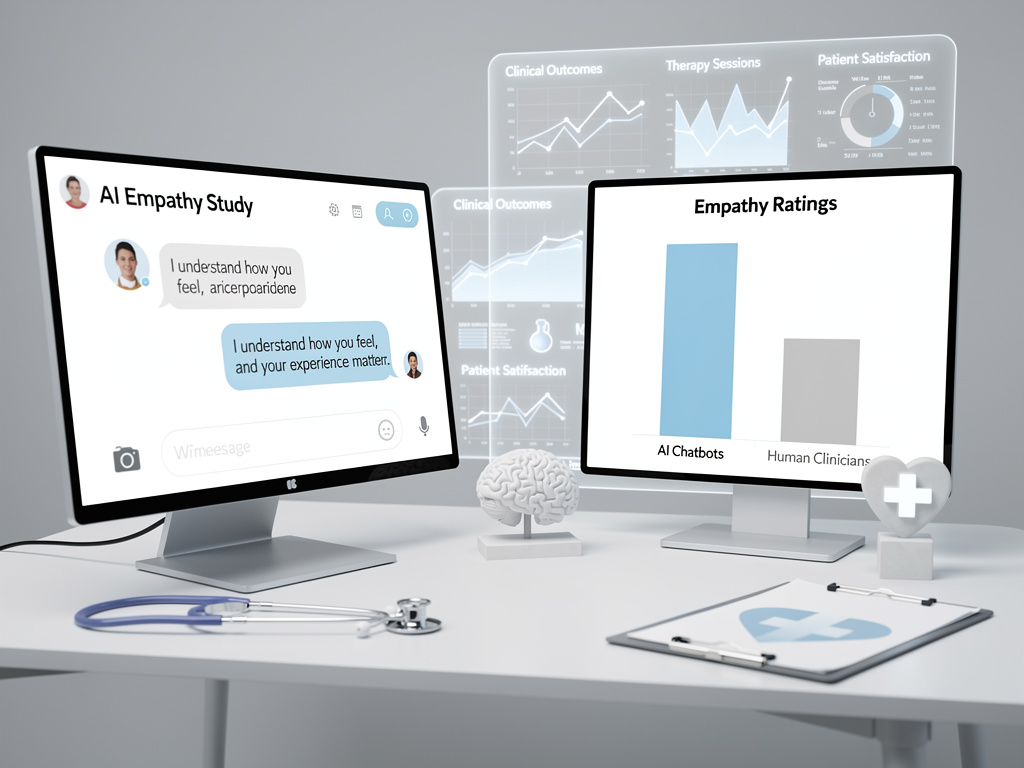
In a finding that challenges deeply held assumptions about what makes us uniquely human, a growing body of rigorous scientific research now shows that artificial intelligence chatbots consistently outperform human beings in delivering empathetic, compassionate responses — not just in casual conversation, but in high-stakes domains like healthcare, mental health counseling, and customer service. The implications are profound, unsettling, and impossible to ignore.
The evidence is no longer anecdotal. Across multiple peer-reviewed studies and controlled experiments, AI-powered large language models such as ChatGPT, Google’s Gemini, and other conversational agents have been rated by both patients and trained evaluators as more empathetic, more thorough, and more emotionally attuned than licensed physicians, therapists, and trained human responders. As Digital Trends recently reported in a detailed examination of the phenomenon, this is not a marginal difference — in several studies, the gap between AI and human empathy ratings was substantial and statistically significant.
The Studies That Shattered Assumptions About Human Empathy
The watershed moment in this line of research came in 2023, when a landmark study published in JAMA Internal Medicine compared responses from licensed physicians with those generated by ChatGPT to real patient questions posted on the Reddit forum r/AskDocs. A panel of licensed healthcare professionals, blinded to the source of each response, evaluated the answers on both quality and empathy. The results were striking: ChatGPT’s responses were rated significantly higher on both dimensions. Nearly 80% of the time, evaluators preferred the chatbot’s answers. More remarkably, ChatGPT’s responses were rated “empathetic” or “very empathetic” nearly ten times more often than those written by real doctors.
This was not an isolated result. As Digital Trends detailed, subsequent studies have replicated and extended these findings across multiple contexts. Research published in Nature Medicine found that AI chatbots could match or exceed the diagnostic accuracy of physicians while simultaneously delivering information in a warmer, more patient-centered manner. In oncology settings, where empathetic communication is critical, AI-generated letters to patients were rated as more compassionate than those written by oncologists themselves.
Why Machines Seem to Care More Than People
The explanation for AI’s empathy advantage is both intuitive and deeply uncomfortable. Human professionals — doctors, therapists, customer service representatives — operate under enormous time pressure, emotional fatigue, and cognitive overload. A primary care physician in the United States sees an average of 20 patients per day, with appointment slots often lasting just 15 minutes. Under those conditions, empathetic communication becomes a casualty of systemic constraints. Physicians are not necessarily less caring; they are simply overwhelmed.
AI chatbots, by contrast, face none of these constraints. They do not experience burnout. They do not carry the emotional residue of a previous difficult patient encounter into the next conversation. They can generate lengthy, detailed, emotionally calibrated responses in seconds, drawing on vast training data that includes examples of effective therapeutic communication, motivational interviewing techniques, and patient-centered language. As the research highlighted by Digital Trends makes clear, the chatbots are not actually feeling empathy — they are performing it, and performing it with a consistency and thoroughness that exhausted humans simply cannot match.
Mental Health: The Most Sensitive Frontier
Perhaps nowhere is this dynamic more consequential — or more controversial — than in mental health care. The global shortage of mental health professionals is well documented. The World Health Organization estimates that nearly one billion people worldwide live with a mental disorder, and in many countries, there are fewer than two mental health workers per 100,000 people. Into this gap, AI chatbots have stepped with remarkable speed.
Apps like Woebot, Wysa, and Replika have attracted millions of users who report finding genuine comfort in their interactions with AI. Studies on Woebot, which uses principles of cognitive behavioral therapy, have shown measurable reductions in symptoms of depression and anxiety among users. Critically, users frequently describe the chatbot as “understanding” and “non-judgmental” — qualities they say they struggle to find in human interactions, including with trained therapists. The absence of perceived judgment appears to be a key factor. People disclose more honestly and more completely to machines, in part because they do not fear social consequences.
The Philosophical and Ethical Quandary
These findings force a reckoning with fundamental questions about the nature of empathy itself. If a patient feels genuinely comforted by an AI’s response — if their anxiety decreases, if they feel heard and validated — does it matter that the machine has no inner emotional experience? Philosophers have debated this question for decades in theoretical terms, but the debate is no longer theoretical. Millions of people are already receiving emotional support from AI systems, and many report that it is more helpful than what they receive from humans.
Critics raise legitimate concerns. Empathy without genuine understanding could lead to harmful outcomes in edge cases — a chatbot might fail to recognize the severity of a suicidal crisis, or might validate feelings that a trained clinician would recognize as symptoms requiring urgent intervention. There is also the risk of what some researchers call “empathy dependency” — users forming deep emotional attachments to AI systems that could be discontinued, modified, or monetized at the discretion of a technology company. The tragic case of a teenager who reportedly developed an intense emotional bond with a Character.AI chatbot before taking his own life has underscored the real dangers of unregulated AI companionship.
Healthcare Systems Take Notice
Despite these risks, healthcare institutions are moving rapidly to integrate AI-powered empathetic communication into clinical workflows. Several major hospital systems in the United States are now piloting AI tools that draft patient messages, discharge instructions, and follow-up communications on behalf of physicians. The physician reviews and approves the message, but the emotional tone and language are generated by AI. Early results suggest that patient satisfaction scores improve significantly when AI-assisted communication is used.
Insurance companies and telehealth platforms are also investing heavily in AI triage systems that can provide initial emotional support and assessment before connecting patients with human providers. The economic incentives are powerful: AI chatbots can handle thousands of simultaneous conversations at a fraction of the cost of human labor. For healthcare systems struggling with staffing shortages and rising costs, the appeal is obvious.
What This Means for Human Professionals
The implications for professionals whose work depends on interpersonal empathy — physicians, therapists, social workers, counselors — are significant but nuanced. The research does not suggest that human empathy is obsolete. Rather, it reveals that the systems within which humans operate often prevent them from expressing the empathy they genuinely possess. A doctor who cares deeply about her patients but has seven minutes per appointment is structurally constrained from demonstrating that care in ways that patients can perceive.
This reframing suggests that AI’s empathy advantage is as much an indictment of broken systems as it is a testament to technological capability. If physicians had more time, smaller patient panels, and less administrative burden, the empathy gap might narrow considerably. Some researchers argue that the most productive use of AI is not to replace human empathy but to handle routine communication tasks so that human professionals can devote their limited time and emotional energy to the interactions that matter most.
The Road Ahead for Artificial Emotional Intelligence
The technology is advancing rapidly. Multimodal AI systems that can interpret tone of voice, facial expressions, and physiological signals are already in development. Future chatbots may be able to detect when a user is crying, when their voice trembles with anxiety, or when their language patterns suggest deteriorating mental health — and adjust their responses accordingly. Companies like Hume AI are building “emotionally intelligent” AI systems designed specifically to optimize for human well-being rather than engagement metrics.
Regulation, however, has not kept pace. In the United States, AI chatbots that provide emotional support exist in a regulatory gray zone — they are not classified as medical devices, and they are not subject to the same oversight as licensed therapists. The European Union’s AI Act may impose some requirements, but enforcement mechanisms remain unclear. As millions of vulnerable people increasingly turn to AI for emotional support, the absence of robust guardrails represents a significant societal risk.
The data is now overwhelming: AI chatbots can simulate empathy more consistently, more thoroughly, and more accessibly than most human professionals operating within current institutional constraints. Whether this represents a triumph of technology or a failure of human systems — or both — is a question that will define the next decade of healthcare, mental health treatment, and human-machine interaction. What is no longer in question is that the machines have arrived at the emotional frontier, and by at least one important measure, they are outperforming us.


 WebProNews is an iEntry Publication