
When the engineering team at BoothIQ, an AI-powered platform for trade shows, crossed the 150,000-line threshold in their codebase, it marked more than a simple milestone. It was a validation of a strategic, and some might say risky, bet on Elixir, a programming language known more for its passionate community and technical elegance than for its widespread corporate adoption. Their journey reveals a compelling paradox facing modern technology leaders: the immense leverage of a specialized tool versus the pragmatic challenges of operating outside the mainstream.
In a detailed retrospective, the BoothIQ team chronicled their experience, painting a picture of a technology that delivers unprecedented performance and developer speed, yet comes with significant operational friction. Their story is a microcosm of a larger debate in Silicon Valley and beyond, as companies seek a competitive edge in their tech stack. The decision to build with a language like Elixir is not merely a technical choice; it’s a business strategy that trades the safety of a vast talent pool for the raw power of a platform built for the modern web’s most demanding tasks: massive concurrency and real-time interaction.
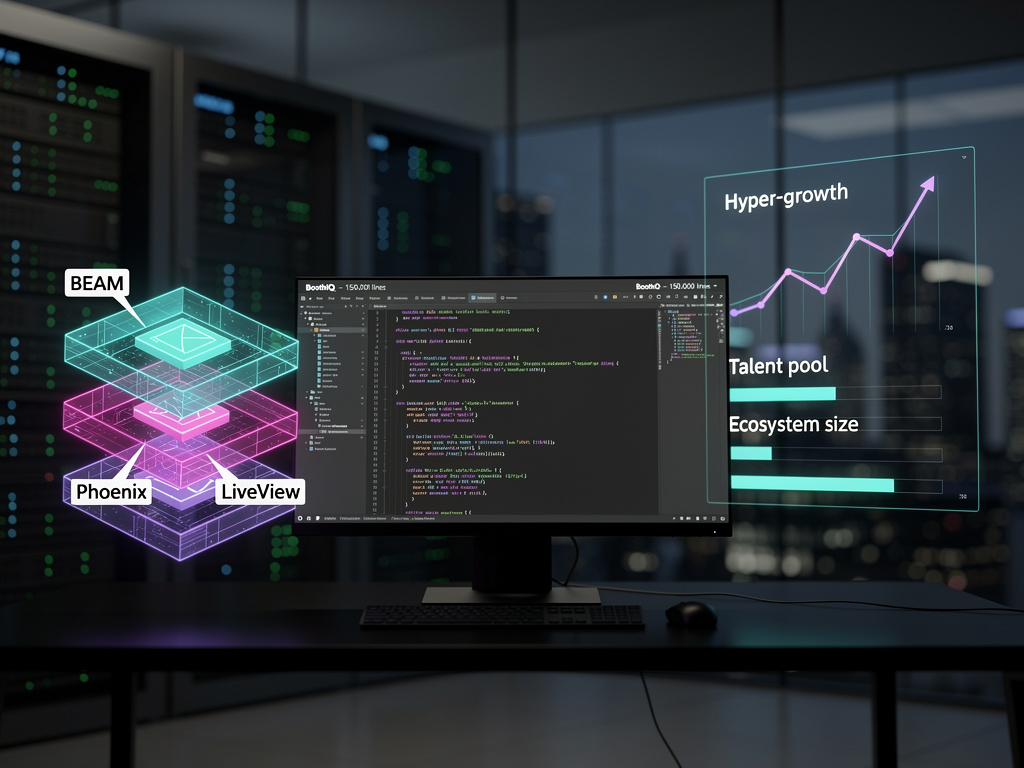
At the heart of Elixir’s appeal is the BEAM, the virtual machine it inherited from its parent language, Erlang. Originally designed by Ericsson for the staggering reliability requirements of telecommunications systems, the BEAM provides a battle-tested foundation for fault tolerance and concurrency. “The BEAM and OTP is Elixir’s superpower,” the BoothIQ team wrote in a post on the company’s official blog. This isn’t just academic; it translates directly to business value. For an application needing to handle thousands or millions of simultaneous connections—from chat applications to live-updating dashboards—the BEAM’s lightweight processes allow it to scale with an efficiency that can feel almost magical compared to more traditional web frameworks.
A Framework That Bends to the Developer’s Will
This inherent power is harnessed by the Phoenix Framework, Elixir’s flagship tool for web development. In particular, its LiveView library has become a game-changer, enabling developers to build rich, real-time user interfaces with server-side Elixir code, largely eliminating the need for complex JavaScript front-ends. This dramatically accelerates development, allowing small teams to achieve what would typically require separate front-end and back-end specialists. This fusion of capabilities fosters an environment of rapid, intuitive development, which BoothIQ half-jokingly refers to as being “vibe-coded.”
This rapid development cycle is a potent advantage for startups needing to out-innovate larger competitors. The ability to quickly ship features and iterate based on user feedback is paramount. According to a deep dive on building modern applications by the Elixir consultancy DockYard, LiveView’s architecture simplifies the creation of complex, collaborative features that are increasingly becoming standard user expectations. It allows engineers to remain in a single language and mental context, reducing cognitive overhead and preventing the fragmentation that often plagues projects split between disparate front-end and back-end technology stacks.
However, this speed can be a double-edged sword. The same intuitive, “vibe-driven” approach that allows for blistering initial progress can, if left unchecked, lead to a codebase that lacks formal structure. The BoothIQ team candidly admits that their early focus on speed meant they had to circle back later to refactor and impose a more rigid architecture. This is a familiar story of paying down technical debt, but it underscores a key challenge with highly productive frameworks: they make it easy to build quickly, but not necessarily easy to build with long-term, large-scale discipline from day one.
Confronting the Realities of a Niche Ecosystem
While the development experience receives high praise, the practicalities of building a business on Elixir present a different set of challenges. One of the most significant is the size of its ecosystem. Developers coming from worlds like JavaScript’s npm or Python’s PyPI, which have libraries for nearly any conceivable task, will find Elixir’s package manager, Hex, to be comparatively small. This isn’t to say it’s barren—the community has built robust libraries for common needs like database access, API clients, and authentication—but the long tail of obscure or highly specific packages is shorter.
This means teams must budget time for building more components in-house or carefully vetting the quality and maintenance status of the available third-party libraries. For BoothIQ, the ecosystem proved to be “more than enough,” but it’s a calculation every team must make. The trade-off is often one of quality over quantity; the Elixir community prides itself on well-crafted, reliable libraries, but the sheer volume of options found elsewhere is absent. This forces a degree of self-reliance that can be a drag on velocity if not properly anticipated.
This reality is a key factor in Elixir’s position in the broader market. While its capabilities are lauded, its adoption remains concentrated among companies that can afford to invest in a less common technology. A 2023 analysis by The New Stack explored this dynamic, noting that while Elixir is a perfect fit for a certain class of problems, it has yet to achieve the escape velocity needed for mainstream dominance. It remains a specialist’s tool, albeit an incredibly powerful one.
The High-Stakes Hunt for Elixir Talent
By far the most significant business challenge, which BoothIQ bluntly labels as “The Ugly,” is hiring. Finding experienced Elixir developers is notoriously difficult. The language, while deeply loved by those who use it, is not widely taught in schools or bootcamps, and the total number of professional developers remains a fraction of those available for languages like Java, Python, or JavaScript. This scarcity creates a hyper-competitive, and expensive, hiring market.
Data from the industry’s most comprehensive annual survey backs this up. The 2023 Stack Overflow Developer Survey reveals that while Elixir is one of the most “admired and desired” languages, its professional usage ranks far down the list. This creates a talent chasm: many developers want to learn and work with Elixir, but few have deep, on-the-job experience. For a hiring manager, this means sifting through candidates who are passionate but unproven, or competing for a tiny pool of senior talent.
This forces companies to adapt their hiring strategies. Many successful Elixir shops have given up on finding seasoned experts and instead focus on hiring smart, capable engineers from other disciplines—often with a background in functional programming or other high-concurrency languages—and training them in-house. This requires a significant investment in mentorship and onboarding but can yield a loyal and highly skilled team. It is, however, a long-term play that may not be feasible for companies needing to scale their engineering teams overnight.
A Calculated Risk with a High Reward Ceiling
After navigating the triumphs and tribulations, the final verdict from the 150,000-line front is overwhelmingly positive. The BoothIQ team affirms their decision, stating the benefits of performance, scalability, and developer happiness far outweighed the hiring and ecosystem hurdles. Their experience suggests that for the right kind of product—one that lives or dies on its ability to handle real-time, concurrent activity—Elixir provides a sustainable competitive advantage that is difficult to replicate with more mainstream technologies.
This sentiment is echoed across the industry by companies that have made a similar bet. From massive communication platforms to financial technology firms, the story is often the same: Elixir and the BEAM provide a level of stability and performance under load that fundamentally changes what a small engineering team can build and maintain. The community, though small, is known for being supportive and mature, driven by a shared appreciation for the craft of building resilient systems.
Ultimately, choosing Elixir remains a strategic decision that hinges on a company’s priorities. It requires a willingness to invest in talent, a tolerance for a smaller ecosystem, and a clear-eyed understanding of the problems the technology is designed to solve. For those willing to make the trade-off, the reward is a robust, scalable, and often joyful development experience that can serve as the bedrock for a high-growth technology business. It is not the path of least resistance, but as teams like BoothIQ have shown, it can be the path to a powerful technical moat.


 WebProNews is an iEntry Publication