
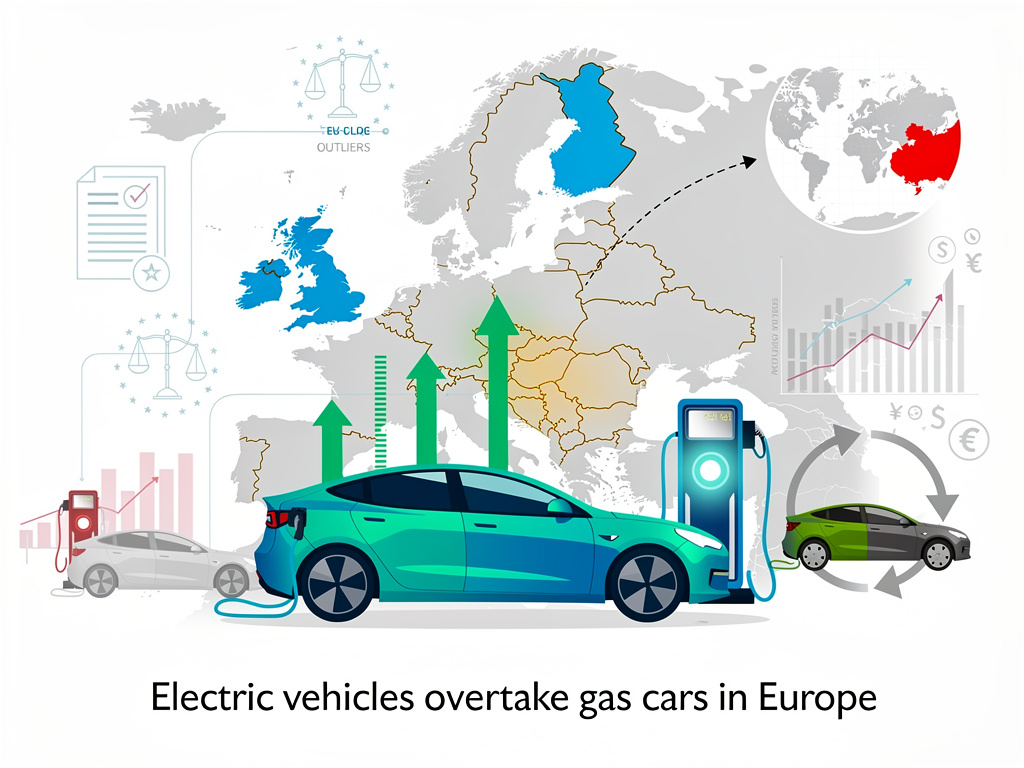
In a watershed moment that automotive historians will likely cite as the beginning of the end for the internal combustion engine in the Old World, electric vehicles have officially surpassed gas-powered cars in European sales figures. This transition, long predicted by bullish analysts and dreaded by legacy executives, has moved from theoretical forecast to statistical reality. According to recent market analysis, the convergence of aggressive regulatory frameworks, a maturation of battery supply chains, and a fiercely competitive pricing war has upended a century of petrol dominance. While the headline figures suggest a uniform victory for electrification, the underlying mechanics reveal a complex, fragmented market where policy decisions in Oslo and Berlin weigh as heavily as manufacturing outputs in Shanghai and Texas.
The data, underscored by a report from TechRadar, highlights a staggering milestone: EV sales have eclipsed petrol volumes, driven largely by outliers like Norway, where electric models now account for a record-breaking 94% of new car registrations. This Nordic dominance serves as a testing ground for the rest of the continent, proving that with sufficient tax incentives and infrastructure investment, the public is willing to abandon fossil fuels entirely. However, industry insiders know that Norway is an oil-rich anomaly; the broader European theater is currently defined by a brutal fight for market share involving slashed margins and geopolitical trade barriers.
While the aggregate data paints a picture of an inevitable electric transition, a granular look at regional disparities reveals a fractured market where Nordic success masks the stagnation plaguing Central European heavyweights like Germany.
The disparity between the Norwegian model and the rest of the continent is stark. While Oslo celebrates near-total electrification, major markets like Germany are grappling with a severe correction following the abrupt removal of purchase subsidies. This volatility has forced legacy automakers to recalibrate their strategies in real-time. As noted by Reuters, Volkswagen is currently considering unprecedented plant closures in its home country, a move that signals deep structural distress within Europe’s industrial core. The German giant’s struggle highlights the fragility of EV adoption when it is tethered too closely to government handouts rather than organic consumer demand.
Despite these headwinds in Central Europe, the overall volume of EV sales has been buoyed by the sheer dominance of specific models that have transcended the niche early-adopter phase. The Tesla Model Y has not only led the electric segment but has frequently topped the charts as the best-selling vehicle of any powertrain type across the continent. This American export has effectively normalized the electric driving experience for the mass market, forcing European incumbents to chase a moving target in terms of software integration and range efficiency. The success of the Model Y proves that the barrier to entry is no longer technological capability, but rather the ability to manufacture at scale with margins that can withstand a price war.
The aggressive entry of Chinese manufacturers into the European theater has fundamentally altered the pricing dynamics, forcing the European Union to erect tariff barriers in a bid to protect its domestic industrial base.
The shift away from gasoline is not merely a story of Western innovation; it is equally a narrative of Eastern expansion. Chinese automakers, led by BYD and SAIC (owner of the MG brand), have flooded the European market with technically proficient EVs priced significantly lower than their Volkswagen or Stellantis equivalents. This influx has democratized access to electric mobility, addressing the affordability critique that has long dogged the sector. However, this has triggered a protectionist reflex in Brussels. As reported by Bloomberg, the EU has moved to impose provisional tariffs on Chinese EVs, arguing that state subsidies in Beijing create an uneven playing field.
This geopolitical friction complicates the trajectory for European consumers. On one hand, the availability of affordable Chinese EVs accelerates the displacement of petrol cars. On the other, tariffs threaten to raise prices and slow adoption rates just as the market hits a critical inflection point. The industry is now navigating a delicate balance: trying to foster a domestic EV supply chain without cutting off the affordable imports necessary to meet stringent decarbonization targets. For the average consumer, the origin of the battery matters less than the monthly lease payment, and this economic reality is what ultimately drove the recent sales crossover.
Amidst the binary narrative of electric versus petrol, hybrid technology has emerged not merely as a bridge but as a resilient destination for risk-averse consumers and fleet managers navigating infrastructure uncertainty.
It is crucial to note that the decline of pure petrol vehicles does not equate to a total rejection of the combustion engine. Hybrid Electric Vehicles (HEVs) and Plug-in Hybrids (PHEVs) are enjoying a renaissance, serving as a safety net for consumers wary of the continent’s uneven charging infrastructure. Toyota, often criticized for its slow rollout of fully electric models, has seen its hybrid-heavy strategy validated by robust sales figures. The market data suggests that while the “pure petrol” car is dying, the internal combustion engine is surviving by evolving into a supporting role within electrified powertrains.
This nuance is critical for investors and industry planners. The “death of gas” is a gradual tapering, not a sudden cliff. Fleet operators, in particular, rely on the flexibility of hybrids to maintain operational uptime in regions where fast-charging networks remain sparse. According to data from the European Automobile Manufacturers’ Association (ACEA), the market share of hybrid electric vehicles continues to expand, suggesting that for many Europeans, the immediate future is electrified, but not necessarily fully electric. This trend complicates the capital allocation strategies for manufacturers who must decide how long to keep engine plants running while simultaneously pivoting to battery production.
The infrastructure deficit remains the single greatest bottleneck preventing the complete obsolescence of liquid fuels, shifting the industry’s focus from vehicle range to charging velocity and grid reliability.
The hardware capability of modern EVs now exceeds the daily requirements of 99% of drivers, yet “range anxiety” has morphed into “charging anxiety.” The milestone of EVs outselling gas cars was achieved despite, not because of, the public charging network in Southern and Eastern Europe. In nations like Italy and Spain, the ratio of EVs to public chargers lags significantly behind the Netherlands and Scandinavia. This infrastructure gap creates a two-speed Europe, where the phase-out of petrol accelerates in the north and west while lagging in the south and east.
Furthermore, the energy grid itself is becoming a focal point of automotive strategy. Utilities and automakers are increasingly collaborating on vehicle-to-grid (V2G) technologies, viewing the growing fleet of EVs not just as power consumers, but as decentralized storage units. This integration is essential for the long-term viability of the transition. Without a modernized grid capable of handling millions of simultaneous high-voltage charging sessions, the sales victory over gas cars could stall. The industry is acutely aware that early adopters are tolerant of inconveniences that the mass market will not accept.
As the 2035 ban on new internal combustion engine sales looms, the current sales figures serve as a validation of regulatory coercion, proving that policy mandates can effectively reshape consumer behavior despite economic headwinds.
The overarching driver of this shift remains the European Union’s legislative mandate to ban the sale of new CO2-emitting cars by 2035. This deadline has forced the hand of every major automaker, compelling them to cannibalize their profitable gas-engine businesses to fund electric development. The recent sales figures validate the efficacy of this hard-power approach. By signaling the definitive end of the petrol era, regulators have altered the residual value calculations for consumers; buying a new gas car today carries the risk of rapid depreciation as the ecosystem pivots away from fossil fuels.
Ultimately, the news that EVs have outselling gas cars is a psychological victory as much as a commercial one. It shatters the argument that electric mobility is a niche curiosity. However, the road ahead is paved with industrial challenges, from securing raw materials for batteries to navigating a trade war with China. The internal combustion engine has reigned for over a century, and while it has effectively been dethroned in the sales charts, its ghost will linger in the form of hybrids and the used car market for decades to come. The transition is messy, expensive, and geographically uneven, but the direction of travel is now irrefutable.


 WebProNews is an iEntry Publication