
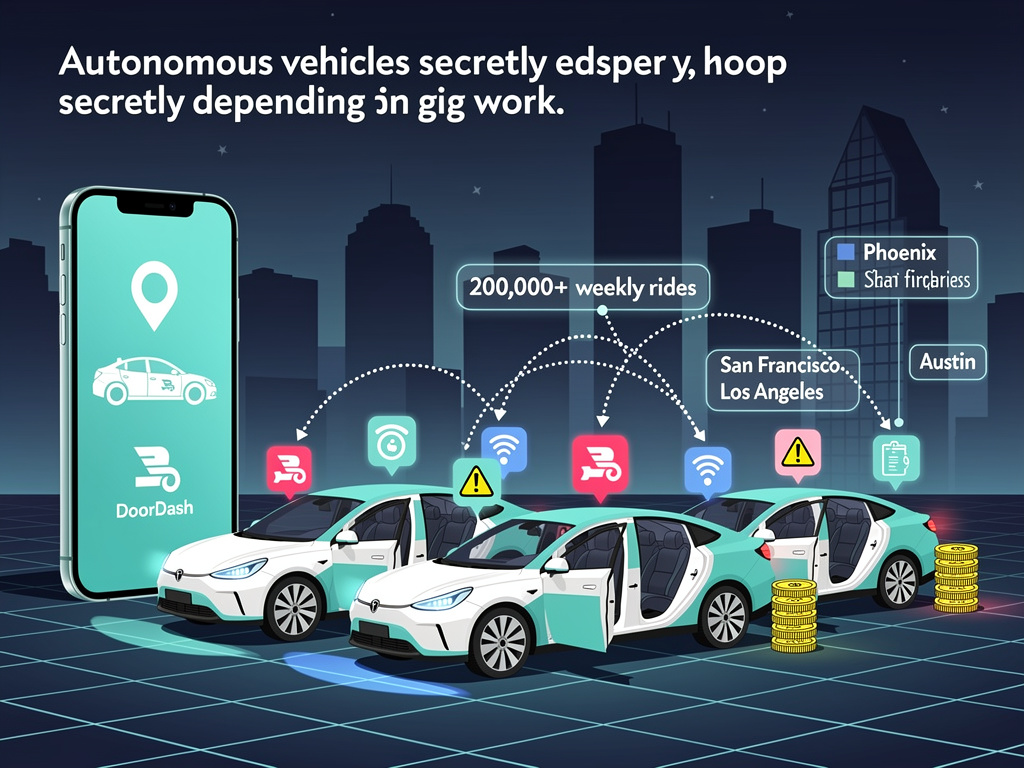
For all the billions poured into autonomous vehicle technology — the lidar arrays, the machine-learning algorithms, the painstaking mapping of every American intersection — it turns out one of the most vexing problems facing the robotaxi industry is breathtakingly mundane: passengers keep leaving the doors open.
Waymo, the Alphabet-owned autonomous driving company widely regarded as the front-runner in the commercial robotaxi race, has quietly begun paying DoorDash gig workers to physically close the doors of its driverless Jaguar I-PACE vehicles when riders exit and leave them ajar. The arrangement, first reported by CNBC, Business Insider, and Bloomberg, underscores a peculiar irony at the heart of the autonomous vehicle industry: removing the human driver from the equation has created a surprising new category of human labor.
A Billion-Dollar Company’s Low-Tech Headache
The problem is deceptively simple. When a passenger in a traditional taxi or rideshare vehicle exits, the driver can lean back and pull the door shut, or at minimum, call out a reminder. Waymo’s fleet of fully autonomous vehicles has no such human failsafe. If a rider steps out and walks away without closing the door, the vehicle is effectively stranded — unable to proceed to its next pickup, unable to return to circulation, and vulnerable to weather, debris, or opportunistic interference. A single open door can take a revenue-generating vehicle offline for an extended period.
According to Business Insider, Waymo explored multiple solutions before landing on the gig-worker approach. The company experimented with audio reminders played through the vehicle’s speaker system, push notifications sent to riders’ phones, and even gentle seat vibrations designed to prompt passengers to close up behind themselves. None proved sufficiently reliable. Riders in a hurry, distracted by their phones, or simply unaccustomed to the etiquette of driverless travel continued to leave doors open at rates high enough to cause meaningful fleet disruption.
Enter the Gig Economy’s Newest Micro-Task
The DoorDash partnership represents a creative, if somewhat ironic, workaround. Under the arrangement, DoorDash drivers operating in Waymo’s service areas — which now include San Francisco, Phoenix, Los Angeles, and Austin — can accept door-closing assignments through the DoorDash platform. When a Waymo vehicle detects that a door has been left open after a passenger exits, it dispatches a request. A nearby DoorDash worker receives a notification, drives or walks to the vehicle’s location, closes the door, confirms completion through the app, and receives payment, as reported by CNBC.
The pay for each task is reportedly modest — a few dollars per door closure — but the assignments are quick, often taking less than five minutes from acceptance to completion. For gig workers already on the road waiting for food delivery orders, the tasks represent a way to fill idle time and supplement earnings. DoorDash, for its part, benefits from a new revenue stream and increased engagement on its platform. The arrangement is a textbook example of how the gig economy continues to find new micro-tasks to monetize, even as the technology sector promises ever-greater automation.
The Paradox of Autonomy and Human Dependence
Industry analysts have been quick to note the philosophical tension embedded in the arrangement. Waymo’s entire value proposition rests on the elimination of human drivers — a pitch to investors and consumers alike that autonomous vehicles will be safer, cheaper, and more efficient than their human-operated counterparts. Yet the company now finds itself hiring humans for a task so basic it would never have required a separate worker in the era of human-driven taxis.
“This is a perfect encapsulation of where we are in the autonomous vehicle transition,” said one transportation technology researcher quoted by Bloomberg. The observation cuts to the core of a broader truth about automation: removing humans from one part of a system often creates unexpected dependencies elsewhere. In manufacturing, fully automated assembly lines still require human workers to handle exceptions and edge cases. In autonomous driving, the “edge case” turns out to be a car door.
Waymo’s Scaling Ambitions Meet Operational Reality
The door problem arrives at a particularly sensitive moment for Waymo. The company has been aggressively expanding its service footprint, pushing into new cities and increasing ride volumes in existing markets. Waymo reportedly now completes over 200,000 paid rides per week across its operating territories, a figure that has grown rapidly over the past year. At that scale, even a small percentage of open-door incidents translates into hundreds of stranded vehicles daily — a logistical nightmare for a fleet operations team already managing the extraordinary complexity of autonomous vehicle deployment.
As Tech in Asia noted, the problem also has implications for Waymo’s international expansion ambitions. Cultural norms around vehicle use vary widely across global markets, and passenger behavior that is merely inconvenient in Phoenix could prove operationally catastrophic in denser urban environments abroad. The company will need a scalable solution — whether technological or human — before it can confidently enter markets in Asia, Europe, or Latin America where rider behavior may differ substantially from its current American user base.
Engineering a Mechanical Fix — And Why It’s Harder Than It Sounds
The obvious question is why Waymo doesn’t simply engineer doors that close themselves. The answer, according to automotive engineers familiar with the challenge, is that self-closing doors are mechanically complex, expensive, and introduce their own safety risks. A door that automatically swings shut could strike a pedestrian, a cyclist, or even the exiting passenger. Sensor systems capable of ensuring a clear path before closing add cost, weight, and another potential point of failure to vehicles already bristling with technology.
Several companies are working on automated door systems for robotaxi applications. Chinese autonomous vehicle firms, including Baidu’s Apollo Go, have experimented with sliding doors similar to those found on minivans, which are easier to automate safely. Some industry observers expect Waymo’s next-generation vehicle platform — reportedly being developed in partnership with Chinese automaker Geely — to incorporate purpose-built door mechanisms. But retrofitting the current fleet of Jaguar I-PACE vehicles is not considered practical, meaning the gig-worker solution may persist for years as a bridge measure.
What DoorDash Gets Out of the Deal
For DoorDash, the Waymo partnership is part of a broader strategic push to diversify beyond food delivery. The company has steadily expanded into package delivery, grocery runs, and other logistics tasks, seeking to maximize the utilization of its massive network of gig workers. Door-closing assignments fit neatly into this strategy, offering a new task type that requires no special equipment or training and can be completed in the gaps between other deliveries.
The partnership also positions DoorDash as a flexible labor platform for the autonomous vehicle industry more broadly. If Waymo needs humans to close doors, other robotaxi operators — Cruise, Zoox, Motional, and the growing roster of Chinese AV companies eyeing U.S. entry — may face similar operational gaps that gig workers could fill. DoorDash’s willingness to take on these unglamorous tasks could give it a first-mover advantage in what may become a significant niche market: human support services for autonomous fleets.
A Revealing Window Into the Future of Transportation
The Waymo-DoorDash door-closing arrangement is, on its surface, an amusing anecdote — the kind of story that lends itself to wry headlines and social media jokes. But for those watching the autonomous vehicle industry closely, it is something more significant: a concrete illustration of the gap between the theoretical promise of full autonomy and the messy, human-dependent reality of deploying it at scale.
Every transformative technology goes through a phase where the old and the new coexist awkwardly. The early automobile era required human “flaggers” to walk ahead of cars warning pedestrians. Early elevators needed human operators long after the technology to automate them existed, simply because passengers didn’t trust the machines. Waymo’s door-closers may be this era’s equivalent — a temporary, slightly absurd human role created by the friction between a revolutionary technology and the stubborn unpredictability of its users. The question is how long “temporary” will last, and how many more such roles the autonomous future will quietly require.


 WebProNews is an iEntry Publication