
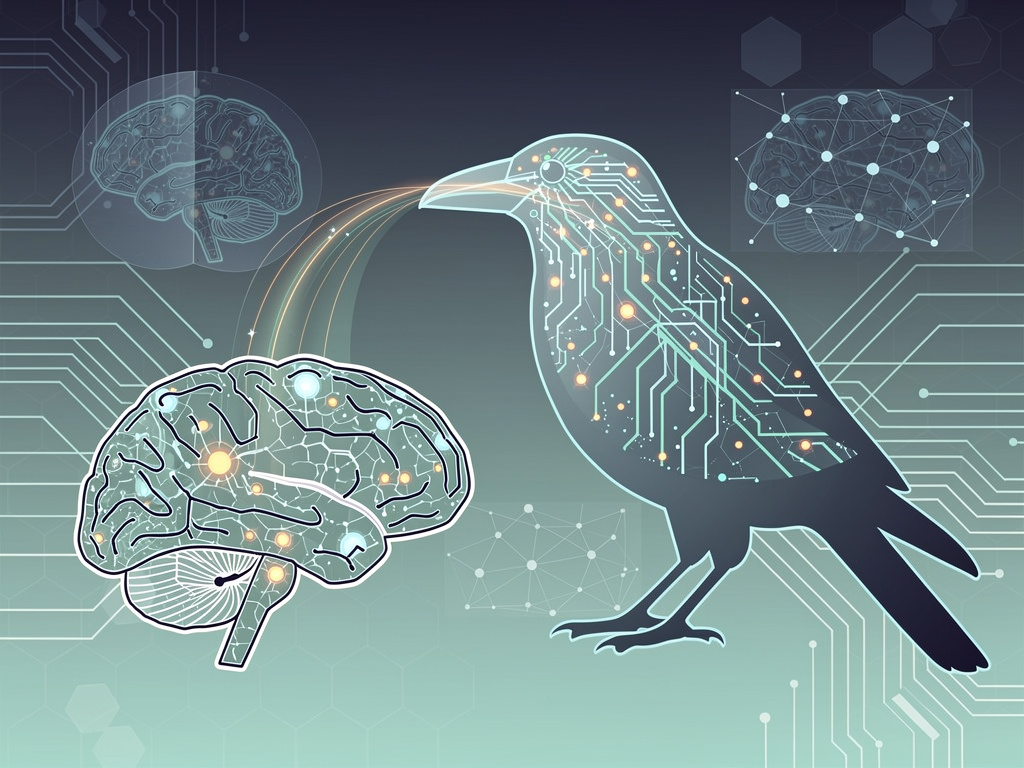
A pigeon can memorize 1,800 images. A crow can fashion a hook from a straight piece of wire. A scrub jay can remember where it cached thousands of seeds months earlier — and knows which ones are about to spoil. These aren’t party tricks. They’re signs of cognitive sophistication that, until recently, the scientific establishment largely refused to take seriously.
The phrase “bird brain” has been an insult for centuries, shorthand for stupidity. It persists because of a deep bias baked into how we’ve understood intelligence — a bias rooted in mammalian chauvinism and a fundamental misreading of evolutionary biology. But a growing body of research, synthesized compellingly by writer Dhanish Semar in a recent essay on his site, makes the case that birds are among the most cognitively capable animals on Earth. And the implications stretch far beyond ornithology, touching on artificial intelligence, neuroscience, and how we define intelligence itself.
Start with the anatomy. The traditional knock on bird brains was simple: they lack a neocortex. In mammals, the neocortex is the seat of higher-order thinking — reasoning, planning, language. No neocortex, no complex thought. Case closed. Except it wasn’t.
As Semar details, birds evolved a completely different neural architecture that achieves comparable — sometimes superior — cognitive outcomes. Their forebrains are densely packed with neurons in a structure called the pallium, which is functionally analogous to the mammalian neocortex but organized differently. Instead of the layered columns found in primate brains, bird brains use nuclear clusters of neurons. Different hardware, similar software. The result is that some bird species pack an extraordinary number of neurons into very small skulls. Corvids and parrots, in particular, have neuron densities that rival or exceed those of primates relative to brain size.
This matters enormously. For decades, brain size was treated as a rough proxy for intelligence across species. Bigger brain, smarter animal. It was a convenient heuristic — and a wrong one. What matters isn’t the size of the brain. It’s the density and connectivity of neurons in the regions responsible for higher cognition. By that measure, a raven with a brain weighing about 15 grams can outperform a dog with a brain ten times heavier on certain problem-solving tasks.
The experimental evidence is staggering in its breadth.
New Caledonian crows are perhaps the most famous avian engineers. They don’t just use tools — they manufacture them. In the wild, they craft hooked sticks from twigs to extract grubs from wood, a behavior that requires planning and an understanding of physical causation. In laboratory settings, a crow named Betty spontaneously bent a straight piece of wire into a hook to retrieve food from a tube, a result that stunned researchers when it was first published. This wasn’t trained behavior. Betty had never seen a hook made from wire before.
Parrots present a different but equally impressive profile. Alex, the African grey parrot studied by psychologist Irene Pepperberg for 30 years, could identify 50 objects, seven colors, five shapes, and quantities up to six. He understood concepts like “same” and “different,” “bigger” and “smaller.” He could ask for things he wanted. When shown a novel object and asked what color it was, he could answer correctly — a task requiring the combination of categorical knowledge and perceptual judgment. Pepperberg’s work, which Semar highlights, was initially met with deep skepticism from the behavioral science community. Some dismissed it as elaborate conditioning. But the consistency and flexibility of Alex’s responses pointed to something far more than rote learning.
Then there are the jays. Western scrub jays cache food and retrieve it later, which alone isn’t remarkable — many animals do this. What is remarkable is the sophistication of their caching strategy. Research by Nicola Clayton at the University of Cambridge showed that scrub jays preferentially retrieve perishable food items before non-perishable ones, suggesting they track the passage of time and understand that certain foods decay. Even more striking: if a jay notices another bird watching it cache food, it will later return — when alone — and re-hide the food in a new location. This behavior implies the jay can model what another bird knows. It can attribute a mental state to another agent. That’s theory of mind, a capacity once considered uniquely human.
Semar’s essay draws these threads together into a broader argument about the nature of intelligence. His central point is that intelligence isn’t a single ladder with humans at the top and everything else arranged below. It’s more like a branching tree, with different lineages arriving at sophisticated cognition through radically different evolutionary paths. Birds and mammals diverged roughly 320 million years ago. The fact that both groups independently evolved complex problem-solving, social cognition, and even something resembling culture suggests that intelligence is a convergent phenomenon — one that natural selection discovers repeatedly, through whatever neural substrate happens to be available.
This idea of convergent cognitive evolution has been gaining traction in academic circles. A landmark 2020 paper published in Science by a team including Martin Stacho and Onur Güntürkün found that the bird pallium, despite its lack of cortical layers, contains circuit motifs strikingly similar to those in the mammalian neocortex. The connectivity patterns — the way information flows between neuron clusters — mirror the columnar organization of primate cortex. Different anatomy, convergent wiring. The paper suggested that the computational principles underlying complex cognition may be more fundamental than any particular neural structure.
So why did it take so long for science to recognize avian intelligence?
Part of the answer is institutional inertia. The mammalian neocortex framework dominated comparative neuroscience for most of the 20th century. If you defined intelligence by the presence of a neocortex, then by definition, no bird could be intelligent. It was circular reasoning dressed up as empirical fact. Another part of the answer is anthropocentrism — the stubborn tendency to measure all cognition against human cognition and find everything else wanting. Birds don’t manipulate objects the way primates do. They don’t have hands. They don’t make facial expressions we can easily read. These superficial differences made it easy to underestimate them.
And part of it is simply that bird cognition research was underfunded and marginalized for years. Pepperberg famously struggled to secure grants for her work with Alex. The idea that a parrot could have meaningful cognitive abilities struck many funding committees as absurd. She persisted anyway.
The tide has turned. Avian cognition is now one of the most active areas in comparative psychology and neuroscience. Recent work has expanded the list of cognitive feats attributed to birds. Cockatoos have been shown to solve multi-step mechanical puzzles — removing a pin, then a screw, then a bolt, then a wheel, then opening a door to reach a nut — and to remember the sequence. Crows in urban Japan have been observed placing walnuts on crosswalks so cars will crack them open, then waiting for the traffic light to change before retrieving the nut. Kea parrots in New Zealand demonstrate cooperative problem-solving, pulling on strings simultaneously to access food rewards.
The implications for artificial intelligence research are not trivial. Modern AI systems are loosely inspired by neural networks, which are themselves loosely inspired by mammalian brain architecture. But if bird brains achieve comparable cognitive outputs with fundamentally different architectures, that suggests there may be alternative computational frameworks worth exploring. The efficiency of avian cognition — achieving so much with so few neurons and such small brains — is exactly the kind of optimization that AI engineers obsess over. A crow’s brain consumes a fraction of the energy of a primate brain while solving problems of comparable complexity. If we understood the computational principles that make this possible, it could inform the design of more efficient AI systems.
There’s a philosophical dimension here too. Semar touches on this in his essay, noting that our failure to recognize bird intelligence reflects a deeper failure of imagination about what minds can look like. We tend to assume that consciousness and cognition must look like ours — must be implemented in structures like ours, must manifest in behaviors like ours. Birds challenge that assumption at every turn. A creature with a brain the size of a walnut, descended from theropod dinosaurs, can plan for the future, deceive competitors, use and manufacture tools, learn human language concepts, and possibly experience something like empathy. If that doesn’t force a rethinking of what intelligence is and where it can arise, nothing will.
The dinosaur connection isn’t metaphorical. Birds are literally the last surviving dinosaurs — the only lineage of theropods that made it through the end-Cretaceous extinction 66 million years ago. Every sparrow at your feeder is a dinosaur. Every crow solving a puzzle in a lab is a dinosaur. The cognitive abilities we’re now documenting in birds didn’t appear from nowhere. They evolved over tens of millions of years, shaped by the pressures of flight, social living, and environmental complexity. Understanding avian intelligence means understanding a cognitive lineage that is ancient, alien to our own, and astonishingly successful.
Not all birds are cognitive superstars, of course. The corvids (crows, ravens, jays, magpies) and psittacines (parrots, cockatoos) are the standouts, much as great apes are the standouts among mammals. But even “ordinary” birds display behaviors that, examined closely, reveal surprising sophistication. Homing pigeons navigate using magnetic fields, visual landmarks, and olfactory cues in combination — a multi-modal integration task that remains poorly understood. Chickadees in harsh climates grow their hippocampus each autumn to accommodate the spatial memories needed for food caching, then shrink it in spring. The brain literally remodels itself seasonally.
This plasticity points to another underappreciated aspect of avian neuroscience: adult neurogenesis. Birds produce new neurons throughout their lives at rates far exceeding those found in most mammals. This ongoing neural regeneration may be one of the mechanisms enabling their cognitive flexibility. It’s an area of active research with potential medical implications — if we could understand how birds maintain robust neurogenesis into adulthood, it might inform treatments for neurodegenerative diseases in humans.
The cultural dimension of bird intelligence deserves attention as well. Several bird species exhibit behaviors that meet the technical definition of culture — socially transmitted traditions that vary between populations and persist across generations. Different populations of New Caledonian crows make different styles of tools, and young crows learn their local tool-making tradition from adults. Some populations of great tits in the UK famously learned to open milk bottle caps in the mid-20th century, a behavior that spread rapidly through social learning. These are not genetically encoded behaviors. They are invented, taught, and inherited culturally.
Where does this leave the old insult? “Bird brain” should probably be retired, or at minimum, rebranded as a compliment. But language changes slowly, and cultural assumptions about animal intelligence change even slower. The scientific community has moved substantially — avian cognition papers now appear regularly in top-tier journals, and researchers like Clayton, Güntürkün, and Pepperberg’s intellectual heirs command significant respect. But public perception lags behind.
Semar’s essay serves as an accessible bridge between the technical literature and a general audience. His argument is well-sourced and clearly structured: birds are not lesser minds operating with inferior hardware. They are alternative minds operating with different hardware that evolution has optimized for a different set of challenges. The outcomes — tool use, planning, social manipulation, abstract reasoning — converge with those seen in primates, cetaceans, and other “smart” mammals. The paths to get there diverged hundreds of millions of years ago.
That convergence is perhaps the most profound takeaway. Intelligence, it appears, is not an accident of primate evolution. It’s something the universe keeps reinventing. In brains large and small, layered and nuclear, warm-blooded and — who knows — perhaps in substrates we haven’t yet imagined. The birds figured it out 66 million years ago. We’re only now catching up to what they’ve been telling us all along.


 WebProNews is an iEntry Publication