
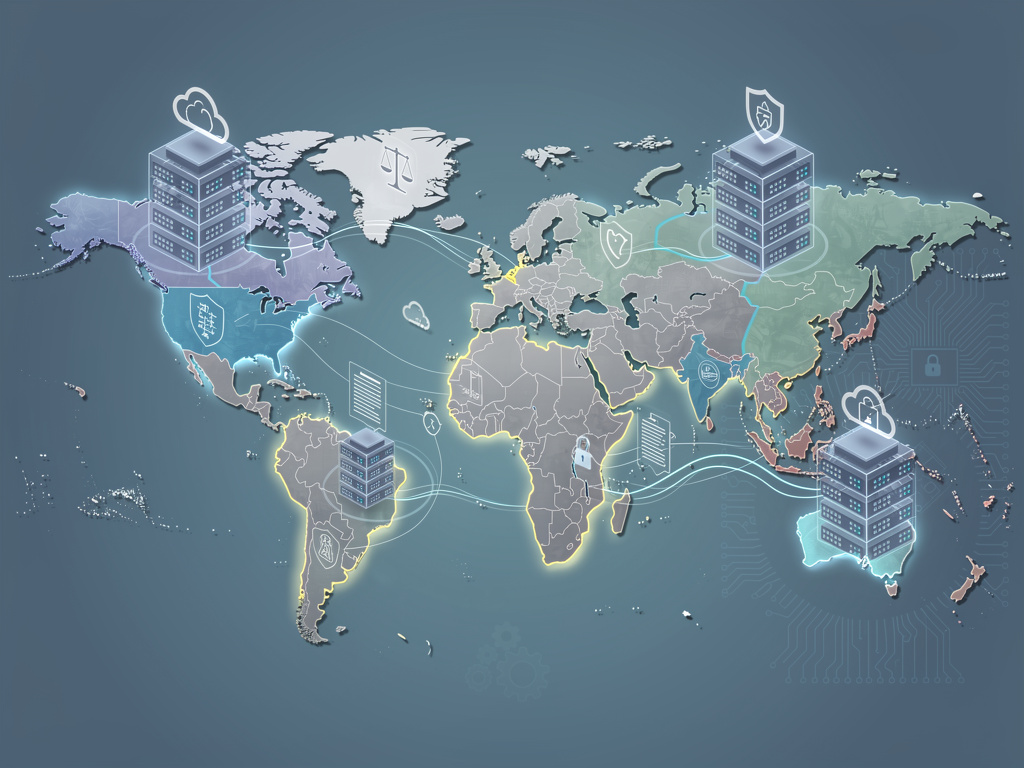
In an era where data flows across borders at the speed of light, a fundamental question has emerged that challenges the very foundation of modern cloud computing: who truly controls your organization’s data? As governments worldwide tighten regulations and geopolitical tensions reshape the digital economy, the concept of sovereign cloud has evolved from a niche concern into a strategic imperative that could redefine how enterprises approach their cloud infrastructure.
The sovereignty debate centers on a deceptively simple premise: ensuring that data stored in the cloud remains subject to the laws and jurisdiction of a specific country or region, free from foreign government access or control. Yet beneath this straightforward concept lies a complex web of technical, legal, and operational challenges that have left many organizations struggling to navigate an increasingly fragmented global cloud ecosystem. According to TechRadar, the test of sovereign cloud isn’t just about where data physically resides, but about the entire chain of control—from infrastructure ownership to operational access and legal jurisdiction.
The urgency of this question has intensified as high-profile data breaches, extraterritorial legal demands, and concerns about foreign surveillance have exposed the vulnerabilities inherent in traditional cloud architectures. For enterprises operating across multiple jurisdictions, the stakes couldn’t be higher: regulatory non-compliance can result in massive fines, while loss of data sovereignty can compromise competitive advantages, intellectual property, and customer trust.
The Regulatory Catalyst: How Global Data Protection Laws Are Reshaping Cloud Strategy
The regulatory environment surrounding data sovereignty has undergone a dramatic transformation in recent years, creating a patchwork of requirements that vary significantly across jurisdictions. The European Union’s General Data Protection Regulation (GDPR) established the gold standard for data protection, imposing strict requirements on data transfers outside the EU and hefty penalties for non-compliance. More recently, the EU’s Data Governance Act and proposed Data Act have further tightened controls over how data can be accessed and processed, particularly by non-EU entities.
Beyond Europe, countries worldwide have introduced their own data localization and sovereignty requirements. China’s Cybersecurity Law and Personal Information Protection Law mandate that critical data collected within China must be stored domestically and undergo security assessments before transfer abroad. India’s proposed Data Protection Bill includes provisions for data localization, while Russia has implemented strict requirements for storing Russian citizens’ personal data within its borders. These divergent regulatory frameworks have created what industry observers call “data balkanization”—a fragmentation of the global internet into isolated, nationally-controlled segments.
The implications for multinational corporations are profound. Organizations must now navigate a complex maze of conflicting requirements, often requiring separate cloud infrastructure in different regions to ensure compliance. The TechRadar analysis highlights that this regulatory pressure has accelerated demand for sovereign cloud solutions, with enterprises seeking providers that can guarantee data remains within specific jurisdictional boundaries while maintaining the scalability and efficiency that made public cloud attractive in the first place.
The Technical Reality: Understanding What Sovereign Cloud Actually Means
True data sovereignty extends far beyond simply choosing a data center location within a particular country’s borders. As security experts emphasize, the physical location of servers represents just one component of a comprehensive sovereignty framework. The critical factors include who owns the infrastructure, who operates it, who has access to encryption keys, and which legal jurisdiction governs data access requests.
Major cloud providers have responded to sovereignty concerns with varying approaches. Some have established local subsidiaries in specific countries, operated by local staff and subject to local laws. Others have created partnership models where local companies operate cloud infrastructure using the provider’s technology. However, questions persist about whether these arrangements truly insulate data from foreign access, particularly when the underlying technology, intellectual property, and ultimate corporate control remain with U.S.-based parent companies subject to laws like the CLOUD Act.
The CLOUD Act, passed by the U.S. Congress in 2018, exemplifies the jurisdictional tensions at the heart of the sovereignty debate. This legislation allows U.S. law enforcement to compel U.S.-based technology companies to provide data stored anywhere in the world, regardless of local data protection laws. European regulators and privacy advocates have expressed concerns that this extraterritorial reach fundamentally undermines data sovereignty, even when data is stored within EU borders but managed by U.S. cloud providers.
The Market Response: How Cloud Providers Are Adapting to Sovereignty Demands
The market for sovereign cloud solutions has exploded as organizations seek to balance regulatory compliance with operational efficiency. European cloud providers have positioned themselves as sovereignty-first alternatives to hyperscale American providers, emphasizing local ownership, operation, and legal jurisdiction. France’s OVHcloud and Germany’s IONOS have built their market positioning around data sovereignty guarantees, targeting organizations with strict compliance requirements.
Meanwhile, the major American cloud providers—Amazon Web Services, Microsoft Azure, and Google Cloud—have launched dedicated sovereign cloud offerings in key markets. Microsoft’s Cloud for Sovereignty initiative promises to give customers greater control over their data through enhanced encryption, isolation, and transparency features. AWS has established dedicated regions and partnership models designed to meet local sovereignty requirements. Yet critics question whether these solutions genuinely transfer control or merely create the appearance of sovereignty while maintaining the fundamental power dynamics that concern regulators.
The emergence of hybrid sovereignty models reflects the market’s attempt to reconcile competing demands. These approaches typically involve partnerships between global cloud providers and local operators, combining the technological capabilities and global reach of hyperscalers with the legal and operational control of domestic entities. However, the effectiveness of these models remains contested, with ongoing debates about whether operational separation truly prevents foreign access when the underlying technology stack remains controlled by foreign entities.
The Hidden Costs: Economic and Operational Implications of Data Sovereignty
Implementing true data sovereignty comes with significant costs that extend beyond simple infrastructure expenses. Organizations pursuing sovereign cloud strategies often face reduced economies of scale, limited access to cutting-edge services, and increased operational complexity. The fragmentation of data across multiple jurisdictional boundaries can impede analytics, artificial intelligence initiatives, and other use cases that benefit from consolidated data pools.
The performance implications can be substantial. Latency increases when data cannot freely move across borders, potentially degrading user experiences for global applications. Disaster recovery and business continuity become more complex when backup data must remain within specific jurisdictions. Organizations may need to maintain multiple cloud environments with separate security controls, identity management systems, and operational processes—multiplying both costs and complexity.
Despite these challenges, many organizations conclude that sovereignty costs represent necessary insurance against regulatory penalties, reputational damage, and strategic risks. Financial services firms, healthcare providers, government agencies, and other organizations handling sensitive data increasingly view sovereign cloud capabilities as non-negotiable requirements rather than optional features. The calculation shifts from whether sovereignty is worth the cost to how to implement it most efficiently.
The Geopolitical Dimension: Data Sovereignty as Strategic Competition
The sovereignty debate transcends technical and regulatory considerations, reflecting deeper geopolitical tensions about technological dependence and economic power. European leaders have explicitly framed digital sovereignty as essential to strategic autonomy, expressing concerns that reliance on American or Chinese technology providers creates vulnerabilities that could be exploited for economic espionage or political leverage.
These concerns have intensified amid deteriorating U.S.-China relations and revelations about government surveillance programs. The Snowden disclosures damaged trust in American technology providers, while concerns about Chinese state influence over companies like Huawei have prompted Western countries to restrict their market access. In this environment, data sovereignty has become intertwined with broader questions about technological self-sufficiency and the balance of power in the digital economy.
Some analysts argue that the pursuit of data sovereignty risks fragmenting the global internet, reducing efficiency, and hindering innovation. They contend that localization requirements protect incumbent providers from competition while imposing costs on consumers and businesses. Others counter that sovereignty represents a necessary corrective to an unsustainable concentration of power in a handful of technology giants, enabling countries to protect their citizens’ rights and their economies’ strategic interests.
The Identity and Access Challenge: Where Sovereignty Really Breaks Down
Perhaps the most overlooked aspect of data sovereignty involves identity and access management—the systems that determine who can access data and under what circumstances. Even when data resides within a sovereign jurisdiction, the question of who holds encryption keys and authentication credentials can undermine sovereignty guarantees. If a foreign parent company retains administrative access or maintains master encryption keys, the practical control over data may remain outside the sovereign jurisdiction regardless of where servers are located.
Advanced persistent threats and sophisticated cyberattacks have demonstrated that technical access controls represent critical sovereignty chokepoints. Organizations implementing sovereign cloud strategies must ensure that privileged access remains exclusively with personnel subject to local jurisdiction, that encryption key management stays within sovereign boundaries, and that authentication systems cannot be compromised through foreign legal demands or technical vulnerabilities.
The complexity of modern cloud architectures makes these assurances difficult to verify and maintain. Supply chain vulnerabilities, from hardware backdoors to software dependencies, create potential access points that could bypass sovereignty controls. Organizations must conduct thorough assessments of their entire technology stack, evaluating not just where data resides but who can access it, through what mechanisms, and under what legal frameworks.
Looking Forward: The Evolution of Sovereignty in an AI-Driven World
The emergence of artificial intelligence and machine learning introduces new dimensions to the sovereignty challenge. These technologies often require massive datasets that may need to cross borders for training and optimization. The computational resources necessary for advanced AI may not be available within every sovereign jurisdiction, creating tensions between sovereignty requirements and technological capabilities.
Organizations are exploring various approaches to reconcile AI development with sovereignty constraints. Federated learning techniques enable model training across distributed datasets without centralizing data. Privacy-preserving computation methods like homomorphic encryption allow processing of encrypted data without decryption. Edge computing architectures process data locally before sending only aggregated insights to central systems. Each approach involves tradeoffs between sovereignty, performance, and capability.
The future of data sovereignty likely involves continued fragmentation and specialization rather than convergence toward global standards. Organizations will need increasingly sophisticated strategies for managing data across multiple jurisdictional boundaries while maintaining operational efficiency. The question is no longer whether data sovereignty matters, but how organizations can implement it effectively while continuing to leverage cloud computing’s transformative potential. As regulatory pressures intensify and geopolitical tensions persist, the ability to demonstrate genuine control over data will increasingly separate market leaders from those left behind in the digital economy’s next chapter.


 WebProNews is an iEntry Publication