
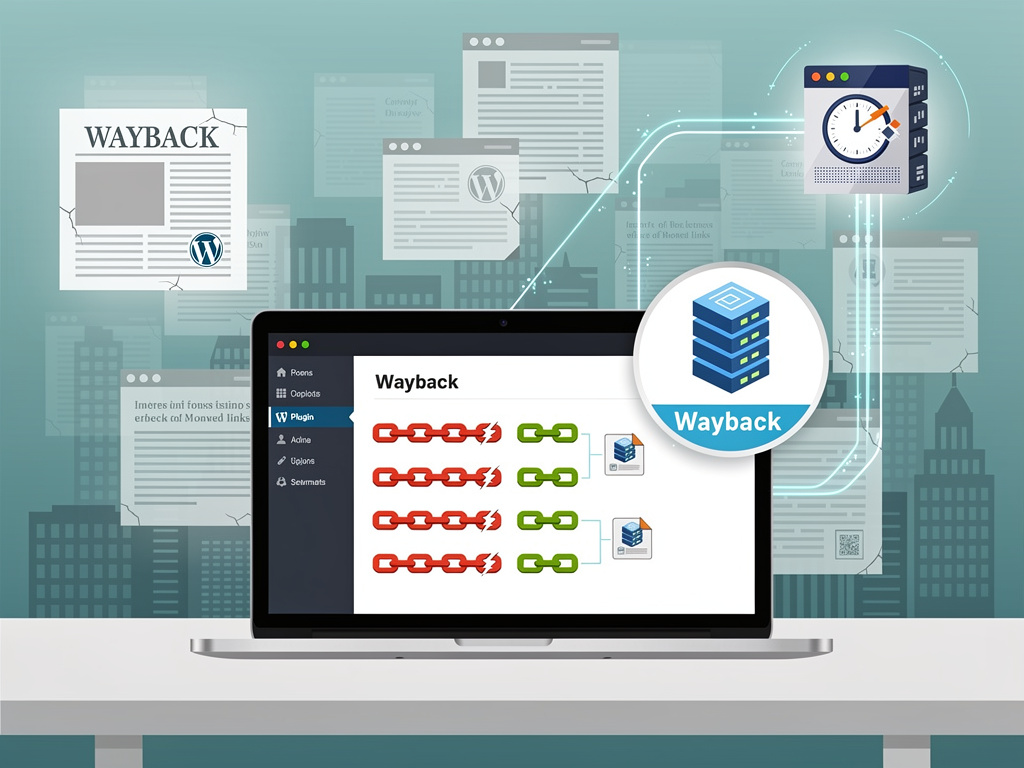
The internet’s greatest weakness has long been its impermanence. Every day, thousands of web pages vanish into the digital void, leaving behind broken links that frustrate users and diminish the value of content across the web. Now, a new WordPress plugin is leveraging one of the internet’s most comprehensive archives to combat this persistent problem, potentially transforming how website administrators approach the inevitable decay of external references.
According to Digital Trends, the Wayback Machine WordPress plugin represents a significant advancement in addressing link rot, the phenomenon where hyperlinks stop functioning because their destination pages have been moved or deleted. The plugin automatically detects dead links on WordPress sites and replaces them with archived versions from the Internet Archive’s Wayback Machine, which has been cataloging web pages since 1996 and now houses over 866 billion archived pages.
The timing of this innovation couldn’t be more critical. Recent studies have shown that link rot affects a staggering percentage of online content, with some research indicating that nearly 50% of links in Supreme Court opinions no longer work. Academic papers, journalistic investigations, and historical records all suffer from this digital decay, undermining the foundational principle of the web as a permanent repository of human knowledge. The Wayback Machine plugin offers a practical solution that operates automatically in the background, requiring minimal intervention from site administrators once installed.
The Technical Architecture Behind Automated Link Preservation
The plugin’s functionality represents a sophisticated integration between WordPress’s content management system and the Internet Archive’s extensive database. When activated, it periodically scans all outbound links on a WordPress site, checking their status and availability. Upon detecting a broken link—typically indicated by a 404 error or similar server response—the plugin queries the Wayback Machine’s API to locate the most recent archived version of the missing page.
What distinguishes this approach from manual link checking is its scalability and automation. Large websites with thousands of articles and tens of thousands of external links would require substantial human resources to maintain link integrity manually. The plugin eliminates this labor-intensive process, automatically updating links to point to archived versions while maintaining the original URL structure in a way that’s transparent to end users. This seamless integration means readers can access the intended information without encountering the frustration of dead ends.
The Broader Implications for Digital Journalism and Scholarship
For media organizations and academic institutions, the implications of automated link preservation extend far beyond convenience. News articles frequently cite sources, link to primary documents, and reference other reporting that provides crucial context. When these links break, the credibility and verifiability of journalism suffer. Readers cannot fact-check claims, verify quotes, or explore topics in greater depth. The Wayback Machine plugin effectively creates a safety net for investigative reporting and long-form journalism that relies heavily on external documentation.
Academic research faces similar challenges, perhaps even more acutely. Scholarly papers build upon previous work through extensive citation networks, and when those citations lead nowhere, the integrity of the research record deteriorates. Universities and research institutions have invested millions in digital preservation initiatives, but individual researchers and smaller institutions often lack the resources to maintain comprehensive link checking protocols. A WordPress plugin that automates this process democratizes access to link preservation technology, making it available to anyone operating a WordPress site regardless of their technical expertise or budget.
The Internet Archive’s Expanding Role in Web Infrastructure
The Internet Archive, founded by digital librarian Brewster Kahle in 1996, has evolved from a quirky digital preservation project into essential internet infrastructure. The Wayback Machine now serves as a critical backup for the entire web, capturing snapshots of pages at regular intervals and making them accessible to anyone. This new WordPress plugin represents a significant expansion of how that archive integrates with active websites, moving from a destination users visit deliberately to a seamless component of everyday web browsing.
The organization operates as a non-profit, funded by donations and grants, which raises questions about the sustainability of this model as more services depend on its infrastructure. The WordPress plugin will likely increase traffic to the Internet Archive’s servers, potentially straining resources. However, the organization has demonstrated remarkable resilience and scalability over its nearly three-decade existence, continuously expanding its storage capacity and improving its search and retrieval systems to handle growing demand.
Challenges and Limitations of Automated Archive Integration
Despite its promise, the Wayback Machine plugin faces several inherent limitations. Not every web page has been archived, particularly newer sites or pages that explicitly block the Internet Archive’s crawlers through robots.txt files. When a dead link points to a page that was never captured, the plugin cannot provide a replacement. Additionally, some websites—particularly those behind paywalls or requiring authentication—present challenges for archiving and subsequent retrieval.
There are also questions about the legal and ethical implications of automatically redirecting users to archived versions of content. Website owners who deliberately remove content may have legitimate reasons for doing so, ranging from legal concerns to outdated information that could mislead readers. By automatically serving archived versions, the plugin potentially circumvents those decisions, raising complex questions about content ownership and the right to be forgotten in the digital age.
The Economics of Link Maintenance and Content Longevity
From an economic perspective, broken links represent a significant hidden cost for online businesses and publishers. They damage user experience, reduce time spent on site, and can negatively impact search engine rankings. Google and other search engines consider broken links a signal of poor site maintenance, potentially lowering a site’s position in search results. For e-commerce sites, broken links can directly impact revenue by preventing customers from reaching product pages or completing transactions.
The Wayback Machine plugin offers a cost-effective solution to these problems, particularly for organizations with limited technical resources. Rather than employing staff to manually check and update links or purchasing expensive link monitoring services, site administrators can install a free plugin that handles the process automatically. This democratization of link maintenance technology levels the playing field between large media organizations with dedicated technical teams and smaller publishers operating on minimal budgets.
Integration with Modern Content Management Workflows
The plugin’s design reflects an understanding of how modern content creators work. Rather than requiring constant attention or manual intervention, it operates silently in the background, only alerting administrators when it makes changes or encounters problems it cannot resolve. This approach aligns with the broader trend in web development toward automation and intelligent systems that reduce the cognitive load on users while maintaining high standards of functionality and reliability.
For newsrooms and content teams, the plugin can integrate into existing editorial workflows without disrupting established processes. Writers and editors can continue linking to external sources as they always have, confident that those links will remain functional even if the original pages disappear. This assurance may encourage more comprehensive sourcing and citation, improving the overall quality and credibility of online content.
The Future of Web Preservation Technology
The Wayback Machine WordPress plugin represents just one example of how preservation technology is becoming more deeply embedded in the web’s infrastructure. Similar initiatives are emerging across different platforms and content management systems, all aimed at addressing the fundamental problem of digital impermanence. As these technologies mature and gain adoption, they may fundamentally alter expectations about link longevity and content availability.
Looking ahead, we may see more sophisticated systems that not only replace broken links with archived versions but also proactively archive linked content at the moment of publication, ensuring that a snapshot exists even if the original page is later removed. Machine learning algorithms could predict which links are most likely to break based on historical patterns, prioritizing them for archiving. The integration of blockchain technology might provide immutable records of content existence and changes, creating a more robust system for tracking the evolution of web content over time.
The broader question facing the internet community is whether automated preservation should become a standard feature of all content management systems, not just an optional plugin. If link rot truly represents an existential threat to the web’s value as an information resource, perhaps preservation should be built into the fundamental architecture of how we publish and share content online. The Wayback Machine plugin demonstrates that the technology exists to make this vision a reality; what remains is building the consensus and infrastructure to implement it at scale across the entire web.


 WebProNews is an iEntry Publication