
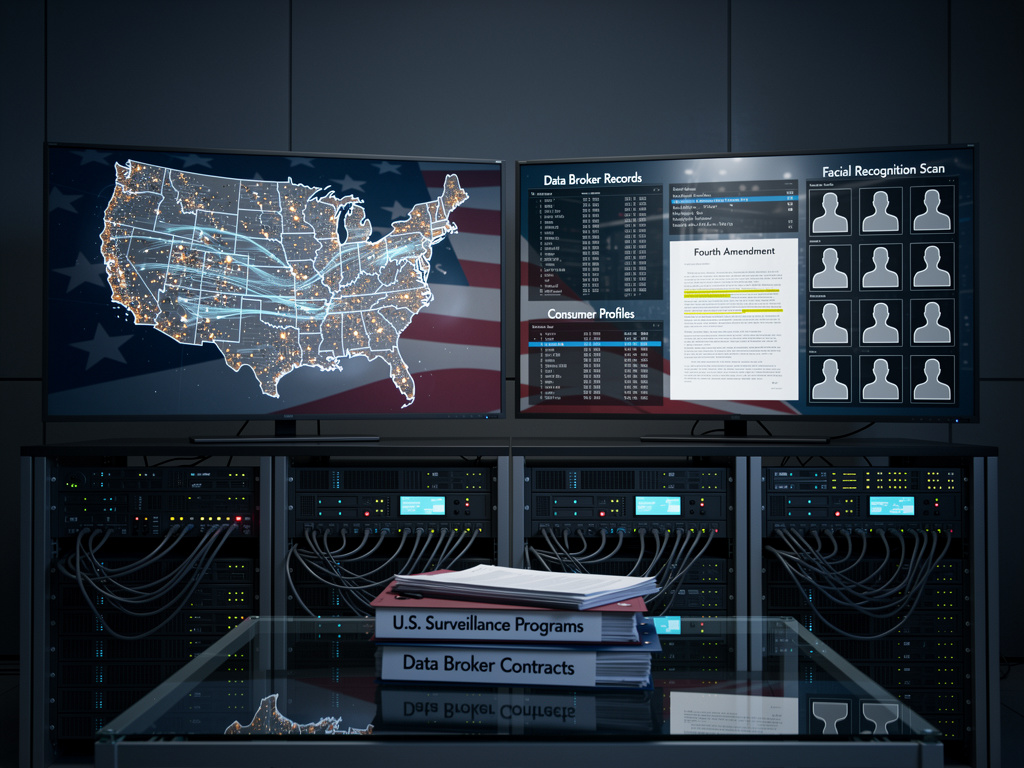
The concept of the panopticon—a prison designed so that inmates could be watched at all times without knowing when they were being observed—was first proposed by philosopher Jeremy Bentham in the late 18th century. Nearly 250 years later, civil liberties advocates and legal scholars argue that the United States government has constructed a digital version of that same architecture, one that encompasses not just suspected criminals or foreign adversaries, but the entire American population.
A recent analysis published by Matt’s Substack lays out in striking detail how a constellation of government programs, legal authorities, and private-sector partnerships have created what amounts to a comprehensive surveillance apparatus operating largely outside meaningful judicial oversight. The picture that emerges is one where the Fourth Amendment’s protections against unreasonable search and seizure have been functionally hollowed out by technology, legal reinterpretation, and the sheer volume of data now available to federal agencies.
From the Post Office to the NSA: A Brief History of American Surveillance
Government surveillance in America is not new. From the interception of mail during the Civil War to the FBI’s COINTELPRO operations targeting civil rights leaders in the 1960s and 1970s, federal authorities have long sought to monitor individuals and groups deemed threatening to national security or public order. What has changed dramatically in the 21st century is the scale, the technological sophistication, and the legal frameworks that enable mass data collection.
The September 11, 2001 terrorist attacks served as a catalyst for a massive expansion of surveillance authorities. The USA PATRIOT Act, signed into law just weeks after the attacks, broadened the government’s ability to conduct surveillance, share intelligence between agencies, and compel private companies to hand over customer data. Section 215 of the act, which authorized the bulk collection of telephone metadata, became one of the most controversial provisions in modern American law—though its full scope would not be publicly understood for more than a decade.
The Snowden Revelations and Their Aftermath
When former National Security Agency contractor Edward Snowden leaked classified documents to journalists in 2013, the public learned for the first time the true extent of the government’s surveillance capabilities. Programs like PRISM allowed the NSA to collect data directly from the servers of major technology companies including Google, Facebook, Apple, and Microsoft. Another program, codenamed UPSTREAM, tapped directly into the fiber-optic cables carrying internet traffic. The NSA was collecting billions of records daily—not just on foreign targets, but on American citizens as well.
As reported by Matt’s Substack, the post-Snowden reforms were largely cosmetic. The USA FREEDOM Act of 2015 officially ended the bulk collection of phone metadata by the government, but it allowed the NSA to query telecommunications companies for the same data on a case-by-case basis. Meanwhile, other collection programs continued to operate with minimal public scrutiny. Section 702 of the Foreign Intelligence Surveillance Act (FISA), which authorizes warrantless surveillance of foreign nationals abroad, has been repeatedly renewed by Congress—most recently in April 2024—despite persistent concerns about the “incidental” collection of Americans’ communications.
The Third-Party Doctrine: A Constitutional Loophole Wide Enough to Drive a Server Farm Through
One of the most significant legal underpinnings of modern government surveillance is the so-called third-party doctrine, established by the Supreme Court in Smith v. Maryland (1979). The doctrine holds that individuals have no reasonable expectation of privacy in information they voluntarily share with third parties—such as phone numbers dialed, bank records, or other transactional data. In 1979, this meant pen register data. In 2025, it means virtually every digital interaction a person has.
Every Google search, every credit card transaction, every GPS ping from a smartphone, every social media post, and every email sent through a commercial provider is, under this doctrine, potentially accessible to the government without a warrant. While the Supreme Court’s 2018 decision in Carpenter v. United States placed some limits on warrantless access to cell-site location data, the ruling was narrow. It did not overturn the third-party doctrine broadly, and lower courts have struggled to apply its reasoning consistently to other types of digital data.
The Data Broker Pipeline: Buying What You Cannot Subpoena
Perhaps the most alarming development in recent years has been the government’s use of commercially available data purchased from private data brokers. As the Substack analysis details, agencies including the Department of Homeland Security, the FBI, the IRS, and the Defense Intelligence Agency have purchased vast troves of location data, web browsing histories, and other personal information from companies that aggregate data from smartphone apps and advertising networks.
This practice effectively allows the government to circumvent the warrant requirement entirely. Rather than seeking a court order to track an individual’s movements, agencies can simply buy aggregated location data that reveals the same information. A 2023 report from the Office of the Director of National Intelligence acknowledged that commercially purchased data could reveal “detailed and sensitive information” about Americans, including their political affiliations, religious practices, and medical conditions. Senator Ron Wyden of Oregon has been among the most vocal critics, calling the practice an end-run around the Constitution.
Fusion Centers, Social Media Monitoring, and the Expansion of Local Surveillance
The surveillance architecture extends well beyond federal agencies. Since the early 2000s, the Department of Homeland Security has funded the creation of more than 80 fusion centers across the country—intelligence-sharing hubs that bring together federal, state, and local law enforcement agencies. These centers were originally designed to facilitate counterterrorism intelligence sharing, but their mission has expanded significantly to include drug enforcement, immigration, and even monitoring of protest movements.
Multiple reports have documented instances where fusion centers tracked activists, journalists, and political organizers who posed no credible security threat. A 2012 Senate investigation found that the centers had produced intelligence reports that were “oftentimes shoddy, sometimes endangering citizens’ civil liberties and Privacy Act protections.” Despite these findings, the fusion center network has continued to grow. Simultaneously, agencies at every level of government have invested in social media monitoring tools that allow them to track public posts, identify networks of associates, and in some cases, create fake accounts to infiltrate online communities.
Facial Recognition, AI, and the Coming Wave of Automated Surveillance
The integration of artificial intelligence and facial recognition technology into law enforcement operations represents the next frontier of the surveillance state. Companies like Clearview AI have scraped billions of photographs from social media platforms and the open internet, building facial recognition databases that are now used by hundreds of law enforcement agencies across the country. The Government Accountability Office reported in 2021 that 20 federal agencies used facial recognition technology, with many lacking adequate policies governing its use.
Recent reporting has highlighted growing concerns about the accuracy and bias embedded in these systems. Studies have consistently shown that facial recognition algorithms produce higher error rates for people of color, women, and older adults. Despite these documented shortcomings, the technology continues to be deployed in airports, at border crossings, and increasingly in routine policing. The lack of comprehensive federal legislation governing facial recognition means that its use is largely regulated—if at all—by a patchwork of state and local laws.
The Chilling Effect on Free Expression and Democratic Participation
Legal scholars and civil liberties organizations have long warned that pervasive surveillance produces a chilling effect on free speech, free association, and political participation. When individuals know—or even suspect—that their communications, movements, and associations are being monitored, they are less likely to engage in dissent, attend protests, or communicate freely about sensitive topics. A 2016 study published in the Berkeley Technology Law Journal found measurable declines in certain types of internet searches following the Snowden revelations, suggesting that awareness of surveillance directly altered online behavior.
The American Civil Liberties Union has argued that the cumulative effect of these surveillance programs is fundamentally incompatible with a free society. “The government has built an infrastructure of mass surveillance that would have been unimaginable to the framers of the Constitution,” the organization has stated in legal filings challenging various surveillance authorities. The Electronic Frontier Foundation has echoed these concerns, warning that the combination of data broker purchases, Section 702 collection, and AI-powered analysis tools creates the capacity for retroactive surveillance—the ability to reconstruct a person’s entire digital life after the fact, without ever having obtained a warrant.
What Comes Next: Reform Prospects in a Divided Political Environment
Despite bipartisan concern about government surveillance—a rare issue that unites libertarian-leaning Republicans with progressive Democrats—meaningful reform has proven elusive. The reauthorization of Section 702 in 2024 passed with only modest changes, and efforts to require warrants for government purchases of commercially available data have stalled in Congress. The Fourth Amendment Is Not For Sale Act, introduced by Senator Wyden, would prohibit law enforcement and intelligence agencies from purchasing data that would otherwise require a warrant to obtain, but the bill has not advanced to a vote.
Meanwhile, the technological capabilities available to the government continue to expand. Advances in artificial intelligence, the proliferation of internet-connected devices, and the growing volume of commercially available personal data mean that the surveillance infrastructure will only become more comprehensive in the years ahead. Whether the legal and political systems can adapt quickly enough to impose meaningful constraints remains an open and urgent question—one that will define the boundaries of privacy and liberty in the digital age.
As the Substack analysis concludes, the panopticon is no longer a theoretical construct or a dystopian warning. For the 330 million people living in the United States, it is an operational reality—one that most citizens encounter daily without ever being aware of its presence.


 WebProNews is an iEntry Publication